


In This Blog
Everything you need to know to prioritize and allocate your budget towards the most important clinic software trends:
- How to avoid investing in software solutions that don’t align with your front-line reality
- A readiness matrix that classifies each trend as essential, mainstream, or early-stage
- The clinic software solutions that you simply can’t afford to ignore and why
- The mainstream software solutions that will make you more efficient, and when to adopt them
- The early-stage healthcare technologies that you should keep an eye out for before spending a single penny
- The 70/20/10 investment strategy that safeguards your clinic from bad software decisions
Why Clinics Waste Money On Software And How To Stop
Let’s look at a common situation for clinical practice administrators. You attend a vendor demo where the product looks great – sleek, feature-rich, and backed by case studies. But three months later, your front desk is calling support daily, most features go unused, and accounting is back on spreadsheets.
This is not an issue concerning technology itself. This is a timing issue. According to research carried out by the Annals of Internal Medicine, the current trend shows that doctors devote up to two hours of their time to administrative tasks per hour devoted to direct patient care. In light of using inappropriate clinic management software, instead of improvement, statistics would grow worse. The issue does not concern the awareness of healthcare providers regarding existing tools or clinic software trends, but their inability to measure readiness prior to application in clinics.
- The Over-Featured Tech Trap: A show floor is no demonstration of what happens at your intake desk on a Monday morning. Vendors often showcase features you’ll never use, yet the technology still comes with a hefty price tag.
- The Unproven Platform Trap: Sales cycles are aggressive, introducing technologies into clinic workflows before all the bugs are fixed. A single crash during billing or appointment booking can quickly outweigh the annual subscription cost.
- The Capital Allocation Trap: Most healthcare practices make tech decisions based on a problem or a strong pitch, but rarely use a structured model to ensure the solution is ready for production environments.
The fix is simpler than any vendor will ever admit. It’s a framework called a readiness grid – and it changes how every technology decision gets made.
Learn more: Clinic Workflow Automation: Where Manual Processes Waste Time and Hurt Patient Care showing how small workflow inefficiencies accumulate into delays, staff overload, and preventable revenue loss.
The Clinical Readiness Assessment Grid: How To Use It
Visualize the readiness grid as a sieve through which you pass each and every software trend for your clinics before spending a single rupee on anything. Each software trend listed in this guide is given a tier classification of its own, and the rule of thumb for distinguishing good from bad is to always look at the tier first before assessing the actual clinic software trend.

- Essential – Deploy immediately. ROI is proven, risk is low, and delay is actually losing you money. This is the arsenal you use to reduce friction directly, and it needs to be included in your clinic stack.
- Mainstream – Adopt within 6–12 months. Early adopters have taken the lead; to wait for one more year is to catch up, not compete. It is proven, mature technology with real efficiency benefits but requires good integration.
- Early-Stage – Monitor only. A lot of promise, but not quite ready to use on real patients just yet. Some very exciting new developments, but they have yet to prove themselves in the real world.
Simple. Now let’s walk through each tier – starting with what should already be running in your clinic right now.
Essential Clinic Software Trends: Deploy Right Now
If you’re looking for where to start, this is it. These trends have moved well past speculation into operational necessity. Clinics that haven’t deployed them aren’t just behind on innovation – they’re carrying real daily risk and often don’t even realize it.
- Web-Based Operations
That’s your starting point right there. All of these changes have moved beyond mere speculation to absolute necessity. Clinics that haven’t implemented them aren’t just falling behind technologically – they’re putting themselves at genuine daily risk, often without even realizing it.
By switching to a reliable cloud-based system, one can totally eliminate this possibility. According to the statistics collected by the federal government concerning investments of hospitals into digital health, the use of cloud-based platforms continues growing from year to year, and the moved clinics experience better accessibility and fewer disruptions.
Why It’s Essential: The medical sector leaves no room for any downtime. Cloud computing is not something to plan for later; it is a cost you are currently paying for right now.
- Consolidated Databases
Operating independent systems for all three aspects, such as EHR, billing, and scheduling, is not going to cut costs; rather, it will increase them by producing more data discrepancies. Every time data is manually transferred from one system to another, the risk increases that data will either be input incorrectly, repeatedly, or not at all.
Research on workflow in clinical settings consistently reveals that data fragmentation is among the top three reasons why clinics lose money on their billing revenues. More employees aren’t the solution – less software is.
Why It’s Essential: Siloed data costs clinics billing revenue, wastes employee time, week after week, and time they should be spending directly on patients.
- Automated Privacy Protection
Compliance has never failed to be important. However, what distinguishes this particular instance of compliance from those that had come before is how the enforcement was done. In the situation where there is the carrying out of an activity that involves the HHS in December 2024, this will mean that there will be the application of cybersecurity to all covered entities working within the health industry; it would leave no room at all for any gray area on the issue of cybersecurity.
Why It’s Essential: One failed audit is a fine large enough to make the annual budget for all your software seem trivial compared to the reputation hit you just took.
 PRO TIP
Now that we’ve covered those, we’re ready to start building. Let’s talk about how to build upon that solid base.
Mainstream Clinic Software Trends: Adopt For Efficiency Gains
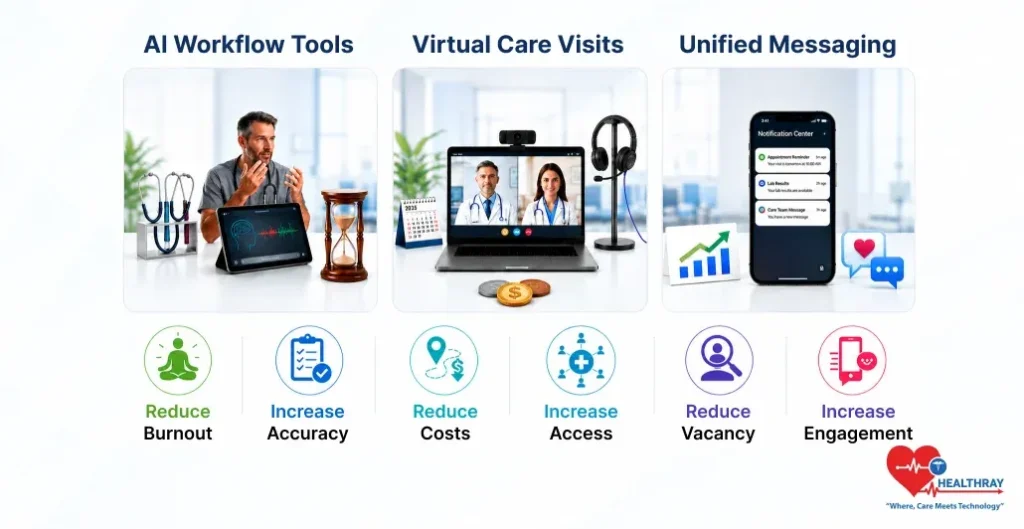
The following trends are not anymore in their trial phase. There are early adopters who have proved that these can work effectively in the clinical settings. The trends are not yet considered mandatory for all organizations; therefore, the next six to twelve months will be the perfect time to take the lead.
- Smart Automation Assistants
Doctors devote anywhere from 26 to 34 percent of their working day to documentation. These hours are subtracted straight from the time spent treating patients and contribute more to physician burnout than any other factor. The use of AI-driven documentation systems creates structured notes based on consultation summaries, which are then reviewed and approved by clinicians in minutes.
It does not eliminate clinical discretion; it liberates it. Clinics that adopt such systems regularly report treating more patients each week without hiring a single additional individual.
Why It’s Mainstream: Stable technology, proven ROI, and staff retention alone are reasons to give priority to this area.
- Native Virtual Appointments
Patients are not merely enduring telemedicine; they are embracing it. If your clinic cannot provide integrated virtual consultations, you are missing appointments to clinics that can. And the word is native. Adding a third-party virtual consultation service means there are more chances for patients to drop off before even scheduling an appointment. Having a seamless calendar-to-consultation process will eliminate all the barriers to booking a consultation.
What happens when there is a cancellation? You switch the appointment from face-to-face to remote. Same provider, same time, different modality, and no revenue loss.
Why It’s Mainstream: Patient expectations have changed permanently, and the friction your competitors have gotten rid of is now your burden to overcome.
- Hands-Free Messaging Channels
Missed appointments can range from 5% to 30% based on the medical specialty, on an average. Each missed appointment leads to a loss due to the cost associated with staffing without any income. The solution here is the use of automated confirmation systems using WhatsApp and SMS reminders that do their job without being disruptive.
First is a confirmation message 24 hours ahead of the scheduled appointment time. Secondly is a reminder two hours before the appointment, and third is an instant reschedule link, in case of a need to cancel. According to some studies, the vacancy rate falls by 20-40% within the first 90 days of implementing this system.
Why It’s Mainstream: Quick ROI, easy implementation, and an issue that every clinic is currently facing. A well-designed set of clinic management system features helps ensure these workflows are fully integrated rather than managed across disconnected tools.
 NOTE
NOTE
These three technologies will be your focus for the next six months. However, there is another tier coming after these three, and this one demands an entirely new intuition.
Early-Stage Healthcare Software Trends: Watch Before You Invest
It is at this stage that the excitement among vendors peaks, and financial protection becomes crucial. Clinic software trends show strong long-term potential, but they also reveal a major gap between expectations and actual outcomes. You should watch these trends closely, but keep your cheque book closed.
- Background Listening Scribes
This idea is really fascinating; an AI program listens to the consultation and creates the clinical note automatically. The early models work well in laboratory tests, but the rate of hallucinations when used in real-life settings with different accents, noise, multiple subjects, and technical language is still a documented and unresolved issue.
Hallucination refers to the creation of notes that seem technically correct but actually contain errors regarding diagnoses, dosages, and patient instructions. Since there have been no independent tests verifying the clinical accuracy of such notes, all notes should undergo manual examination by the physicians themselves.
Watch For: Accuracy standards derived through peer review, rather than case studies by vendors, prior to any pilot near a live patient.
- Algorithmic Traffic Forecasting
Predictive appointment systems that schedule staff based on historical traffic patterns sound very appealing during the demonstration phase. They have good logic behind them. The issue lies in the need for data. Years worth of structured appointment data will be needed for predictive forecasting to be useful.
However, federal research exploring whether AI prediction systems have truly yielded positive outcomes in hospitals has found an ambivalent scenario – while there has been uneven uptake in healthcare settings, small independent clinics tend to lag behind bigger organizations despite equal enthusiasm, owing to their inability to generate enough data.
Watch For: Always request the minimum requirements from the vendor at the beginning. It’s not yet ready for you if they can’t provide that information.
- External Data Pipelines
Seamless transfer of the medical data among labs, pharmacists, and even specialists is the most valuable and challenging aspect of healthcare technology. Regulatory systems around data exchange between different platforms are only being developed right now in many jurisdictions. The liability involved in a possible mistake in a live environment is very high, and its consequences will likely be quite severe.
Watch For: Fully drafted local guidelines and independent legal approval of any vendor’s architecture before linking it. Clinics may also consult an online business attorney to review data exchange agreements and liability risks before enabling external integrations.
So now you know what to deploy right away, what you will be planning for tomorrow, and what to monitor without any spending. The final part is knowing how to finance everything without leaving your clinic vulnerable to the unknown.
How To Allocate Your Clinic Software Budget Using A Readiness Model
The readiness grid will only be successful if it has a budget structure to avoid excessive funding of the incorrect readiness level. This is how it goes: budgeting for each clinic software trends readiness level in order to provide full funding for critical tools, staged funding of mainstream tools, and limiting funding of early experiments.
| BUDGET TIER | ALLOCATION | WHERE IT GOES |
| The 70% Foundation | Core infrastructure | Cloud computing, integrated EHR/Billing system, security/compliance solutions |
| The 20% Accelerator | Proven growth tools | Appointment scheduling automation, telemedicine connectivity, SMS/WhatsApp communication |
| The 10% Sandbox | Experimental watch | Early stage pilot programs – Never touches operating capital |
The 70% makes sure your practice operates smoothly regardless of whether the servers crash, the billing fails, or there is compliance risk. The 20% makes sure you grow in a controlled and measured manner utilizing systems already proven for their worth. The 10% ensures that you are always aware of the direction of the market without risking your operational stability.
By following this framework, you are always well-insulated from unproven technologies while investing adequately in the ones that have been established. The latter is actually the more frequent and costly error clinics commit. Apply this framework to your practice’s readiness matrix, and see where you stand.
To Sum Up: Why Right Clinic Software Timing Changes Everything
Poor timing, not poor technology, is what causes most clinics to struggle financially with their software investments. When a clinic adopts nascent clinic software trends ahead of their maturity curve, or clings to manual systems long past when cloud-based computing has become the standard, the problem doesn’t appear during a vendor demonstration. It’s one that manifests through billing discrepancies, regulatory violations, employee turnover, and lost revenue from no-shows month after month.
The readiness grid in this guide removes speculation from sequencing decisions. Emerging essential clinic software solutions such as cloud computing, unified database systems, and automated compliance now require immediate priority due to rising costs of inaction. Clinics should adopt established healthcare technology solutions such as automation assistants, native telehealth systems, and messaging tools as immediate needs. They can still implement them within a realistic 6 to 12 month framework. Clinics should only monitor emerging technologies like ambient intelligence and predictive analytics. They should avoid spending on them for at least another 12 months while benchmarks mature.
Act now based on your clinic’s current needs because technology that arrives too early wastes capital, and technology that arrives too late causes lost patients.