

In This Blog
Here’s everything you need to know about how clinic software manages OPD queues – in minutes:
- Precise timing of where bottlenecks occur throughout a 12-hour OPD day (8 AM–8 PM)
- The exact digital workflow tools that resolve each operational bottleneck
- How a connected healthcare platform links intake, treatment, pharmacy, billing, and discharge workflows
- Quantifiable, data-backed operational outcomes – not vague marketing promises
- The most common questions clinics ask before implementing a digital OPD management system
Why Busy Medical Facilities Need Clinic Software Faster Than Ever
Imagine this: It’s 8:15 AM. A clerk types information from a patient’s insurance while her photocopier gets jammed. Four minutes gone. Noon arrives and the lobby becomes a hotbed of activity. Fifty patients fall behind schedule, nurses face complaints, and doctors run over an hour late before lunch.
It’s all about a chain reaction of delays that happens in thousands of health centers on a daily basis.
But the issue is not about incompetent staff. It is about the organization of the processes, where the OPD department has one kind of system, daycare another one, a pharmacy with its paper records, billing with handwritten invoices, and so on. Patients get stuck in all the cracks of this structure.
Any organization that digitally optimizes its patient intake process through modern clinic management software sees noticeable reductions in congestion throughout the facility, from patient registration to pharmacy and billing, without hiring a single new employee. The disconnects among healthcare departments are not financial problems; they are operational challenges. Clinic management software helps solve those challenges.
Contemporary clinic software makes a whole new set of possibilities possible. It takes the chaos out of health care and turns the patient experience into an exact science.
12-Hour Journey: Mapping Every Major Traffic Jam And Its Digital Fix
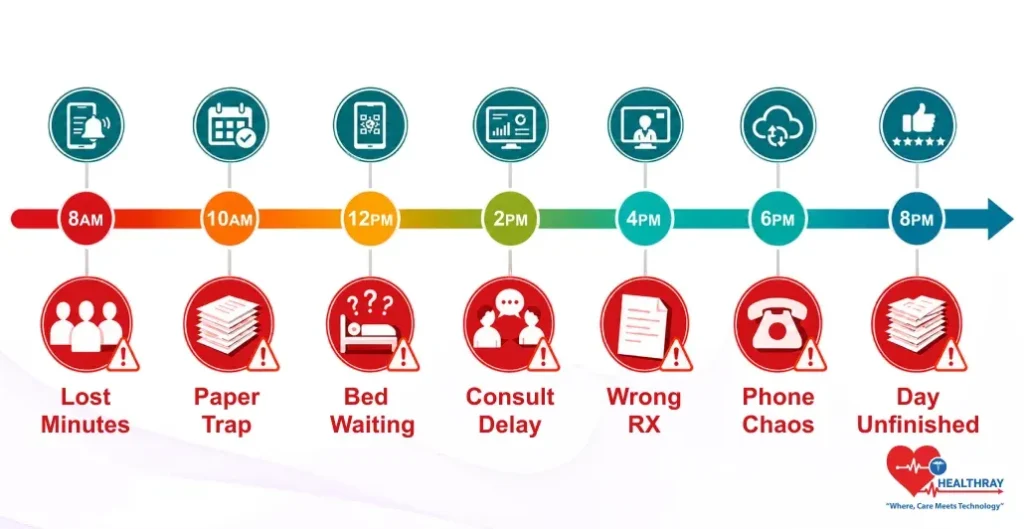
08:00 AM – Slow Front-Desk Registration Traps Patients In The Lobby
- Queue Location: The queue starts forming in front of the reception desk in the lobby, where walk-in patients register by hand and have their documents and insurance verified during the busiest part of the day.
A lot of walk-in patients show up as soon as the clinic opens. Staff record patients’ names, addresses, and contact information by hand. They photocopy and scan insurance cards, which often causes equipment problems. The procedure takes around 4–6 minutes per person.
- Digital Solution: OCR-Based Extraction of Documents and Online Pre-Check-In. Patient registration forms are filled out online using a secure website prior to their visit. Walk-ins can have their insurance cards scanned by the scanner and relevant information extracted.
- Operational Outcome: The average time spent checking in is less than 45 seconds for each patient, meaning that the pre-9:00 AM line is now non-existent.
10:00 AM – Crowded Hallways Stall Clinicians And Frustrate Families
- Queue Location: The queue formation occurs in the hallway outside the consultation room, where there is variation in consultation time and visibility of wait times, which leads to crowding and frequent queries by patients to the nurses.
There is a wide variation in consultation times; some patients might get done in 8 minutes, whereas others might take 20 minutes or even more. Since the wait times are not visible to the patients, many patients come back to ask for their call timings, which diverts the nurses from clinical duties.
- Digital Solution: The Queue Management System (QMS) uses algorithmic processing and real-time token tracking technology. It gives patients instant feedback on their queue status and expected consultation time through live token updates on their mobile devices.
- Operational Outcome: There will be a 60% reduction in corridor congestion as nurses have more time to look after patients rather than addressing queries regarding waiting times.
12:00 PM – Broken Ward Transitions Keep Patients Waiting In Hallways
- Queue Location: The queue forms at the day care unit admissions desk and nursing triage counter where patients wait to be admitted to bed. The delay in confirming bed readiness creates a backlog in corridors and waiting rooms.
OPD patients cleared for daycare services usually wait in wheelchairs along the corridor because the daycare staff lacks real-time visibility into bed availability. Clinic software solves this by displaying live bed status updates across all authorized nursing stations and dashboards. There is a need to go around the ward manually to check if the beds have been cleaned and made available for the next batch of admissions.
- Digital Solution: Automated Live Visual Bed Management Dashboard with Housekeeping Alerts. The moment a discharge or transfer takes place, an automated cleaning alert goes off for the housekeeping department. Following the completion of the cleaning process, the bed automatically becomes Available on the dashboard.
- Operational Outcome: Turnover time for beds reduces from 45 minutes to 12 minutes, thereby enhancing admission rates and capability for short-term treatments.
 NOTE
NOTE
02:00 PM – Documentation Loops Eat Into Doctor Face Time
- Queue Location:The queue takes place within the consultation cabin itself, which is an invisible bottleneck in documentation that cannot be detected from any physical layout of the clinic. As doctors are taking the time to complete their documentation process for each case, the delay accumulates and ultimately causes delays in the whole schedule.
Doctors tend to take longer time in documenting each session rather than seeing patients themselves. Documentation usually takes 6-10 minutes extra for each patient. In turn, this results in a chain reaction affecting the overall schedule by mid-afternoon.
- Digital Solution: Specific to Specialty EHR Macro Templates that Feature an Ambient AI Scribe. While consulting patients, doctors talk normally as AI-driven scribes capture the information in their medical records instantly. The use of pre-populated templates for various disorders also limits unnecessary data entry into the system.
- Operational Outcome: Up to 70% of time used for charting can be regained, thereby alleviating the backlog in consultations and ensuring that doctors spend more time caring for patients.
04:00 PM – Handwriting And Inventory Checks Freeze The Pharmacy
- Queue Location: Patients form lines at retail pharmacy counters, where delays occur due to the prescription check, manual inventory checking, and billing process during the high OPD period.
OPD patients arrive in the morning to collect prescribed medicines. This increases queues at pharmacy counters. The pharmacist has to decode the handwritten prescriptions, check abbreviations, ensure dosage, and perform manual stock checking on their own.
As highlighted in the WHO Medication Without Harm campaign, medication errors result in a loss of at least $42 billion each year for health care systems, with one of the top three sources of medication error being related to prescription, transcribing, and dispensing errors.
- Digital Solution: Direct E-Prescribing (eRx) with Built-In Inventory Interlocks in Real Time. The physician sends the prescription electronically immediately after completing the consultation. The pharmacist receives instant information about medicine, dosage, and real-time inventory on a single display. The system eliminates the need for interpretation or shelf checking.
- Operational Outcome: The system reduces drug dispensing time to under 2 minutes per patient. It eliminates issues in prescription interpretation and drug identification.
 PRO TIP
06:00 PM – Manual Billing Causes Major Cashier Overload At Discharge
- Queue Location: Queues form at billing points and discharge counters where invoices are created, payments are processed, and discharges are cleared. Staff calculate charges and verify bills during busy discharge periods. This leads to long queues at the end of the day.
Billers create invoices by manually collecting charge forms from consultations, lab investigations, and daycare materials used. They then perform manual calculations and verify the invoices. As each discharge process can last 15-20 minutes, queues easily form at the end of the day.
- Digital Solution: Unified Ledger Engine with Automated Mobile Payment Links. The system records each transaction on a unified patient ledger in real time. It automatically completes the bill once the patient checks out of the facility. It then sends a mobile payment link to the patient’s smartphone for easy payment.
- Operational Outcome: The system reduces settlement time from 20 minutes to under 3 minutes per patient. It also significantly shortens discharge queues.
08:00 PM – Leaving Tomorrow’s Schedule To Chance Inherits Today’s Backlogs
- Queue Location: The queue forms during the shift change period when there are outstanding appointments, changes in the rosters, and unfinished tasks.
Incomplete appointments, unfinished rosters, and scheduling gaps make operations susceptible to problems the next day, even before the clinic opens. This happens because remaining tasks are not sorted out proactively. As a result, bottlenecks form and patient queues appear immediately at the start of the first shift.
- Digital Solution: Cloud Scheduling Optimization with Automated Task Alerts. The system automatically analyzes the following day’s schedule, discovers gaps, and verifies appointments through SMS and WhatsApp messages. It also reminds employees of pending tasks before their last shift ends.
- Operational Outcome: The entire operation is fully ready for the following day by 8 PM. This ensures morning operations start smoothly before any bottlenecks arise.
Connecting Operations From Intake To Discharge Using Clinic Software
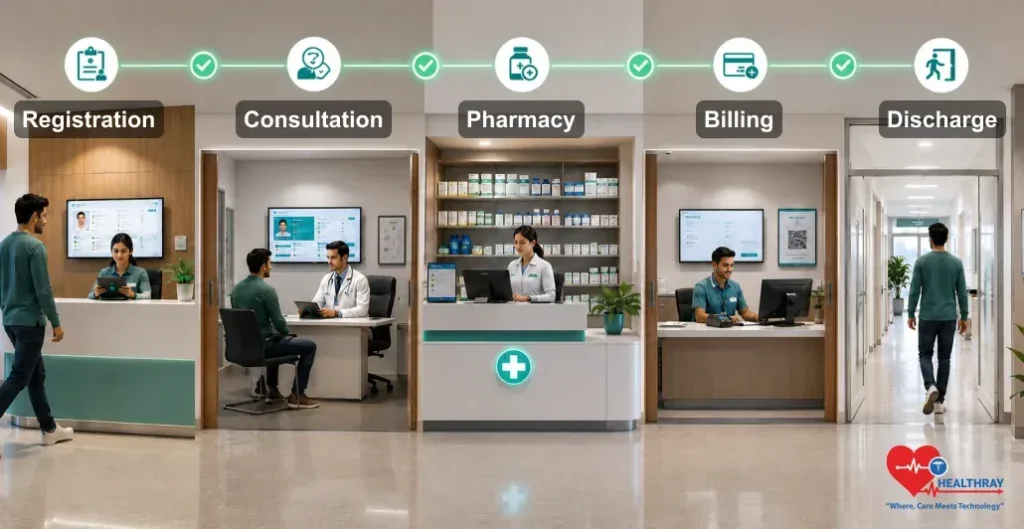
The major benefit that the current generation of clinic management software provides is the lack of siloed operations.
- Real-Time Dashboard Visibility: It provides a real-time overview of operational processes across all departments at once. This enables problem-solving before situations escalate into patient queues.
- Frictionless Interdepartmental Transfers: Enables immediate exchange of billing documents, prescriptions, lab reports, and clinical data within the department. This happens without paperwork, phone calls, or unnecessary delays.
- Centralized Patient Tracking: Brings together all aspects of outpatient information, scheduling process, accounting, and daycare bed management under one system. This unified system streamlines operations across departments. It removes any chances of patients falling through cracks in administrative processing.
- Administrative Interface Automation: Covers self-service kiosks, document scanning machines, online payments, and automation systems. These enable clinics to serve more patients without increasing administrative staff.
The World Health Organization notes that as many as 4 out of every 10 patients may be injured during visits to primary and outpatient facilities, and that as much as 80 % of this injury could be prevented.WHO Patient Safety Fact Sheet shows a clear connection between avoidable patient harm and inefficiency within the care process itself, which is exactly what an integrated clinic management solution is designed to address.
Learn more: Clinic Management System Features Every Modern Clinic Needs to discover the essential tools modern clinics use to streamline OPD workflows, reduce patient wait times, automate billing, and improve overall operational efficiency.
Final Verdict: When Every Hour Has A Fix, The Whole Day Changes
Remember that 8:15 morning when the copier jammed, four minutes wasted, and first domino set into motion. Imagine that same morning with patients checked in before they arrive. A waiting list clearly shows how long you must wait for service. Beds move from patient to patient in 12 minutes instead of 45, and doctors focus on consulting rather than typing. It’s the same clinic but with connectivity.
Clinic software does not solve just your busiest hour. It solves your busiest twelve-hour day – without adding a single additional employee. Every function covered in this article works as part of a connected operational chain. Registration speed determines hallway congestion. Hallway congestion affects consultation availability. Efficient consultations improve pharmacy throughput. Faster pharmacy throughput accelerates billing, and streamlined billing enables a smoother end-of-day closure process.
This process separates efficient clinics from those constantly trying to catch up. These constraints, identified within twelve hours, are tangible, quantifiable, and solvable. Each constraint discussed has an exact name, reason, and solution. The only thing remaining is whether you are utilizing the solution or paying the price for not doing so.