

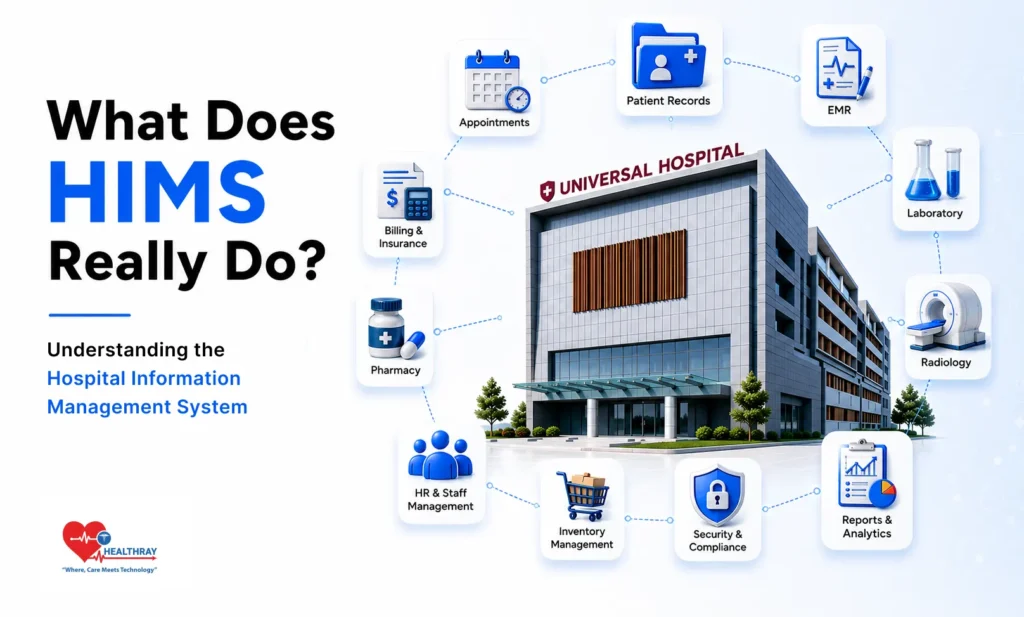
HIMS full form is Hospital Information Management System. It is an integrated system of software that links different departments of a hospital such as registration, OPD/ IPD, EMR, lab, pharmacy, and billing. Patient data will move effortlessly through each department of the hospital using HIMS.
Have you ever wondered how hospitals can easily have access to your medical information without asking you the same questions repeatedly? This is precisely what the HIMS system is meant for. Be you a student, health care professional, or a hospital administrator, this guide will give you all you need to know about the HIMS system.
In this guide, you’ll learn:
What HIMS stands for and its meaning in healthcare
- How HIMS works: From patient registration to discharge
- Key differences between HIMS, HMS, HIS, HMIS, EMR, and EHR
- Importance of HIMS in Indian healthcare: ABDM, ABHA, NABH & PMJAY
- Where HIMS is used, in hospitals, healthcare careers, and government systems
- Meaning of key healthcare IT acronyms used with HIMS
- How to choose the right HIMS software for a hospital
At the end of the article, not only will you learn the full form of HIMS, but you will also understand how it drives the complete hospital process from the time the patient enters the hospital till he leaves.
But have you ever wondered:
- Why do patients no longer need to repeat their medical history at every hospital counter?
- How do doctors instantly access your past reports, scans, and prescriptions?
- What connects the pharmacy, laboratory, billing desk, and doctors into one system?
- And why are terms like HIMS, HMS, HIS, and HMIS often confused with each other?
This is made possible through the Hospital Management System, the digital backbone of modern healthcare that keeps everything connected, organized, and efficient.
H-I-M-S Decoded: What Each Letter Really Means
In a medical or health administration setting, HIMS is as follows:
| Letter | What it signifies | What does it mean |
| H | Hospital | Care settings from clinic to multi-specialty hospital |
| I | Information | Patient details with clinical context, not just archive files |
| M | Management | Organized data in such a manner that the right individual takes action on it. |
| S | System | All divisions are integrated, not working independently. |
Notice something? The acronym uses ‘Information Management’ rather than ‘Records System.’ This is an intentional distinction: storing files is passive, but managing data is active. A stack of stored files tells you nothing on its own.
Managed information flow ensures nurses know which medication to administer, doctors instantly see new lab results to update treatment plans, and billing staff know exactly which services have been paid for. Storage is passive. Management is active, and this is the difference that hospitals really pay for.
Explained Inside a HIMS: Every Module That Keeps a Hospital Running
Ever wondered what goes on backstage when you go through the reception desk at the hospital? Take a look below:
| HIMS Module | Purpose |
| Registration & UHID | Creates a unique health identifier for every patient and manages appointment queues |
| OPD (Outpatient) | Handles consultations, prescriptions, and follow-up visits for walk-in patients |
| IPD/Ward Management | Tracks bed allocation, nursing charts, and inpatient treatment records |
| EMR/EHR | Stores the digital patient chart and, where connected externally, shares it across providers |
| Laboratory | Routes test orders, results, and reports back into the patient’s record automatically |
| Radiology | Manages imaging orders and reports using standards like DICOM |
| Pharmacy | Links prescriptions to stock, batch numbers, and dispensing |
| Billing & Insurance | Connects treatment records to invoices and insurance/TPA claims. |
| Inventory | Tracks medicine and consumable stock across departments |
| MIS Dashboards | Gives management visibility into bed occupancy, revenue, and patient load. |
The key here to note is that no module stands on its own. A pharmacy module without prescription data is just a stock register; a billing module without clinical treatment data is just a calculator. The true value of HIMS comes from integrating these systems.
It is only the integration between these modules where the true value of a HIMS lies.
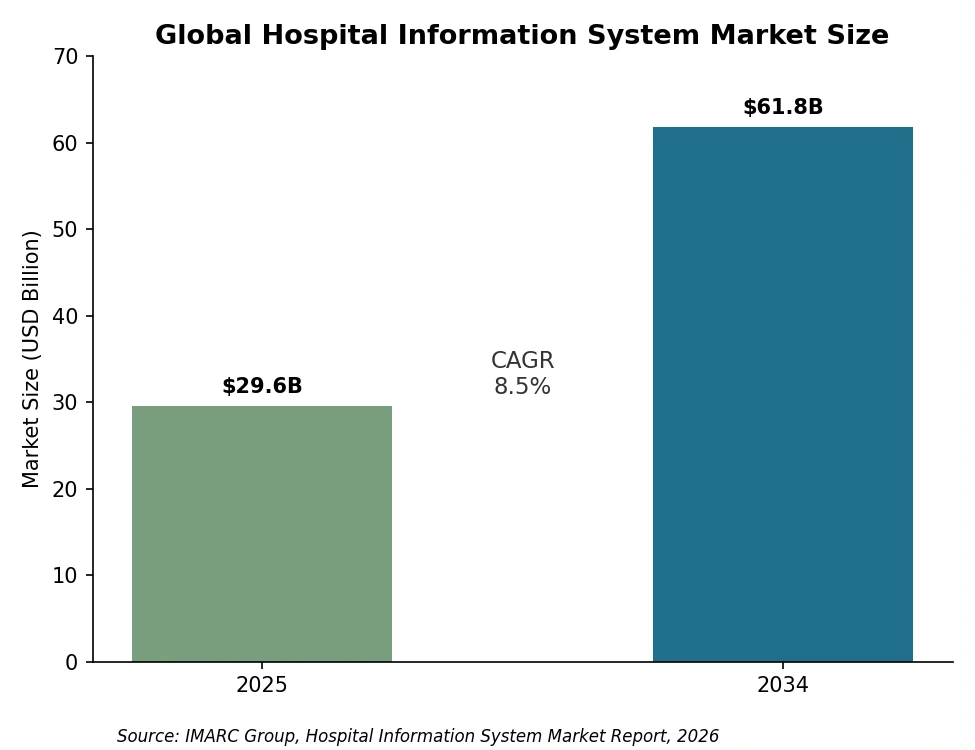
Did you know? The global hospital information system market was valued at roughly USD 29.6 billion in 2025 and is projected to reach USD 61.8 billion by 2034, a compound annual growth rate of about 8.5%, largely driven by rising demand for electronic health records and cloud-based deployment (IMARC Group, 2026).
HIMS vs HMS vs HIS vs HMIS vs EMR: Which One Are You Actually Talking About?
Confusing these acronyms can cause real issues, especially when evaluating software vendors or responding to government tenders that explicitly specify ‘HMIS’.
| Terminology | What’s the full form | What it Actually Means |
| HIMS | Hospital Information Management System | Integrated system that covers financial, clinical, & administrative operations. |
| HIS | Hospital Information System | The old-fashioned medical term for the similar system. |
| HMS | Hospital Management System | In commercial terminology, vendors often use HMS instead of HIMS. |
| HMIS | Health Management Information System | In India, this refers to the official health portal of the government/NHM rather than the hospital’s own system. |
| HIM | Health Information Management | The science of managing health data as a profession rather than a product. |
| EMR/EHR | Electronic Medical/Health Records | The storage media that resides within a HIMS; EMR operates at one facility only, whereas EHR is transferable among facilities. |
| LIS/RIS | Laboratory/Radiology Information System | Departmental subsystems feeding data to HIMS. |
It is essential to understand the context. In Indian government tenders and medical college documents, hospital information management system (HMIS) refers to a public health reporting portal not the internal operational software marketed by vendors as HIMS or HMS or hospital management system software and they mention “HMIS”.
It is usually meant to be a reporting mechanism of public health data within the national program and not the hospital management software that the vendor tries to sell you.
That’s the one detail that distinguishes a true expert in the field from the one who just knows what the acronym means.
 PRO TIP
Why This Acronym Is Booming Across Indian Healthcare By the Numbers
How does a nation of over 1.4 billion start on its digital mission to record hospital details? Well, the answer lies right there in front of us, and the extent of this is truly amazing.
The Ayushman Bharat Digital Mission connects the patients via an ABHA health ID and prepares hospitals for ABDM-readiness.
Cumulative ABHA account creation has climbed from 14.7 crore in 2021 to over 90 crore in 2026, according to the National Health Authority via the Press Information Bureau meaning roughly two-thirds of India’s population now holds a digital health identity that a HIMS is expected to recognize.
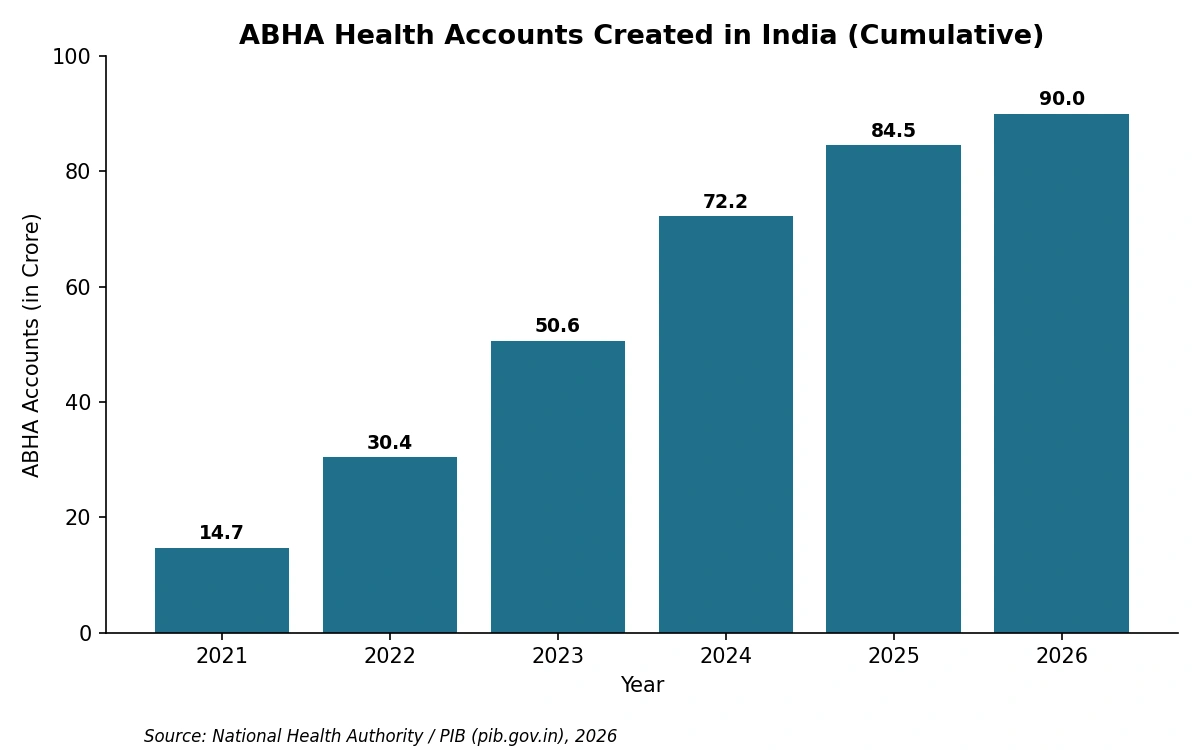
This growth graph is not just an indicator for government policy, but it indicates what all hospitals’ HIMS will be needed to facilitate soon. Apart from ABDM, hospitals which want NABH accreditation have to maintain auditable documentation that can be made possible by using HIMS only.
The government insurance schemes such as PMJAY need HIMS in order to deal with eligibility, treatment, and claim settlement. And “HIMS” or “HMIS” is common terminology used in government tenders and college medical tender documents where most of the readers come across it.
Where You’ll Actually Run Into This Acronym
Once one learns what to look for, this acronym is found almost everywhere in Indian healthcare management:
- Job advertisements for positions in hospital administration, health informatics, and healthcare IT.
- Government tenders for public hospitals and medical colleges procuring software.
- Hospital administration and health-informatics course curricula, such as MHA and healthcare-management courses.
- Vendor proposals and RFPs, where precise terminology affects which product category is being compared.
 NOTE
NOTE
What Actually Matters When Choosing a HIMS
In case you’re the person assessing the vendors instead of merely studying the concept, you might be interested in knowing what one factor should weigh heavily in your judgment process. Hint: it’s not the cost.
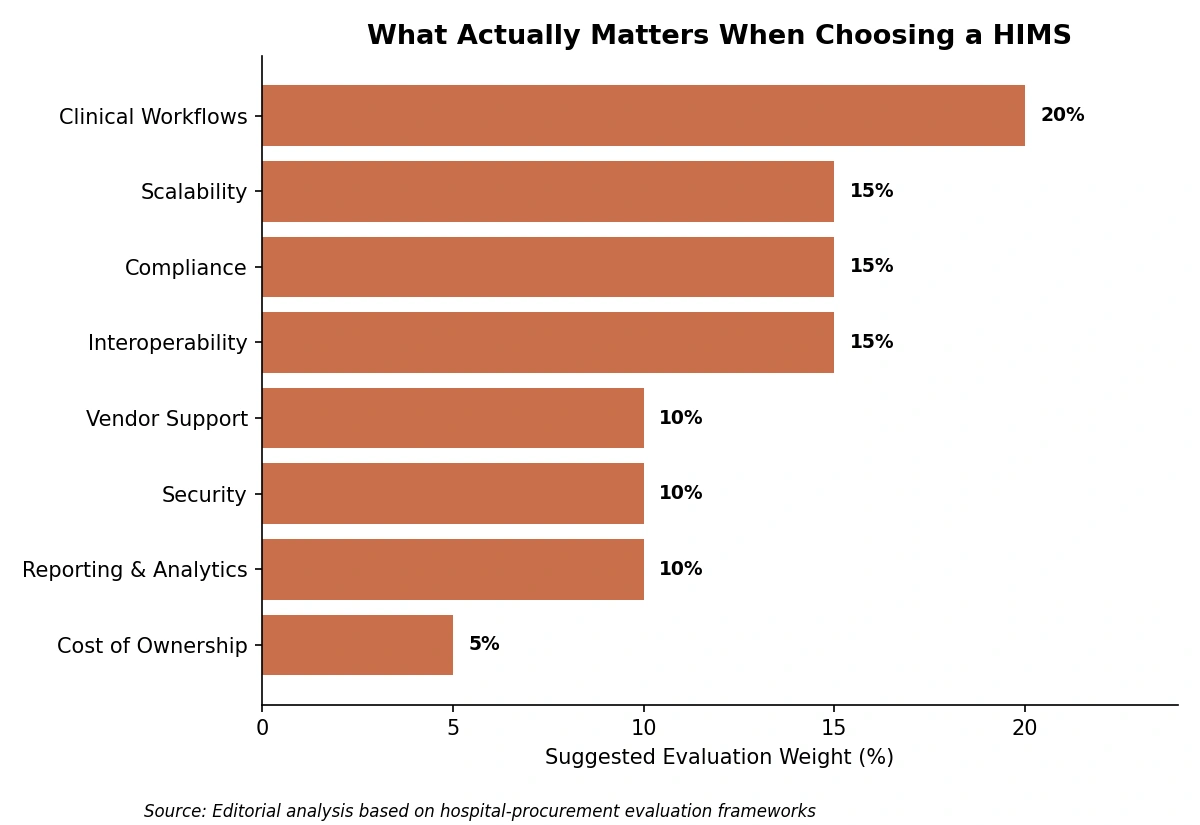
Hospital purchases always favor clinical workflow usability over the cost of ownership, and for one good reason – an unwelcome system will simply be circumvented, not used. This is why hospitals often find themselves back in paper mode a year after their “successful” implementation of a software solution.
The Healthcare Acronym Cheat Sheet
| Term | Full Meaning |
| ABDM | Ayushman Bharat Digital Mission, India’s national digital health framework. |
| ABHA | The patient’s unique digital health ID under ABDM. |
| UHID | Unique Hospital ID assigned at registration |
| CPOE | Computerized Physician Order Entry, for electronic treatment orders. |
| EMR | Electronic Medical Record, the digital chart within one hospital. |
| EHR | Electronic Health Record, shareable across providers. |
| LIS | Laboratory Information System. |
| RIS | Radiology Information System |
| PACS | Picture Archiving and Communication System, for medical imaging storage |
| TPA | Third-Party Administrator, managing insurance claims |
| NABH | National Accreditation Board for Hospitals & Healthcare Providers, India’s quality-accreditation body. |
| NABL | National Accreditation Board for Testing and Calibration Laboratories. |
When you go beyond just defining what you need in a hospital information management system and start comparing options available to you, then I suggest that you seriously consider Healthray’s solution, which integrates OPD/IPD, EMR, pharmacy, laboratory, billing, and ABDM/ABHA into a single system designed specifically for Indian hospitals.
Choosing the Right HIS Hospital Information System for Your Facility
Before signing on to the contract, run through this list with your IT and clinical personnel.
- Test it out on some actual staff members. Just because the system looks great on a demo doesn’t mean it’ll work for nurses mid-shift. Try it out before you buy.
- Scalability is key. Make sure the vendor can handle more beds, more departments, and more patients a day.
- Check the system’s connectivity. Look for connections to ABDM systems, insurance carriers, and your current lab equipment.
- Find out their support model. How do they respond when things go wrong in a live environment rather than a setup process?
- Find out what their plan for the product is. A system purchased now must fulfill the requirements in five years.
The 2 A.M. Test: How You Really Know a HIMS Works
There is a simple test that will tell you if the hospital’s HIMS is a functioning system: just observe how it responds in the event of any disturbance, be it a power failure, a glitch in the servers, or a patient appearing without the past records. A well-implemented health management system handles unexpected disruptions seamlessly, keeping patient care moving forward without staff having to scramble for paper registers and pens.
This is precisely what this entire abbreviation means. The letters, the modules, the charts showing market sizes – all of these are irrelevant compared to the question of how a patient’s record survives the transition from one department to another, without needing anyone to remember, type or find it again.
Market projections and national statistics only matter if they deliver real-world results. Success means that at 2:00 AM, an emergency room doctor can instantly access a critical patient’s medical history without relying on panicked family members to recall it.
That’s what is expected of the Hospital Information Management System – that it be judged not based on its full name that needs to be learned, but on how it vanishes into the background and makes healthcare possible.
Step towards digital era with our healthcare solution
Revamp your hospital facilities and embrace change for better healthcare management. Ease in managing and organizing large medical datasets leads to effective analysis. Seize the opportunity now!