


A therapist eases the patient to her appointment by sending a reminder via Gmail. A therapist sends her a reminder e-mail through Gmail before the session. A GP forwards lab results to a specialist. A dental receptionist answers an insurance-related question, adding the patient’s name & procedure code.
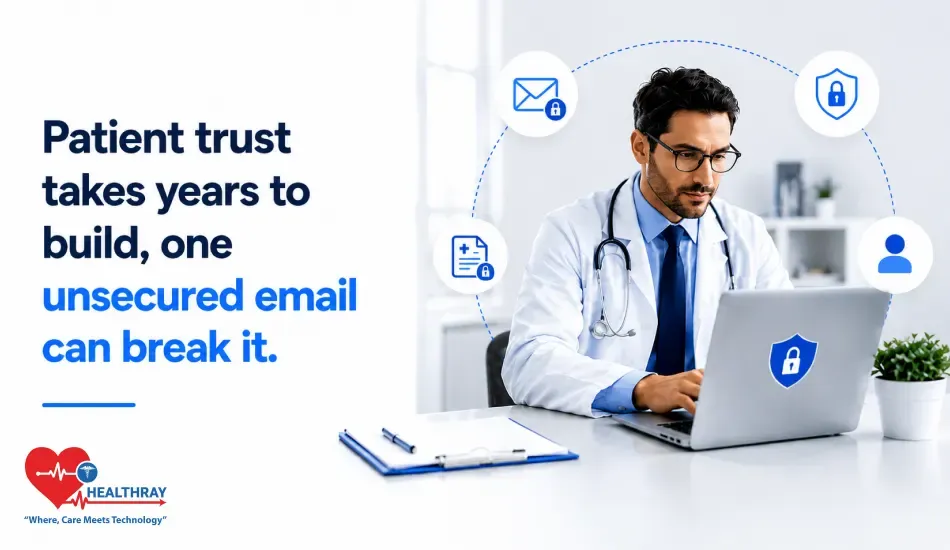
They are not threatening looks. However, each one is a potential HIPAA violation, and the first step to the fix is a HIPAA-friendly email.
Most providers of health care communicate via email. It also happens to be one of their biggest compliance challenges. In 2025, a total of 170 HIPAA email violations put the private data of 2.5 million patients at risk. HIPAA-friendly email infrastructure is more important than ever as many clinics are beginning to implement an AI receptionist for scheduling, routing patients, and communicating with patients outside of clinic hours.
The average cost of each breach is $7,500,000 in fines, legal fees, corrective action, and other costs. This number doesn’t count for reputational damage or patient-notification expenses.
The need is escalating. Updates to the HIPAA Security Rule before mid-2026 will make email encryption a hard requirement, not an addressable specification. Those organizations that don’t have a HIPAA-friendly email server are running out of time.
This guide will tell you what HIPAA requires of your email, why end-to-end encryption is the standard to follow, and how to choose an email provider that is HIPAA-compliant.
What HIPAA Demands From Healthcare Email
Security Rule vs. Privacy Rule
Two HIPAA rules apply to providers’ use of email.
Electronic protected health information (ePHI) is under the Security Rule. It establishes the technical measures needed to ensure its security – encrypted emails, access controls, audit logs, and integrity protection for any system used to handle patient information.
The Privacy Rule deals with the sharing of PHI, including when and how it gets shared. It specifies who will have access to it, for what, and how much.
Both rules are in effect each time a healthcare provider emails anything containing patient data.
The “Addressable” Misconception
HIPAA splits implementation specifications into two types: required and addressable. The current encryption in place for email is under ‘addressable. That’s a piece of extra information for most organizations. It is not.
“Addressable” means: implement it, or document in writing why you have not and what equivalent safeguard you have in place instead. That’s a real piece of law.
Four Technical Obligations
- Encryption in transit – ePHI must be protected while moving between mail servers.
- Encryption at rest – ePHI must also be encrypted when stored on a mail server. Transit protection alone is not enough.
- Access restrictions – only authorized staff may access emails containing.PHI
- Audit trails – your system must track who accessed what and when
 NOTE
NOTE
The BAA Nobody Discusses Enough
Every provider that handles your email, including whoever hosts your inbox, must sign a Business Associate Agreement before you send a single message containing PHI.
A BAA is a legally binding contract. In this, the provider agrees to safeguard patient information in accordance with HIPAA requirements.
However, none of the email services are HIPAA-friendly by themselves, even if it has a strong encryption, without a signed BAA. A BAA alone does not create compliance either. You need both. Both are necessary but not enough.
Another interesting fact that a lot of providers find out is that there’s no certification for email platforms under HIPAA. No software is “compliant”. It depends on the usage of the software completely.
Recognizing PHI Inside Your Inbox
The 18 Identifiers
HIPAA defines PHI as individually identifiable health information related to care, treatment, or payment. The Act specifies 18 identifiers – name, date of birth, phone number, Social Security number, account number, etc. One that consistently gets through: an email address is a HIPAA identifier.
Messages That Look Harmless But Aren’t
PHI appears in messages that look nothing like medical documents:
- A subject line reading “Follow-up: John Smith cardiology referral” contains PHI before anyone opens the email
- An appointment reminder naming the specialist type – psychiatrist, oncologist, addiction counselor discloses a clinical relationship.
- A billing reply connecting a name to a procedure code qualifies as PHI
- Any message with treatment dates, prescription details, or insurance information alongside an identifier is covered
The Subject Line Blind Spot
Many email systems encrypt the body parts of an email, but do not do so for the subject lines. An attacker intercepting metadata alone can expose sensitive patient data without ever accessing the email content.
A true HIPAA-friendly email system will encrypt the subject line and headers in addition to the body.
 PRO TIP
Simple rule: if the email could identify a specific patient and connect them to anything health-related, treat it as ePHI and protect it.
TLS vs. End-to-End Encryption – Choosing the Right Standard
Where TLS Falls Short
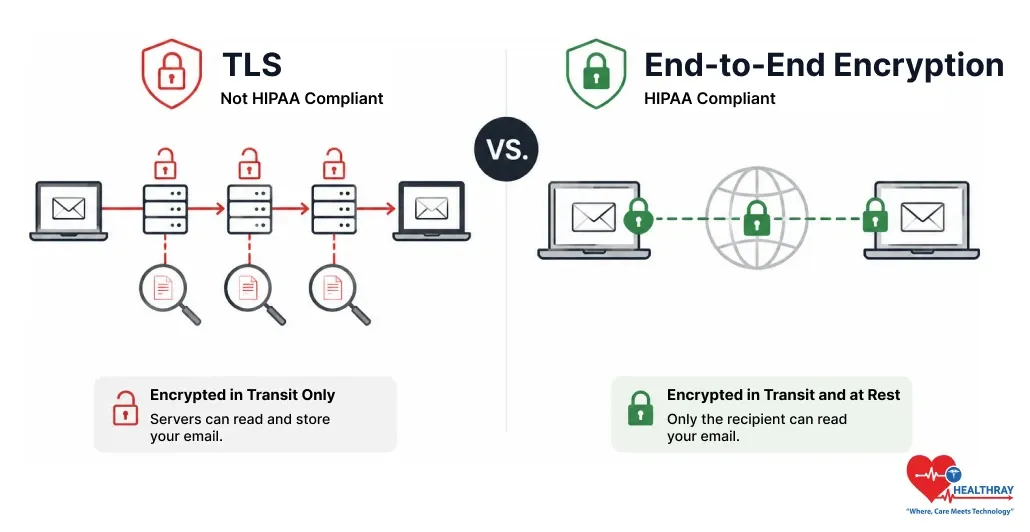
Most mainstream email providers (such as regular Gmail and Outlook) use TLS (Transport Layer Security) as their encryption standard. It secures the link between mail servers when delivering.
Suppose TLS were an armored truck that locked up a package in the truck but unlocked it at every stop along the way. You receive an email, but each email server on the way may be able to read the message. Once it’s on the email provider’s servers, the email is readable. A breach exposes it. A subpoena compels them to hand it over.
HIPAA requires PHI encryption both in transit and at rest. TLS covers transit only. It can’t do anything with data on your provider’s servers.
How End-to-End Encryption Works
The end-to-end encryption is different. The message is scrambled on the sender’s device before it exits. Only the recipient’s device holds the decryption key. No server in between can read the content.
Even if your provider suffers a breach, the exposed data is unreadable ciphertext. Even under a subpoena, the provider has nothing readable to hand over. The content stays protected in transit and at rest simultaneously.
That’s the formula for a HIPAA-friendly email. TLS meets one-half of the requirement. End-to-end encryption does both.
Why This Gap Catches Providers Off Guard
Most healthcare providers consider a “secure” email provider to equate to HIPAA-compliant email. Security and compliance are not the same thing.
Gmail is safe by the standards of consumers. Not HIPAA compliant without a Google Workspace enterprise subscription, proper signing of a BAA, and proper configuration. Even then, zero-access encryption has more features than the regular Google Workspace for enterprise.
Safe assumption: If your provider can read your email, then HIPAA at-rest requirements are not met.
Zero-Access Architecture and Patient Data
Managed Keys vs. No Provider Access
The majority of enterprise email appliances touted as “encryption at rest” employ a managed key approach. The provider encrypts emails that you store, but retains the decryption keys. This means that the provider is able to technically access your content. If there is a compromise in their main system, they will be open. Taking part in a legal request will force decryption.
Zero-access architecture gets rid of the provider completely. Only on a user’s device is there any encryption or decryption. The provider has servers on which the user only stores ciphertext that is unreadable without the private key, which never moves from the user’s device.
The Compliance Advantage
This makes the provider a non-breach vector. Not even a complete compromise of the infrastructure of the provider reveals anything readable. That is the highest level of satisfaction of the confidentiality requirement of HIPAA, not only for data in transit and at rest, but for no one in the chain of custody to have access to it.
As you consider HIPAA-friendly email services, you do not have to ask, “Is it encrypted?” It is “Who has the keys?
Financial Penalties for Getting Email Wrong
Four Tiers of Enforcement
The Office for Civil Rights enforces HIPAA violations across four tiers based on culpability:
- Tier 1 – Unknowing violation. The provider could not reasonably have discovered the violation. Penalty: $100–$50,000 per violation.
- Tier 2 – Reasonable cause. The provider could have anticipated the violation but failed to act. Penalty: $1,000–$50,000 per violation.
- Tier 3 – Willful neglect, corrected. The provider discovered the issue and fixed it. Penalty: $10,000–$50,000 per violation.
- Tier 4 – Willful neglect, ignorance. The provider discovered the issue and did nothing. Penalty: $50,000 per violation, up to $1.9 million annually per violation type.
How Charges Multiply
Each unauthorized email can trigger multiple violations at once, one per patient record disclosed, and one per missing safeguard.
Public Reporting Obligations
If a HIPAA email violation occurs, it is a required patient notification violation. The provider is required to report to HHS within 60 days if there are more than 500 people affected and notify local media. The organization then appears on HHS’s public breach list, known in the industry as the “Wall of Shame.” State attorneys general may impose additional sanctions.
Organization Size Offers No Protection
Email-related HIPAA breaches cost an average of $7.5 million per incident. That applies to large health systems and small practices alike. OCR does not scale penalties to organization size in any predictable way.
Ignorance is not a legal defense. An unknowing violation still carries penalties up to $50,000 per incident. The tier reflects what the provider knew, not whether the violation was intentional.
Evaluating Any Provider Before You Commit
Automatic Encryption, No Manual Trigger
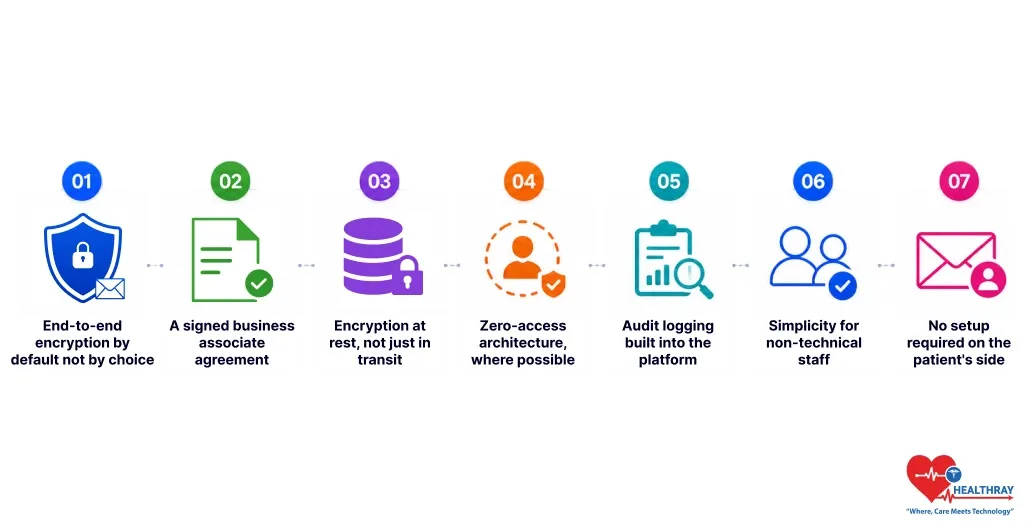
All outgoing messages must be encrypted automatically. No button to click. There is no setting that can’t be forgotten. No option to skip.
Human-triggered encryption is human-error encryption. In a hectic practice, the messages with the most sensitive content will likely be the ones sent most quickly and on the fly.
A Signed BAA Before Anything Else
Ensure that the provider signs a BAA before evaluating the technical feature. This is non-negotiable. A provider that refuses to provide, or provides only a general terms of service, does not qualify for use in a compliant workflow, even if it provides an encryption option.
Storage Protection, Not Just Transit
Face to face: Does your company have access to the content in stored emails? A vague or affirmative answer means managed keys, and that does not satisfy HIPAA’s at-rest requirement.
Zero-Access Infrastructure
Providers providing sensitive specialties (mental health, addiction, oncology) should consider (zero-access protection. The Atomic Mail team is looking at how to approach healthcare communication differently, but in this case, by not introducing anything new, such as encryption, on top of the regular storage.
Built-In Audit Trails
Your provider must maintain access logs that you can produce if challenged. Confirm this during evaluation, not after signing up.
Usability for Non-Technical Staff
It is bypassed within a week if you cannot figure it out by your front office. While HIPAA does not explicitly refer to compliance vulnerabilities as “complexity,” it is nonetheless a compliance vulnerability in practice.
Frictionless for the Recipient
If a patient needs to install software or log into a portal to read your message, most will not. Portal adoption rates consistently fall below 50% even among motivated patients. A HIPAA-friendly email system that decrypts transparently in the recipient’s existing inbox is the only model that works at real practice volume.
Today’s communication tools are increasingly merging the encrypted email with an AI voice agent for healthcare, without compromising security, to handle appointment reminders, intake coordination, and follow-up without burdening administrative resources.
Before You Choose – A Final Compliance Checklist
Complete compliance involves four things: end-to-end encryption of data in transit, a signed BAA with each provider that has access to PHI, access controls restricting access to that data, and audit logging that will demonstrate compliance in case of a challenge.
From mid-2026, documented alternatives to encryption will no longer be acceptable. Many organizations are also pairing HIPAA-friendly email with a HIPAA-compliant AI voice assistant – securing scheduling, inbound calls, and appointment reminders alongside their email infrastructure.
Policies and staff training are relevant. However, they only get you so far. No matter how well your team adheres to protocol, there is always a provider who can access your email content. Exposure will be what your system is designed for, beyond the influence of human behavior.