


In This Blog,
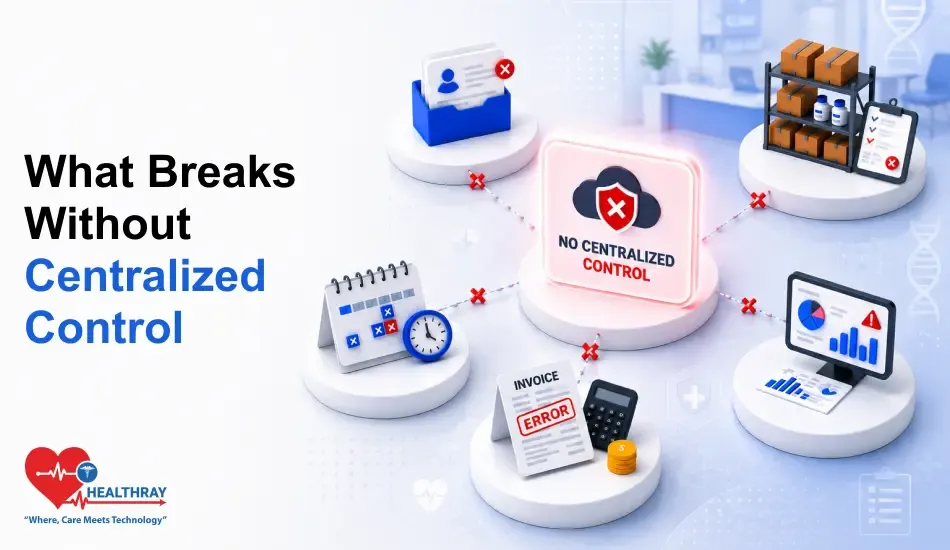
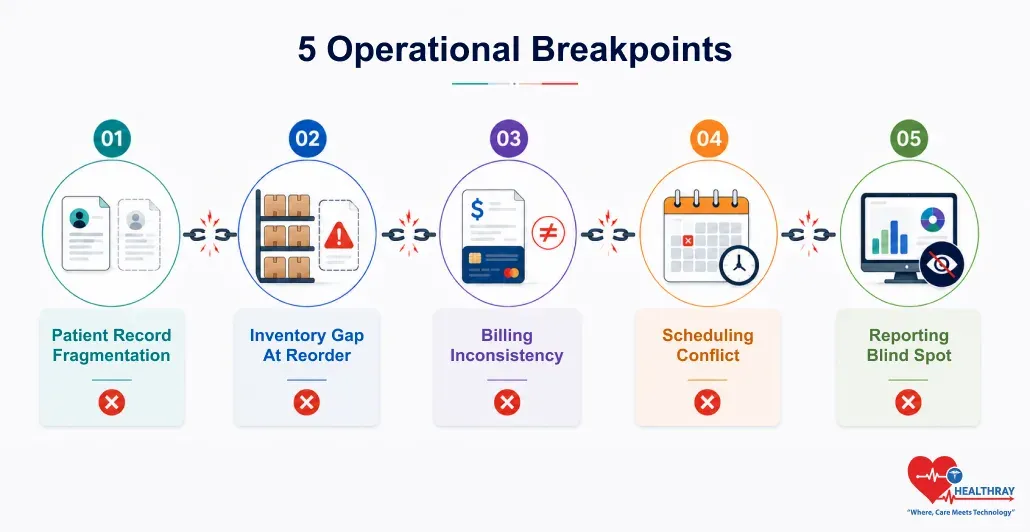
Without multi-location clinic centralized software, clinics don’t collapse in a single event. They break at specific operational moments. These five show where and how to fix them:
- Patient record fragmentation refers to a situation in which a patient visits a branch that is not equipped with their history.
- Inventory gap refers to the situation where a branch reorders stock without being aware of what other locations already have.
- Billing inconsistency occurs when the same service is charged differently in different branches.
- Scheduling conflict occurs when a shift change at one branch leads to a staffing shortage at another.
- Reporting blind spot refers to the situation when month-end reports require manual data collection from each location.
Running one clinic is one sort of systems challenge. However, running 3, 5, or 10 or even more is quite another. The bar is when disconnected sites break critical systems. This blog highlights five such breakpoints and the way centralized software solves each.
The Five Moments Multi-Location Operations Start Breaking
Every single time an operation fails, it is at one exact, very specific moment, not a slow deterioration, not a failure in theory only. In fact, it is a certain stage in the process when the absence of centralized clinic management software and unified data results in a failure that local staff have to implement a workaround. The workarounds heap up. Consequently, the failures become more and more frequent, creating hidden compliance risk across locations. This is where each one starts.
1. Patient Record Fragmentation at Check-In
A patient comes to Branch B, a different place from the patient’s usual one. The receptionist looks up their file. Branch A created the record and never transferred it, so Branch B cannot access it. The employees make a new file. Now the patient has two files in the system, and each location is unaware of the other’s.
The Exact Moment It Breaks:
The front desk staff at Branch B, upon entering the patient’s name and not finding any results, proceed to create a new profile. The reason is that the records of Branch A are kept in a different database. Due to this, the doctor does not have access to any prescription history, diagnosis notes, or allergy warnings. So, the consultation starts with no clinical information.
What Centralized Software Changes:
Each patient is entitled to a single record, which can be seen at any location. When a patient checks in at Branch B, the system fetches the same record that Branch A had created, with the same medical history, prescriptions, and allergies. There is no duplication. No clinical context is missing. The phytotherapy clinic’s dream omnichannel patient experience, undivided care across branches, is attainable only when the record layer is unified.
2. Inventory Gap at Reorder
Branch C’s stock manager notices that the supply of paracetamol is almost finished and decides to place an order. What she is unaware of is that Branch A also ordered 400 units from the same supplier last week. The order will be fulfilled without any issues. Now the chain has 800 units distributed between two branches, whereas Branch D remains without stock.
The Exact Moment It Breaks:
If Branch C’s reorder request is made without knowing that Branch A has some stock, the purchase order will be approved, and the stock will be delivered. The chain may even double its stock of paracetamol, while Branch D will be running out since each location’s inventory count is only local.
What Centralized Software Changes:
Inventory is controlled at the whole chain level. Branch C will check the entire inventory of the chain, including Branch A’s extra stock. The system triggers a reorder only when the chain’s total stock falls below the minimum threshold. It records branch-to-branch transfers and allows staff to resolve shortages at one branch using surplus stock from another branch instead of placing a new order.
3. Billing Inconsistency at Invoice
A patient comes to Branch B for her follow-up visit and is asked to pay 500. The same consultation at Branch A last month was only 450. She brings it to the staff’s attention. The front desk employee at Branch B does not know why the fee differs because the branch’s billing manager configured the pricing independently during setup.
The Exact Moment It Breaks:
Imagine a situation where the billing configuration at Branch B differs from that of Branch A; this might happen quietly during the installation of the system, and no one notices it until a customer points out the discrepancy at the counter. Without centralized billing rules, each branch sets and manages its pricing independently. Eventually, small differences accumulate and create a billing system where patients pay different prices for the same service depending on the branch they visit.
What Centralized Software Changes:
The billing rules are set up only once at the chain level and then automatically applied to all branches. Changing the price of a service in one place means affecting every location at once. Changes made at the branch level need to be approved deliberately. Bills are always the same. The work of the finance department at the end of the month is smooth because there is no need to do a manual check of prices in different branches.
 NOTE
NOTE
4. Scheduling Conflict at Shift Change
Dr Sharma will be working at Branch A on Thursday morning and at Branch B on Thursday afternoon. A last-minute change moves her Branch A session to Thursday afternoon. The problem is that Branch B is not connected to their system. It still shows her Branch B arrival time as 2 PM on the screen. She is, in fact, still at Branch A at 2:30. Eight patients are waiting in Branch B’s waiting room.
The Exact Moment It Breaks:
When Branch A updates the schedule but does not sync that change with Branch B, Branch B’s staff remain unaware of it. Meanwhile, Patients arrive for a session that the doctor has not confirmed they can attend. Staff discovered the conflict only at 2 PM, which is too late to reschedule appointments or notify patients in advance.
What Centralized Software Changes:
All doctor schedules across branches are managed in a single shared calendar. When Branch A makes a schedule change, Branch B sees it immediately. The system flags conflicts before appointments are confirmed, not after patients arrive. Automated notifications reach affected branches instantly. Cloud clinic software security controls keep schedule access role-based, allowing branch managers to view only their location’s schedules while chain administrators can view all schedules across the network.
5. Reporting Blind Spot at Month-End
The operations manager takes a revenue report across five different branches. She asks five people for the data. Three have it by Wednesday. One delivers an Excel file in a different format on Friday. One arrives next Tuesday. She spends three days integrating five sheets, reconciling uneven fee fluctuations and estimating chain-wide no-show rates from corrupted data. This doesn’t even consider the marketing requirements of the clinics, which can be extensive.
The Exact Moment It Breaks:
At the very moment the operations manager dispatches the first data request email, as this is when they realise that there is no reporting layer at the chain level. Doing month-end reports for the clinic, which has several locations but no centralized software, is not a reporting job at all. Rather, it is a data-gathering exercise that takes a whole week and generates results that are probably not accurate.
What Centralized Software Changes:
Staff can generate chain-wide reports instantly from the unified data layer the moment they request them. Things like revenue by branch, no-show rate by location, inventory turnover across the chain; all of them on demand, without the need for any data collection. Clinic software usability testing for multi-location platforms should mainly check for this: the chain-level report should not need any manual assembly, no cross-branch data requests, nor spreadsheet reconciliations.
 PRO TIP
What to Look for in Multi-Location Clinic Centralized Software
The five breakpoints listed above are the evaluation criteria, not the feature list. So, use them as a demonstration checklist. For each one, request the vendor to show centralized behaviour with multiple modelled locations.
1. The Non-Negotiable Technical Requirements
Before you delve into product features, double-check that the suppliers you have shortlisted are technically capable of meeting these non-negotiable requirements. If they do not, the software will merely give rise to the problem of fragmentation that you are trying to solve with the new interface.
- Single patient record across all locations; any branch check-in loads the same history.
- Chain-wide inventory pool with branch views and tracked inter-branch transfers.
- Centralized billing rules with branch overrides allowed only via authorization.
- Unified scheduling calendar for all staff with real-time multi-location updates.
- Chain-level reporting from one data layer with no manual data collection.
2. The Cloud Clinic Software Downtime Risk Question
When a clinic has multiple locations, the cloud clinic software downtime risk is even higher; one outage hits all the branches at the same time. Make sure to check the vendor’s uptime SLA, failover protocol, and breach response time before you sign. A breakdown on all the branches during peak hours is an issue for the whole centre recovery, a very different thing from a one-location breakdown.
3. Access Control Across Locations
Centralized data, in a way, means the risk is centralized. Role-based access restrictions must be such that a Branch A receptionist is not able to look at Branch B’s patient records, branch managers can only see the reports of their own locations, and chain-level admin access should be limited. This is what actually ensures centralisation is secure rather than only being functional.
Learn more: This guide, Clinic Appointment Booking Software and the Receptionist Hours It Reclaims Every Week. shows how the same centralized control that prevents record, billing, and inventory breakdowns also frees receptionists from manual scheduling.
Final Thoughts
Multi-location clinic operations do not really break suddenly; they break at specific moments where things add up to a daily operational burden. The five breakpoints mentioned in this blog are the ones that happen weekly in multi-location clinics using siloed software. By centralizing control, you can get rid of the whole category of problems that arise when different locations cannot even see each other’s data. Surprisingly, this is a category of problems that is bigger than most chains realise only after they have measured it.