


In This Blog:
- Long OPD lines show that current patient flow systems are not working well.
- Clinics mostly use token systems, but tokens and queuing software are not the same thing.
- Doctor queue management software handles both booked visits and walk-in patients in one place.
- In India, OPDs must clearly treat appointments and tokens as two different things.
- The right system tracks patients through the clinic instead of just replacing paper tokens with a screen.
- This kind of system cuts patient waiting time, reduces staff workload, and makes visit times more predictable.
Why Indian OPD Queues Are a Different Problem Altogether
The waiting space of the clinic is crowded, like usually, which is because plastic chairs fill the room and the paper slip token counter is used. Many patients who come before 7 o’clock in the morning can still be sitting there by the middle of the day, like twelve. This is a concern since two factors have to be sorted out by changing the whole doctor appointment system design.
1. The Walk-In Reality Most Clinics Are Built Around
Outpatient departments in India are mainly made for people walking in. People do not make appointments; instead, they just arrive, sometimes coming from far away, having no information about how much waiting is ahead. The staff at the entrance spends most mornings trying to keep up with crowd control instead of taking care of the patients’ needs.
2. The Problem of Token System
At first, the paper token system brought some rules to randomness with walk-in patients, so it worked in the beginning. However, it has a strong upper limit. This system says your number in line, but not your actual waiting time. It cannot change if doctor comes late, does not notify any patients when they are about to be called, and managing both booked and walk-in people is not possible together. It is just a way to assign numbers and not actually a real queue management system.
3. What Do Patients Feel When They Wait
Patients have to stay near waiting area; if they go away, they might miss their turn. They cannot properly arrange other activities. That is not only the time spent, but also unpredictability which causes annoyance and some even finally leave. The main problem to solve is uncertainty, not simply ordering the patients.
Difference Between Appointment Queuing vs Physical Token Systems
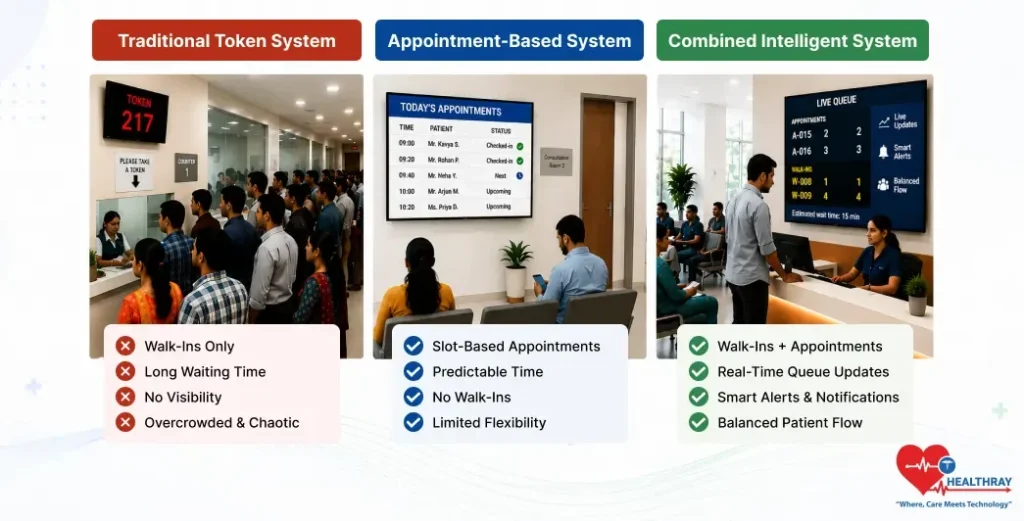
Token systems and queues with appointments are not just two similar methods. These systems have their own problems to fix, people to help, and end results.
1. How a Physical Token System Works And What It Can’t Do
A patient comes inside, gets a token number and waits till their number is shouted. The system does not store any patient details. There are no times for appointments given. Notifications do not happen. A walk-in and a pre-booked patient are the same to the tool. For small clinics that do only walk-ins, it is fine for basic order keeping, but as soon as there are more people or when people start booking appointments, the system is not able to work well.
2. How Appointment-Based Queuing Works And What It Changes
With a doctor appointment system, patients can book a time from their home, app or at the reception, and the system gives them a specific place on timetable, so they get a time before coming. There is no number card to carry. The waiting depends on appointment time instead of coming early. Doctors know better about what to expect in their day. Staff are able to look at order of things for whole day, even before starting. Patients already know when doctor sees them before reaching there.
3. When You Need Both Running Together
Walk-in patients will still exist because of emergency or just the way people always did it, so both approaches need to exist. It does not help to make everyone use just one way. A good cloud-based doctor booking system in India keeps both working in tandem: patients with a fixed time hold their place, walk-ins fill in where there is space, and waiting times get calculated all over again instantly. Everything is combined into a single queue. The staff does not switch back and forth between two lists by hand.
Learn more: Managing queues is only half the picture. See how a complete doctors appointment system ties scheduling, reminders, and patient flow into one structure that actually holds: How to Control Peak-Hour Chaos with an OPD Appointment Management System
What Doctor Queue Management Software Actually Does in an OPD Setting
When working in an Indian OPD, the appointment management software must fix three operation issues at same time instead of finishing one by one.
1. Managing Walk-Ins and Booked Patients in the Same Queue
Mostly, normal scheduling software cannot deal with places where booked and unplanned patients come together. Using special queue management, system keeps the slots of booked patients secure, fits walk-ins into any possible spaces and updates the waiting times after each doctor visit. Receptionists now use one real-time list instead of separate lists fighting each other.
2. Real-Time Updates That Keep Patients Out of the Waiting Room
Patients who can see their queue status on their mobile or who get a message a bit in an advance do not stay in the waiting area all of the time. They step out, run an errand, come back when it’s almost their turn. More advanced systems even use an AI voice agent in healthcare settings to call patients automatically when their turn is approaching, no SMS needed, no staff involvement. That single change reduces physical crowding more than any other feature on the spec sheet.
3. How It Reduces Staff Pressure at the Front Desk
Front desk employees in the majority of OPDs manage tokens, respond to inquiries about wait times, process walk-in registrations, and handle complaints, all of which are reactive tasks. When queue software functions correctly, patients self-check in, queue positions automatically update, and inquiries about wait times are addressed by the display board or a patient’s SMS rather than by a staff member who is already overworked.
 NOTE
NOTE
What to Look For in Healthcare Appointment Software for Queue Management
When assessing healthcare appointment software for queue management, it is more appropriate to ask “what does this system prevent?” rather than “what does it do?”
1. Does It Handle Both Appointment and Walk-In Flows?
In an Indian OPD, any system that solely handles scheduled appointments will not work. Both streams, booked patients in their slots and walk-ins dynamically inserted, must operate concurrently without human intervention. Inquire directly with vendors about how their system manages walk-in and scheduled patients who arrive during the same 90-minute timeframe. You can learn everything from the answer.
2. Can Patients Track Their Position Without Being Present?
Examine whether the system uses WhatsApp or SMS, which have the greatest reach across Indian patient demographics, to give proactive queue updates. Also check if the system works on basic feature smartphones without needing the installation of apps. Most people coming for OPD won’t be interested in installing an app for their single visit however, they can be prompted through an SMS.
3. Does It Integrate With Your Existing OPD Setup?
If the appointment scheduling software for the hospital doesn’t communicate with the new queue system that you are planning to implement, then it can potentially create another silo and not resolving any of the existing issues. Before your decision, make sure the solution can work together with your registration, billing, and medical records handling system. Besides that, check the display equipment can the system handle queue boards or send updates to a screen in the waiting area? In a crowded OPD, these are not luxury items.
 PRO TIP
Signs Your OPD Queue Management Is Actually Working
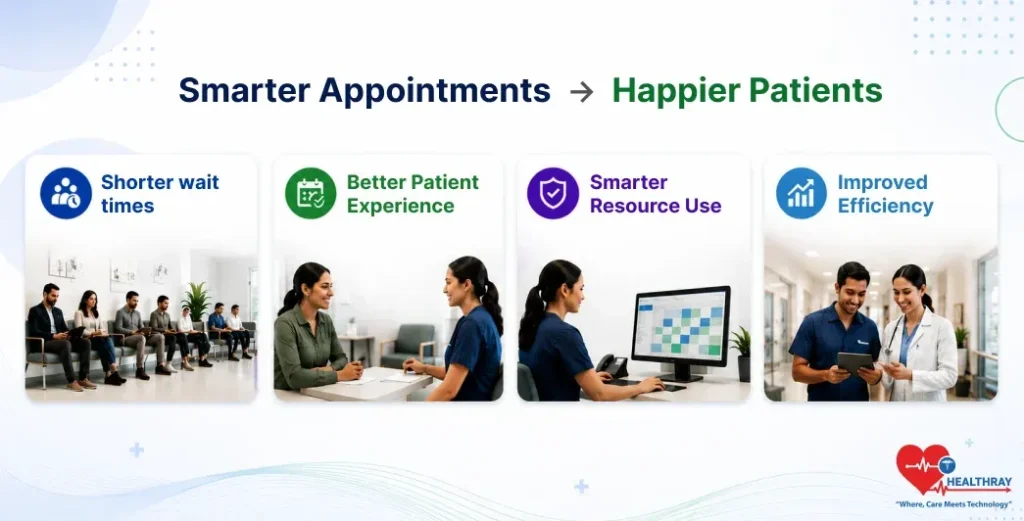
Going live is just the beginning. The online slot booking for clinics will only be effective if the right indicators are monitored, not waiting for a quarterly report. Here is what a system performing well looks like on the ground.
1. What Staff Notice First
- Reception staff will stop spending the first two hours of each morning trying to control the crowd.
- Without any hassle, more patients walk in and register themselves, which means there is less queue for the patients who come to the counter.
- Besides wondering about the waiting time, patients actually keep track of their turn via their phone or the display board.
- Instead of manually tallying paper tokens, the end-of-day reconciliation takes only a few minutes.
2. What Patients Notice First
- They have an idea of their waiting time right from the start.
- They don’t have to sit in the waiting room all the time, as they can be sure not to miss their turn even if they leave the area.
- The waiting area is less crowded and noticeably calmer.
- Patients with appointments are generally seen just about their appointment time, not waiting behind walk-ins.
Conclusion
Long OPD lines should not be a given in Indian healthcare; they are simply the result of a system that was not designed to handle the volume and complexity it is now facing. Doctor queue management software can help solve this problem, but only if it is selected for the right context, installed with a comprehensive view of patient flow, and evaluated with results that really matter to staff and patients. The objective is not just having a cleaner waiting area. It has a clinic where patients can be sure that their time will be respected.