

In This Blog:
You’ll see why peak-hour chaos in a large hospital OPD is usually a scheduling problem, not a staffing one. You’ll also learn how an OPD appointment management system can spread patient visits across the day so your busiest hours become easier to handle.
- Peak hours in large hospital OPDs are very busy and often lead to system breakdowns.
- Most hospitals blame staff shortages when the real issue is weak scheduling.
- An OPD appointment management system should prevent chaos, not react to it.
- Slot limits, live queue updates, and digital registration each fix different peak-hour issues.
- You should test any OPD system during your busiest hour, not on a normal day.
- With the right system, peak hours can become organized, calm, and easier to manage.
Why Large Hospital OPDs Collapse During Peak Hours
Peak-hour disorder in a large hospital OPD is quite different from a busy afternoon at a small clinic. On one hand, the scale and risks are greater; on the other, the points of failure are very diversified. A doctor appointment system that works for 30 patients a day may be ineffectual at 150. It is essential to learn why peak hours break down the way they do before resorting to any remedies.
1. Most Patients Arrive During the Morning Rush
In most large hospital OPDs, the majority of patients arrive between 8:30 and 10:30 a. m. regardless of when their actual appointment is, or whether they have one at all. Cultural habits, travel logistics, and the assumption that earlier means faster all push patients to front-load their arrival. The result is a two-hour window that concentrates an entire day’s patient volume into a fraction of the available time.
2. Manual Scheduling Keeps Overloading Peak Hours
Manual scheduling by telephone, paper register, or rudimentary spreadsheet cannot set a cap or allocations for the day. Bookings are allocated to each new patient as they call. The consequence is that an increasing number of patients continue to be booked into the same morning slots with nothing to control this. Waiting areas become crowded, registration queues grow, consultation times are delayed, and patients become annoyed from the outset.
3. Front Desk Operations Slow Down During Peak Hours
Interview any front desk team about what peak hours are like, and you can expect the same list of complaints: patients wanting to know their waiting time, walk-ins breaking the flow of the queue, doctors running late because of incomplete patient files, and a registration desk turning into a physical jam point. This really isn’t a staff performance issue. It’s a problem with the system design, which begins way before the first patient is admitted.
How an OPD Appointment Management System Redistributes the Load
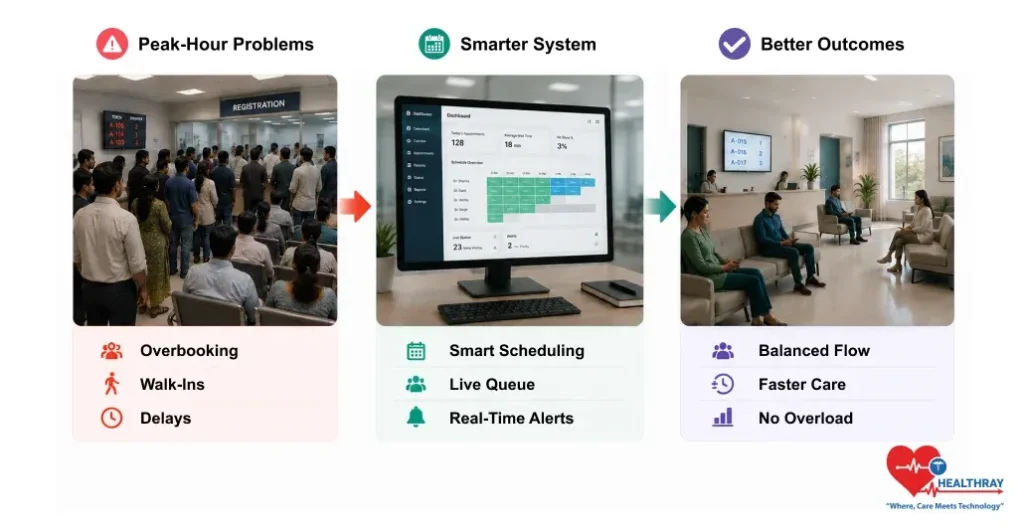
The main function of an OPD appointment management system during busy hours is not really to speed up the process; it is to spread the load. Redistribution of patient load even before the first patient enters the hospital is where the real solution lies, and this is where doctor appointment automation becomes essential. These are the three features that make it possible.
1. Slot Capping Prevents Peak-Hour Overload
The idea of slot capping is quite simple: it puts a hard limit on the number of appointments that can be booked within a certain time period. Once a slot is fully booked, it is closed, and patients are automatically redirected to the next available slot without any staff intervention.
In large hospital outpatient departments where 9 to 10 a. m. is a peak period, simply slot capping can lead to a significant portion of the crowd being moved to the 11 a.m. – 1 p.m. time slot, which is usually underutilized. The same number of patients will be seen, but without the morning rush.
2. Staggered Scheduling Spreads Morning Arrivals
Staggered scheduling takes patient redistribution a step further. Rather than booking all patients into one broad morning time slot, the system issues specific arrival times, 9:00, 9:15, 9:30, depending on the expected time for consultation and doctor availability. Patients arrive in a steady stream instead of a crowd all at once.
Along with pre-visit SMS reminders that confirm the specific arrival times, staggered scheduling can greatly diminish the arrival spike. The waiting room never reaches capacity because the system controls inflow, not just orders.
3. Real-Time Queue Balancing Handles Delays Smoothly
It is well known that no schedule is perfect and will not change based on reality. Doctors may get late for their appointments, consultations can be longer than expected, an emergency case may come up, and get worked in. A good OPD appointment system does not stop or become disorganized due to these happenings; instead, it adjusts. Patient’s wait time is recalculated almost immediately, communication about delays is done to patients before these delays turn into complaints, and walk-ins are placed into the gaps without affecting the booked sequence.
Digital Patient Intake Cutting Peak-Hour Bottlenecks Before They Start
Patients encounter the registration counter first bottleneck at the busiest hours – and faster staff is not the solution. The registration must be moved out of the OPD before the patient comes, is the answer.
1. Why Registration at the Counter Is a Peak-Hour Multiplier
Counter registration in large OPDs usually means staff typing name, age, ID, complaint, and insurance data for every arriving patient. Handling 100 patients per hour, with each patient spending 35 minutes at the counter, is a wall that leads to triage delays, file holds, and doctor start times getting pushed back.
2. How Online Slot Booking for Doctors Moves Registration Out of the OPD
Online slot booking for doctors allows capturing registration data right at the moment of booking – like a patient’s name, contact details, and reason for visit – even before they enter the hospital. Check-in is done within seconds instead of minutes. In a high-volume outpatient department, even a 60% shift of patients to pre-registered bookings removes the morning counter bottleneck.
In the case of a high-volume outpatient department, even a 60% shift to pre-registered online bookings is enough to reduce counter load and thereby eliminate the morning bottleneck. The rest of the walk-in patients will move faster because the counter won’t be overwhelmed with the entire day’s registration volume.
3. How an Online Form Captures Patient Info Before Arrival
Online form builder takes this one step further, symptom checklists, medication history, and allergy declarations can be gathered from patients at their homes. When the doctor starts the case, the clinical scenario is already present. In clinical areas where history-taking accounts for 5-7 minutes of a consultation, this time-saving can greatly add up over a peak-hour morning.
 NOTE
NOTE
What a Clinic Appointment System Needs to Handle Peak-Hour Pressure
Definitely, not every clinic appointment system is designed to handle peak-hour scale. So, measure against your busiest time, not your average volume. Here’s the thing that really matters.
1. Real-Time Visibility Across All Counters and Departments
During peak times, a big hospital OPD (Outpatient Department) usually manages several queues across different departments. A cloud-based doctor booking system displaying only one doctor’s availability is only a partial view, and staff would not be able to take any action. A consolidated live dashboard showing every counter, department, and doctor in real time is what allows staff to anticipate load and redistribute before it peaks.
2. Patient-Facing Tools That Reduce Walk-In Dependency
A healthcare appointment software that truly simplifies advance booking fast, mobile-first, no login tension, and gradually converts patients who usually walk in to patients who book their appointments. This conversion is what makes slot capping and staggered scheduling genuinely effective. Don’t just look at the admin dashboard. Give as much thought to the patient-facing side as well.
3. Escalation Logic What Happens When a Doctor Is Late or Absent
Most clinic appointment systems neglect this, and it becomes evident during the busiest hours. If a doctor is 30 minutes late and the system does nothing until staff manually intervene, all the patients in that queue end up waiting without any warning.
Look for built-in escalation logic: automatic patient notifications when delays exceed a threshold, doctors in the same department being rebalanced automatically to queues, and an admin view of delays that are flagged before morning cascades.
 PRO TIP
How to Know Your OPD Appointment Management System Is Handling Peak Hours
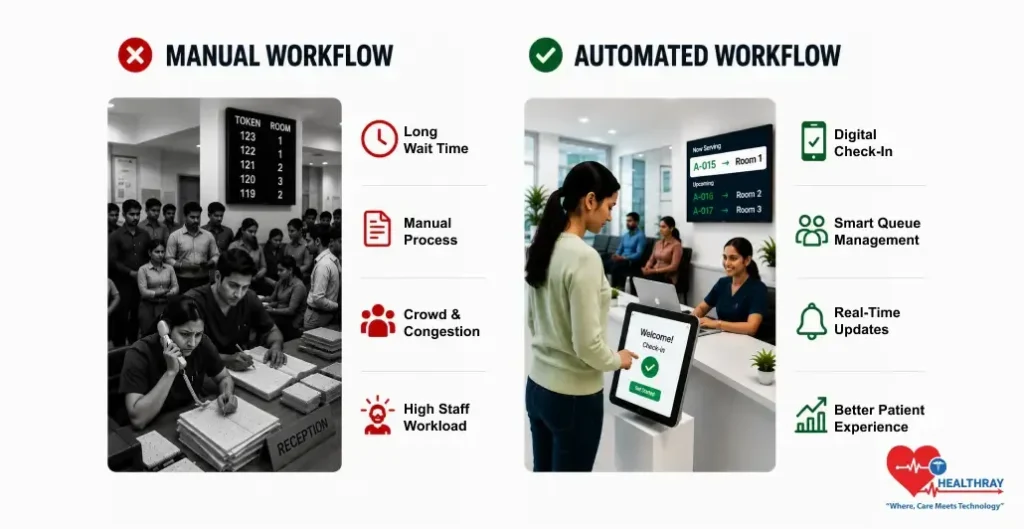
Any OPD appointment system’s real challenge lies not in how it handles a quiet Tuesday afternoon but what peak times look like after 60 days of full usage. These are the signs that the system is actually doing the job.
1. What Changes First On The Staff Side
- Receptionists start the day off right because they can see the whole line of people waiting.
- Work at the counter goes faster because patients who have already booked come in with all their information filled out.
- Patients ask “how long left?” less often when they can see the queue status on screens and phones.
- The system shows late doctors, so staff don’t have to run around to tell everyone.
2. What Changes First On The Patient Side
- People come at different times because they know their time slot will be followed.
- People who walk in get a clear, honest wait time instead of a random token.
- Patients who make an appointment ahead of time are seen close to the time they booked.
- People stop complaining about waiting because they know what to expect, even if there is still a line.
Learn more: Emergency handling becomes easier when patient flow is already digitally organized. Why Clinics With Online Slot Booking Handle Emergencies More Effectively explains how clinics reduce delays during unexpected situations.
Conclusion
The uproar during the peak hour at the big hospital OPD is not about extra personnel or more patience; it’s the scheduling architecture dysfunction. Imagine 80% of patients arrive in the same 90-minute session, no team, supplied with excellent staff, can manage such a flow perfectly without the presence of a system that is constantly regulating inflow.
An OPD appointment management system truly designed to handle pressure during peak hours by limiting the number of slots, staggered scheduling, digital intake, and real-time rebalancing not only lessens disorder but also effectively stops the environment that creates it. This is the step that justifies expenditure.