



In This Blog
Everything you’ll need to understand the difference between clinic software and hospital software before you make your next purchase decision:
- There is a difference between clinic software and hospital software; they are not just two versions of the same software
- It all comes down to three factors: whether patients stay overnight, internal departments’ work process flow, and billing method
- Many expanding clinics buy hospital software that they do not require
- Use this simple three-question quiz to determine which type suits your practice
- Buying the wrong one not only wastes your money but also gets your practice processes moving in the wrong direction for years to come
Making a bad decision regarding healthcare management software can cost your practice much more than just the extra bucks paid for it. It slows down your staff. It messes up their day-to-day operations. Finally, it leaves your practice with a gaping compliance hole that will take years to mend. Most practice administrators listen to a demo of the enterprise HMS. They find the functionalities impressive enough. Then they leave with the impression that they need an entire hospital infrastructure for a 12-room outpatient clinic. The vendor wins. The practice wastes money – and battles the software every single day.
The Functional Boundary Map: Clinic Software vs Hospital Software Explained
Too many purchases eat away at your budget, while too few leave you stuck in a manual-based environment. For growing healthcare organizations, the decision between a specialized clinic management software and a comprehensive hospital management system is not about feature lists. It reflects the underlying healthcare IT infrastructure and how your system is designed to scale with clinical operations.
Whether patients are treated and discharged the same day or formally admitted through a physician’s order for an overnight stay determines which side of that line you sit on. CMS maintains separate quality reporting frameworks for outpatient and inpatient settings precisely because these are not interchangeable environments. They are structurally different, and the software that runs them must be too.
| DIMENSION | CLINIC SOFTWARE | HOSPITAL SOFTWARE (HMS) |
| System Concurrency | Designed for a single site with lower concurrency and primarily outpatient workflows. | Concurrent operations of various departments and multiple sites that are stable in terms of large-scale operations. |
| Patient Workflow | Standard OPD flow: appointment, consultation, prescription, and day of discharge. | Standard inpatient ADT flow: admission, treatment, discharge over days. |
| Bed Management | Simple scheduling of OPD examination rooms. | Real-time bed tracking across wards, ICUs, and recovery units. |
| Clinical Depth | Rapid OPD notes, SOAP notes, and single visit prescription. | Continuous patient record, nursing charting, vital signs, and OT planning. |
| Ancillary Services | Integration of external laboratory and imaging systems using HL7/APIs. | On-site LIS, PACS, blood bank management and coordination system. |
| Inventory Control | Basic drugs and inventory tracking for clinics. | Hospital-wide pharmacy management with batch tracking. |
| Revenue Cycle | Per visit billing and insurance processing. | Complex multi-departmental billing and payer management. |
 NOTE
NOTE
The 3-Question Test For Choosing Clinic Software Vs Hospital Software
The boundaries chart will help you understand the functions of the systems. The answers to these three questions will help you determine which one fits your business best. Be honest with yourself and ask these questions before meeting any supplier, while also considering future clinic data migration requirements if you ever switch systems.
According to the National Center for Health Statistics (NCHS), CDC ambulatory care is the primary type of care in the United States. National surveys like the National Ambulatory Medical Care Survey support this finding. In fact, most practices reading this are ambulatory clinics. Many are being sold inpatient equipment they do not need.
Question 1: Do You Manage Patient Admissions And Overnight Stays?
No: If your facility is closed at night or patients go home after treatment, you stay entirely within the clinic software realm. You don’t have to worry about costly ADT processes, 24-hour vital signs tracking, nighttime nursing documentation, or advanced AI tools like create videos from images for patient education.
Yes: If you need to cover shifts with nurses on a round-the-clock basis, document patient nutrition information, and keep tracking vital signs around the clock, you simply must have the whole hospital system running in order to comply with medical requirements. Trying to mimic inpatient 24-hour operations on a clinic software platform is a recipe for compliance and audit problems.
This is the most important of the three questions because a “Yes” answer determines everything else, regardless of Questions 2 and 3.
Question 2: Do Internal Departments Coordinate Around One Patient?
No: When your physicians handle routine testing on their own or when labs and imaging are outsourced to external vendors, a clinic management system or clinic management software, typically HIPAA compliant clinic software, meets all your needs through seamless and cost-effective API integrations.
Yes: In case your pharmacy, lab, and radiology are billing separately, maintaining their own inventory, and needing custom integration within a single patient chart, then a hospital system with LIS and PACS is likely the better fit. Creating such an integrated system within a CMS via API integrations often complicates healthcare data integration, leading to duplicated data and billing mistakes. Such errors can multiply as patient volume grows.
Question 3: Will You Expand Locations Or Services Very Soon?
No: Since you operate under the same team structure or location for your working model, the software for the clinic ensures that your processes stay swift, efficient, and cost-effective. It is better for business sense to remain stable rather than scale up prematurely.
Yes: If your strategy involves multidisciplinary centers, decentralized bill collection, or partial resource sharing, you will require the foundational infrastructure needed for scale and concurrent multi-user operations. AHRQ highlights the role of health IT tools in improving care quality and practice operations in ambulatory care settings. As healthcare organizations expand, software that cannot accommodate increasing workloads, users, and interconnected workflows can create inefficiencies, administrative challenges, and barriers to coordinated care.
You have identified the boundary line and answered all three questions. Ultimately, they lead to the same point – an obvious architectural choice that has already been defined by your operations.
 PRO TIP
The One Boundary That Matters Most In Healthcare Decisions
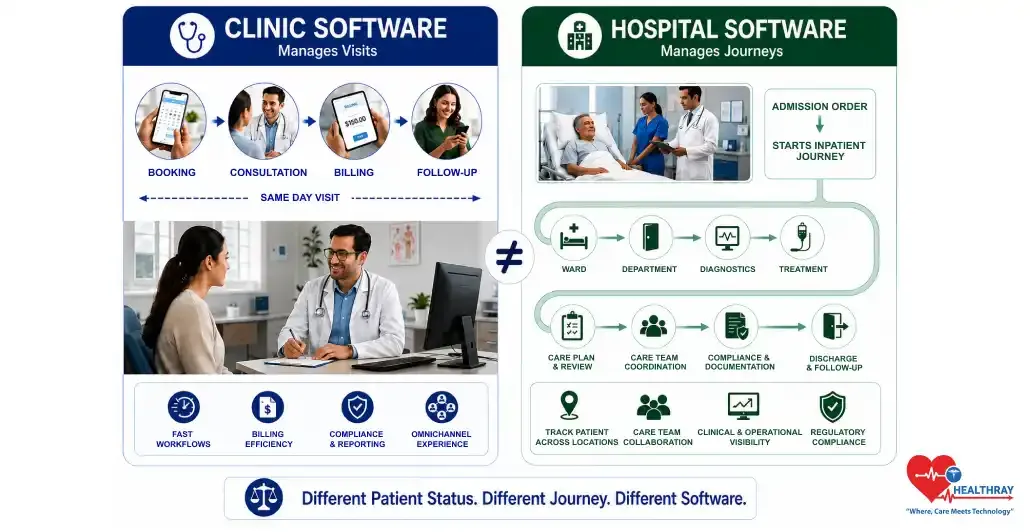
- Clinic Software Facilitates Visits: Typically, Clinic software is designed to ensure fast workflows, billing efficiency, and compliance for time-bound visits including day procedures such as IVF treatment where patients receive care and leave the same day, while also supporting an omnichannel patient experience across booking, consultations, and follow-ups.
- Hospital Software Facilitates Journeys: In contrast, hospital software requires continuous tracking of patient movements across departments and wards following a formal physician admission order.
According to the Office of the National Coordinator for Health Information Technology (ONC), inpatient status begins on the date of admission through a physician’s written order. In the absence of such an order, a patient remains an outpatient regardless of how long they stay within the facility. Ultimately, this single regulatory distinction determines the type of software your organization needs.
Learn more: How to Choose Clinic Management Software: Global Buyer’s Guide to learn what features, tools, and factors to consider before choosing the right software for your clinic.
Final Verdict: The Data Already Tells You Which System Your Practice Needs
The choice between clinic software vs hospital software is something that does not require a consultant. It does not require a half-year period of evaluation. What it requires are three honest responses to three questions regarding what goes on at your facility on a daily basis. The demarcation chart has already shown you the boundary. It is clear where clinic software stops and where hospital systems begin. The six distinctions between the two are also clear: patients, beds, clinicals, ancillaries, logistics, and billing. And you have responded honestly to three questions that no vendor would dare ask you.
With your patients leaving on the same day, your departments will never cross-bill, and your growth limited to a certain model – your clinic software becomes the only option. Any attempt at forcing HMS to work in this situation will result in increased expenses, disrupted workflows, and a huge amount of unnecessary complexity for a completely different system. The right software should fit your operation and support effective healthcare operations management as your organization grows. When it does, your business will start operating faster, from initial appointment to final insurance billing. This is the concept you need to apply to your particular situation, with all its specifics considered.