


In This Blog
Most clinics concentrate on bringing patients in, but this article reveals clinic patient engagement tools at various steps and retention outcomes when one is absent:
- The post-visit stage, not the booking stage, is where retention of chronic patients breaks down.
- Six steps of engagement between one appointment and the next, and what these steps do.
- Tools that fire at each step and a patient’s experience when the tool does not fire.
- Multiple patient engagement failures leading to patient loss, rather than just no-shows.
- What’s included in an effective post-visit engagement schedule, starting from day one, to follow up.
Chronic retention in a patient does not fall short at the stage of booking; it falls short during those quiet weeks in between visits when no follow-up is programmed through patient engagement tools of the clinic. What this blog discloses is that chronic patient retention is not a failure at booking but in silent weeks without engagement between visits.
Why Chronic Patients Are a Different Retention Problem
Most clinics evaluate their tools based on the booking and arrival processes. That method suits acute care, but it is not suitable for chronic care since patients tend to come back every few weeks. So, in this case, clinic management software should not only facilitate patient engagement at the time of check-in, but rather the whole continuum of care support.
1. The Difference Between Acute and Chronic Engagement Needs
Acute patients just need a single well-timed reminder and quick check-in, but chronic patients need a whole system of engagement between visits, medication reminders, lab prompts, check-ins, result notifications, and even a re-booking trigger based on their care interval. If a patient misses one step, it won’t just be a failed reminder; they will experience a gap in their care.
2. Where Retention Actually Breaks for Chronic Patients
After about three to six weeks post-visit, patient retention tends to fail; by then, the urgency of the appointment has diminished, and the next one seems far off. At this point, clinic patient engagement tools at the clinic either maintain the patient’s connection with the clinic or let it go cold. Most clinics have no automation in this area at all.
3. The Patient This Blog Follows
This blog tells the story of Ethan, a 52-year-old gentleman with Type 2 diabetes who is on medications and consulting Dr. Miller every 2 months. His post-consultation path charts 6 patient engagement steps from one meeting to another, plus reveals the tool activated at each step.
The 6-Step Post-Visit Engagement Sequence
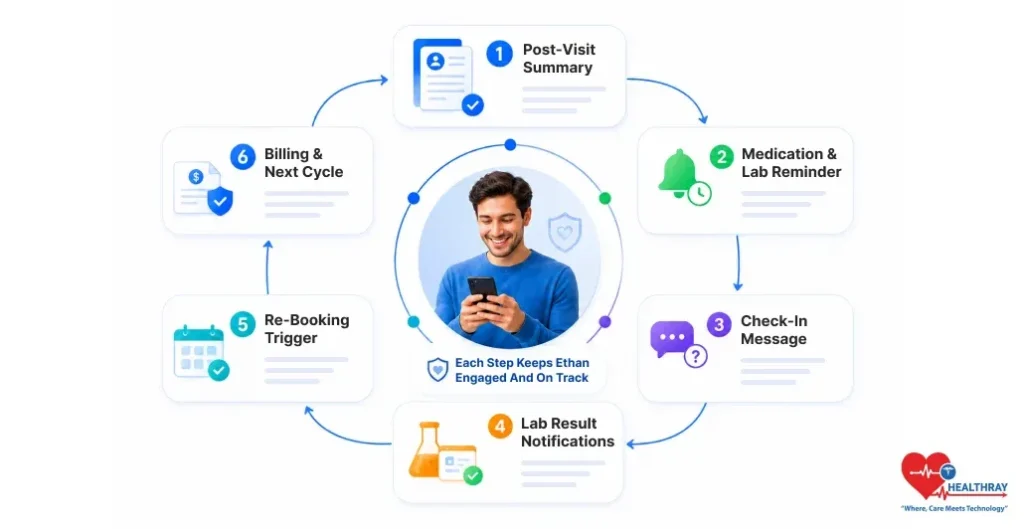
Most clinic patient engagement tools focus on after the visit, when the patient leaves the hospital. Though in reality, continuous follow-up features in what occurs between two visits and each step of the sequence help the patient stay engaged, informed, and more motivated to come back on time.
Step 1: The Post-Visit Summary (Day 1)
Just hours after the doctor’s appointment, Ethan gets a clear and easily understandable summary of the visit: his medicine instructions, due date for blood work, and the time of the next appointment. This is a guide for him on what to do after the visit. Otherwise, he would only have his memory and a prescription to rely on, and this might mean minor uncertainties (such as how to take the medication) as well as forgetting important tasks like going for lab work.
Step 2: The Medication and Lab Reminder (Day 3 to Day 7)
On the third day and these days, the automated reminders clinic will alert Ethan to do his blood work and continue his medication. The message is clear, constrained to a certain time, and connected to his next appointment with Dr. Miller. Without these messages, quite often the blood work is done so late that the results are not even available when Dr. Miller has to see the patient. This is a clinical gap that arises solely from a missing engagement step.
Step 3: The Check-In Message (Week 2 to Week 3)
Somewhere between the 2nd and 3rd weeks, a short check-in message is sent to ask how Ethan is doing and whether he has any questions or concerns. This method opens up a very easy way for him to share with the clinic if he experiences any side effects or has any doubts. In the absence of this, small problems remain unreported because there is no easy way for the patient to contact the clinic; signals that Dr. Miller would want are never communicated back to her.
Step 4: Lab Result Notification and Record Update (Week 4 to Week 5)
The clinic software promptly alerts Dr. Miller. Meanwhile, it also gives indirect support to Ethan by reassuring him that the tests have been checked again and that he will be given a detailed explanation by the doctor at the next visit. But if there had been no communication, Ethan might have thought that he was making a trip to the clinic in vain. Silence is a luxury that many clinics cannot afford, as its cost includes the risk that they would be missing out on.
 NOTE
NOTE
Step 5: The Re-Booking Trigger (Week 6)
Six weeks before the date of the appointment he had planned, a letter came to him urging that he change the appointment date. Besides his laboratory results and a brief of his consultation with Dr. Miller, this letter had a link to schedule an appointment. If the communication channels of steps one and two have not opened, this one is very cold, and the most likely actions he will take are cancel, postpone, or just ignore.
Step 6: Billing, Continuity, and the Handoff to the Next Cycle
When Ethan secures the appointment, the clinic billing software works in the background to manage the pre-authorization and even settle any due payments, ensuring that he does not face any unexpected issues at the clinic. His file is updated with the newest lab reports, notes, and patient details that give Dr. Miller a whole picture of the patient’s last 8 weeks. A mere check-in would have exposed significant billing errors, and the time spent investigating visit gaps would have overshadowed the time dedicated to planning the next steps of the care.
 PRO TIP
What Happens to Retention When Any Step Is Missing
The six steps cannot be each other’s substitutes. Each step performs a specific task at a specific time. Omitting any one of them will not only lead to a gap but also weaken every subsequent step slightly.
1. Missing Step 1: No Post-Visit Summary
The doctor did not give Ethan a post-visit summary, so he is using just his memory and the written prescription to remember the details. This leads to a delay in medication compliance and lab orders, and the subsequent patient journey will be based on a rather uncertain foundation.
2. Missing Step 2: No Lab or Medication Reminder
The blood test may be conducted way after the best time if no lab reminder is received by the patient. Performing the consultation of the patient without having the latest information after that is Dr. Miller’s way of a clinical quality gap that was caused entirely by a missing patient engagement step.
3. Missing Step 3: No Mid-Cycle Check-In
By not having a mid-cycle check-in, Ethan virtually loses contact with the clinic. His inquiries are not responded to, the side effects that he might have experienced are not conveyed, and when a clinic is supposed to call him for moving a week 6 appointment, in fact, they have not had a talk with him for more than a month.
4. Missing Steps 4 to 6: Results, Re-Booking, and Billing Follow-Up
By now, all the small gaps have together reduced retention quite a bit. Not informing Ethan about his results means he does not know that his condition is being checked. Lack of a re-booking reminder in the role-based clinic software means that the recall depends entirely on his memory. If there is no billing continuity, there will be a problem at the next visit. Each missing step results in a patient who slowly becomes less and less regular and finally disappears.
Learn more: The engagement sequence in this blog depends on data flowing correctly between scheduling, lab, billing, and patient communication systems. Interoperability is what makes that flow possible, and Enabling Interoperability Across Clinic Systems Step by Step, this guide shows how to build it step by step.
Conclusion
Chronic patient retention is not a relationship problem; it is a sequence challenge. The six steps of engagement outlined in this blog provide the structure that sustains the link between visits, and when properly set in the care context, the clinic patient engagement tools can carry out that sequence automatically, transforming those random reminders into a steady engagement plan.