


In This Blog
Everything you require to avoid silent billing loss from becoming more prevalent in your practice, from pinpointing errors to securing every rupee earned by your business.
- Monthly calculation of exact monetary losses incurred through every single error made in the process of billing – determined using the exact formula.
- The only software tool that will prevent each and every one of your revenue leaks from impacting your financial situation forever.
- What makes your practice undervalued silently through silent billing due to under-coding and inefficiency in the claims process.
- The silent revenue loss that arises from your most serious problem regarding your cash flow management system.
- The silent revenue loss that goes unnoticed until it seriously affects the financial situation of your entire practice.
Mistake 1: Simple Front Desk Typos Slip Past Clinic Billing Software
Error Cost Calculator
Formula: Monthly Revenue Lost = Total Claims × Rejection Rate × Average Claim Value
- India (INR): 400 claims × 9% × ₹5,500 = ₹1.98–3.3 lakh/month
- Global (USD): 300 claims × 10% × $84 = $2,500–4,000/provider/month
Insight: Larger claims in India result in larger loss ratios, but in general, higher rejection rates translate into greater revenue impacts.
Operational Metric Impact
Increases your front-end rejection rate and artificially inflates your Days in AR – both metrics that directly affect the valuation of your business and your ability to accurately predict revenues, a problem that the right clinic management software can help prevent.
Front-Desk Problem
The revenue cycle does not start with the physician; it starts the minute a patient crosses your threshold. As soon as intake personnel view registration as a mundane exercise in data entry, disaster strikes: misidentified subscriber numbers, transposed birth dates, and incomplete secondary insurance information spell certain death for the claim even before the coding process begins. A small oversight at the front desk results in irreparable harm to your revenue stream.
According to the CMS’s Comprehensive Error Rate Testing (CERT) program – which tests annual billing accuracy on a fee-for-service basis – the improper payment rate for FY 2025 was 6.55%, with the absence of appropriate documentation being listed as the most prevalent type of error.
In the case of such mistakes being made in your front desk, then you will be losing money, and not the insurer.
Exact Software Prevents Errors
Real-time Automation for Demographic Data Cleaning. The best clinic billing software uses 270/271 eligibility loops to validate demographic data in a hard-stop fashion before a patient’s appointment, ensuring incorrect data is never accepted.
Mistake 2: Playing It Safe With Under-Coded Claims Bleeds Revenue
Error Cost Calculator
Formula: Monthly Revenue Lost = Monthly Billable Encounters × Down-Coding Rate × Average Code Differential
- India (INR): 250 encounters × 22% down-coded × ₹4,000 avg code differential = ₹2,20,000 – ₹4,50,000 per month
- Global (USD): 200 encounters × 20% down-coded × $75 avg code differential = $3,000 – $5,500 per provider/month
Insight: The high levels of down-coding that occur in India results in huge losses in revenue generated by every visit, and on a global level, even slight decreases in down-coding have serious financial implications for providers.
Operational Metric Impact
Permanently reduces the Average Revenue Per Encounter and quietly erodes your base practice value every month without a single warning light ever going off within your existing revenue cycle process.
Coding Accuracy Problem
Even with perfect capture of demographic data, the issue of revenue leakage moves straight to the examination room via charting, where doctors often resort to “defensive” coding of complicated Level 4 or Level 5 visits, fearing audits by insurance companies – even when no such audits occur. In the process, necessary coding modifiers are sometimes omitted, and complex patient encounters that are fully billable go undetected. The benefits of digital clinic software become evident here, as it can automate accurate coding, flag missing modifiers, and ensure that every billable service is captured, reducing revenue loss while easing the administrative burden on providers.
The NCCI codes set out the correct coding relationships between procedures that determine how a claim should be put together, and the edits are revised on a quarterly basis with new additions, deletions, and modifier changes.
Furthermore, failing to address Mistake 2 triggers Mistake 3, where under-coded low-value claims consume as much processing time as high-value claims, causing delays and near-misses on timely filings.
Exact Software Prevents Errors
Real-Time CPT Code Validity Checking Engine. Smart clinic billing software automatically checks your documentation against NCCI rules and guides you to bill at the correct level before chart completion.
 NOTE
NOTE
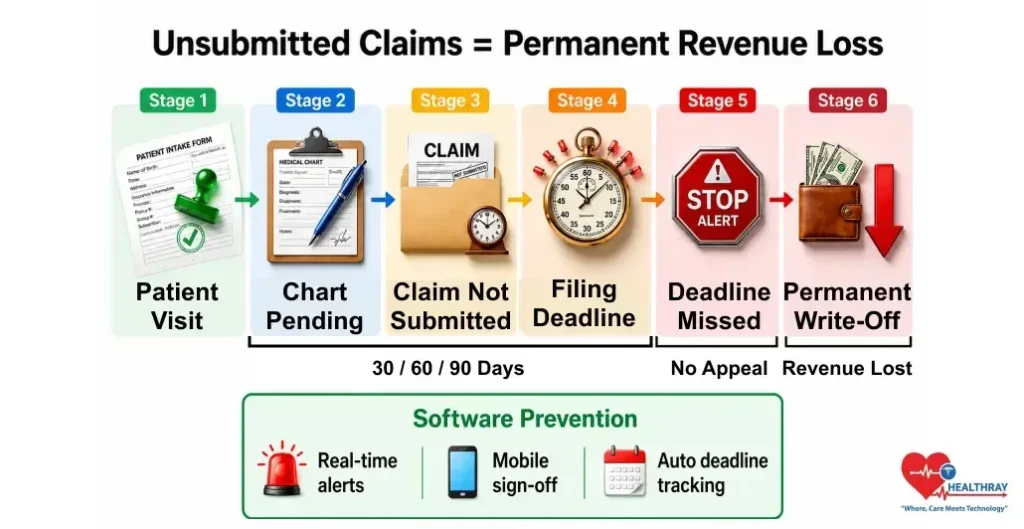
Mistake 3: Sitting On Unsubmitted Claims Causes Missed Deadlines
Error Cost Calculator
Formula: Permanent Write-Off = Unsubmitted Claims × % Aged Past Filing Deadline × Average Claim Value
- India (INR): 180 unsubmitted claims × 12% aged past deadline × ₹6,000 avg = ₹1,29,600 – ₹2,60,000 written off/month
- Global (USD): 150 unsubmitted claims × 10% aged past deadline × $180 avg = $1,800 – $3,100 per provider/month
Insight: Loss of income through non-submission of claims after filing deadlines is an unnecessary write-off that has major effects on clinic operations.
Operational Metric Impact
Consequently, irretrievable write-offs increase your Adjusted Collection Rate in a negative direction, causing income to be lost permanently without any possibility of appeal, regardless of the initial claim’s accuracy.
Timely Filing Problem
Meanwhile, the insurance payer does not immediately process the claim. It remains stuck in the system because physicians fall behind on signing off the charts. Consequently, by the time the claims are ready for submission, they exceed the 60-, 90-, or 180-day timely filing window.
This is not a case of delayed payment; it is a legally uncollectible write-off with no path of appeal. What makes it even more frustrating is that this isn’t about earning the revenue it’s purely an administrative issue, even though the services were properly earned and coded. A mobile app for clinic software can help alleviate this problem by allowing physicians to review and sign charts on the go, ensuring claims are submitted promptly and reducing the risk of uncollectible write-offs.
Exact Software Prevents Errors
An Algorithmic Claim Deadline Monitor. The top-of-the-line clinic billing software determines the burn rate in real time of each aging claim that hasn’t been submitted and alerts the appropriate administrative person when the claim is about to expire and close.
 PRO TIP
Mistake 4: Ignoring Confusing Insurance Rejection Codes Creates Gaps
Error Cost Calculator
Formula: Unrecovered Revenue = Total Monthly Denials × % Left Unworked × Average Denied Claim Value
- India (INR): 120 denials/month × 40% left unworked × ₹7,700 avg denied claim = ₹3,69,600 – ₹5,80,000 per month
- Global (USD): 90 denials/month × 38% left unworked × $165 avg denied claim = $4,500 – $7,000 per provider/month
Insight: Unaddressed denials will lead to substantial revenue loss, underlining the need for an effective denial management process.
Operational Metric Impact
As a result, denied claims reduce your First Pass Clean Claim Rate and create an overwhelming volume of backend work that the billing team cannot keep up with manually.
Denied Claims Problem
These consistently prove to be the biggest loss of revenues in all clinics. In cases where a claim comes back with the obscure CARC and RARC errors, the busy billing team will always choose to work on the easiest denials and ignore the difficult ones. This backlog builds up secretly till the time to file an appeal elapses, and hence, makes the revenue unrecoverable. Below are some of the four types of the most ignored denial codes:
| CODE | ROOT CAUSE | REVENUE RISK |
| CARC 4 | Incorrect payer billingat intake | High – resubmission isneeded |
| CARC 16 | Insufficient demographicdata entry | Medium – correctible when identified |
| CARC 97 | Not verified for NCCI edits before submission | High – not payable, only appeal option |
| RARC N30 | Inconsistent subscriber identification on check-in | Critical – requires immediate attention |
Notably, the RARC N30 directly links to earlier errors, and because the six mistakes interconnect, no single mistake alone can account for the total monthly revenue loss.
Exact Software Prevents Errors
With a Centralized Denial Management Workflow, the latest clinic billing software automatically performs Root Cause Analysis for each remittance report, transforming denial codes into organized appeals that can be clicked through immediately. As a result, staff no longer cherry-pick claims and can work from the most valuable down to the most urgent every day.
Mistake 5: Mailing Old-Fashioned Paper Bills Drives Up Bad Debt
Error Cost Calculator
Formula: Effective Monthly Loss = Total Patient AR × % Unpaid Past 60 Days × Recovery Rate Drop
- India (INR): ₹8,00,000 patient AR × 24% unpaid past 60 days × 83% avg recovery drop = ₹1,60,000 – ₹2,90,000 per month
- Global (USD): $60,000 patient AR × 22% unpaid past 60 days × recovery drop = $2,000 – $3,500 per provider/month
Insight: The later the delay in collecting balances from patients, the lower the amounts recovered, which makes it important to act promptly on collection matters.
Operational Metric Impact
It raises your Bad Debt Expense ratio and undermines the financial transparency of your patients. Both of these negative consequences affect your bottom line and patient retention rate.
Patient Collection Problem
Once the insurance amount due is paid, the outstanding balance still needs to be collected. However, clinics often delay to send invoices, which can take several weeks if done manually. Accounts remaining unpaid for more than 60 days see a significantly lower recovery rate.
Most bills are classified as bad debt by the time a second reminder is sent. A modern clinic system tracks every payment automatically, giving staff a clear view of which invoices are settled and which require follow-up, helping prevent revenue from being lost unnecessarily. Automated billing and digital reminders help clinics issue invoices promptly and improve overall collection rates.
Moreover, this mistake stands out as the only one not tied to complicated insurance, coding, or any payer-related factor. It’s all under your control, yet costs you an average of Rs. 1,60,000 to Rs. 2,90,000 each month!
Exact Software Prevents Errors
Omnichannel Patient Portal Integration. State-of-the-art clinic billing software offers tokenized Card-on-File processing, automatic SMS text-to-pay functionality, and immediate payment plan generation whenever there is an Explanation of Benefits posting. Consequently, streamlining the payment system speeds up payments and reduces debt defaults.
Mistake 6: Running A Practice Without Metrics Costs Revenue
Error Cost Calculator
Formula: Total Loss Over Time = Annual Gross Revenue × Silent Net Collection Leakage Rate × Compounding Factor
- India (INR): ₹4,00,00,000 gross revenue × 4% leakage = ₹16,00,000 lost per year
Over 3 years: ₹16,00,000 × 3.12 compounding factor = ₹49,92,000 cumulative loss - Global (USD): $800,000 gross revenue × 4% leakage = $32,000 lost per year
Over 3 years: $32,000 × 3.12 compounding factor = $99,840 cumulative loss per provider
Insight: The smallest inefficiencies in continuous data gathering can compound to produce substantial revenue losses over many years.
Operational Metric Impact
Blinds executive leadership to changing payer behavior, underpayment by contract, and provider leakage. Makes it impossible to see systemic revenue losses until the problem is so big that even restructuring will not be able to fix it.
Leadership Oversight Problem
All these mistakes mentioned above occur due to an inability to identify another blind spot that exists throughout the entire system: the assessment of the quality of practice operations by using monthly revenues.
Mistake number 6 enables Mistakes 1-5 to continue unnoticed. The lack of financial monitoring capability means that a medical practice may be making all five mistakes simultaneously at any given moment. Even with good gross income, the practice may not notice its net collection rate has been dropping for a year.
Exact Software Prevents Errors
A Real-Time Financial Analytics Dashboard. Clinic billing software allows tracking of the Net Collection Ratio, Accounts Receivable aging by payer, leakage at the individual physician level, and workflow speeds in real time. Recent clinic software trends emphasize dashboards and analytics, enabling practices to detect potential revenue leaks early. Seeing everything going right helps management spot issues before they become long-term problems.
Learn more: Telehealth-Enabled Clinic Software: Where Remote Care and In-Person Visits Meet, integrating telehealth to capture both in-person and virtual visits accurately while preventing the six revenue drains.
Final Verdict: End All Six Billing Errors Instantly With One System
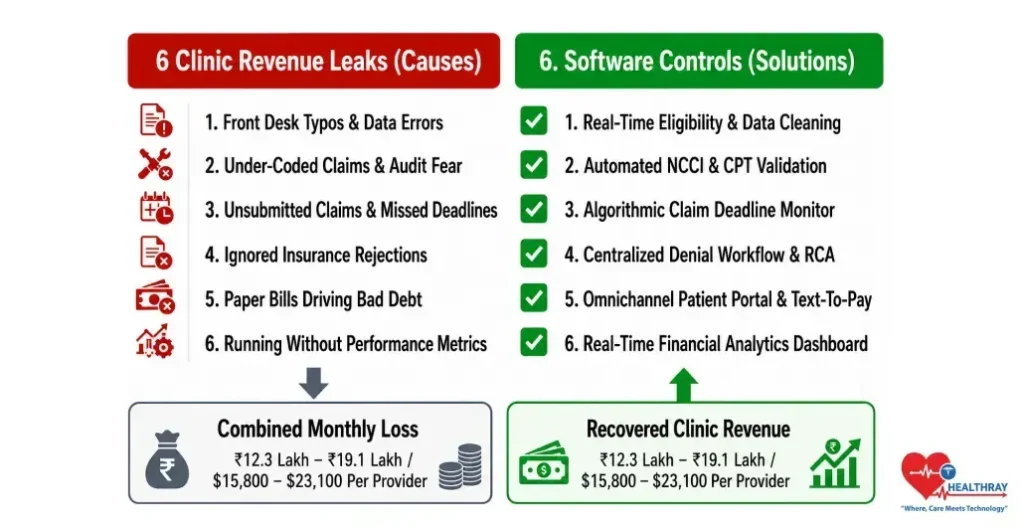
Ultimately, six billing errors lead to six concrete monthly losses, all stemming from one major issue – revenue cycle processes performed manually without automation to prevent mistakes from turning into bad debt. The math is straightforward enough: at its lowest, the loss stands at Rs. 12,30,000 monthly. At its highest, it’s above Rs. 19,00,000 a month. In dollars, providers lose $15,800–$23,100 monthly, all preventable with the right clinic billing software.
In fact, the processes that consistently outperform the competition in collections rely not on having the largest billing staff or the best-trained coders, but on their automation and workflow efficiency. What sets them apart is their automation processes – processes which take place every hour of every day – starting from front desk data entry all the way to receipt of patient payments. Every single step in the process either has a control or an open drain attached to it. There is nothing else.
With at least Rs. 12,30,000 monthly drain rate, each and every single month that goes by without adequate controls installed translates into actual monetary loss. The right medical billing software infrastructure can pay for itself even before the next billing cycle starts.