


In This Blog
Everything you need to understand about how recurring doctor appointment scheduling directly tackles the compliance crisis, breaks the cycle of missed follow-ups, and reduces the long-term burden of living with a chronic condition:
- Chronic disease patients worldwide are losing the health battle not in hospitals but in the gaps between doctor visits.
- What makes a compliant patient suddenly stop showing up for follow-ups?
- How does one missed appointment silently set off a chain reaction of worsening complications?
- Why does willpower-based compliance always fail chronic care patients in the long run?
- How does building a recurring visit rhythm directly reduce the physical burden of living with a chronic condition?
Why Chronic Disease Patients Keep Missing Their Doctor Visits
It is not the issue of awareness. The majority of patients who are chronically ill understand that they have to visit doctors on a regular basis. But life, tiredness, budgets and the I feel fine today attitude silently relegate follow-ups to the back burner.
Firstly, the very cognitive burden of living with a chronic condition is draining. Patients are on medications, self monitoring, dietary limitations, and work, all at the same time. When a follow-up visit is to be made, one has the feeling that to make a follow-up visit would be an added burden.
Moreover, a doctor appointment system that depends on the patient to initiate every visit puts the entire compliance burden on the most fatigued person in the room. This structure fails chronically ill patients by design.
There is also the “low urgency trap. In between the symptoms, the patients feel comparatively stable. This causes them to postpone visits not knowing that silent damage is building up in blood vessels, kidneys, joints and the heart. Research confirms that between 50–60% of chronic disease patients show poor treatment adherence and 30% of hospital admissions globally trace directly back to that compliance gap.
 NOTE
NOTE
What Missed Appointments Actually Cost Disease by Disease
Inconsistent follow-ups not only slows down treatment but actually increases disease burden. Moreover, one missed appointment may produce a ripple effect, without creating any noise. A single uncontrolled lab result, results in a delayed change in medication, which helps the complications to progress beyond the next visit even taking place. Imagine what this would appear to be on a condition by condition basis:
- Diabetes: Due to the irregular visits, there will be no timely adjustments of the medication. Unchecked blood sugar silently affects nerves, kidneys and eyes – typically before the patient can tell something is wrong.
- Hypertension: When the patient does not check their BP regularly, small increases and decreases are not corrected. In the long term, this puts the actual risk of stroke, heart failure, and target organ damage.
- Hypothyroidism: TSH levels are changing according to the body changes, stress and seasons. Lack of consistent monitoring would result in inconsistent levels of hormones leading to fatigue, weight gain and metabolic disruption which patients will often attribute to other causes.
- Arthritis: Joint destruction in inflammatory arthritis does not go away between visits. Unregular reviews enable the destruction to advance quicker, raising pain, deformity, and long-term loss of mobility.
The similarity in each of these conditions is the fact that lack of a structured follow-up rhythm will cause patients to lose track of active care management.
A strong no-show policy at the clinic level helps reduce missed appointments, but it works best when paired with proactive scheduling systems that reduce the patient’s burden of rebooking.
How Recurring Doctor Appointment Scheduling Solves the Compliance Problem
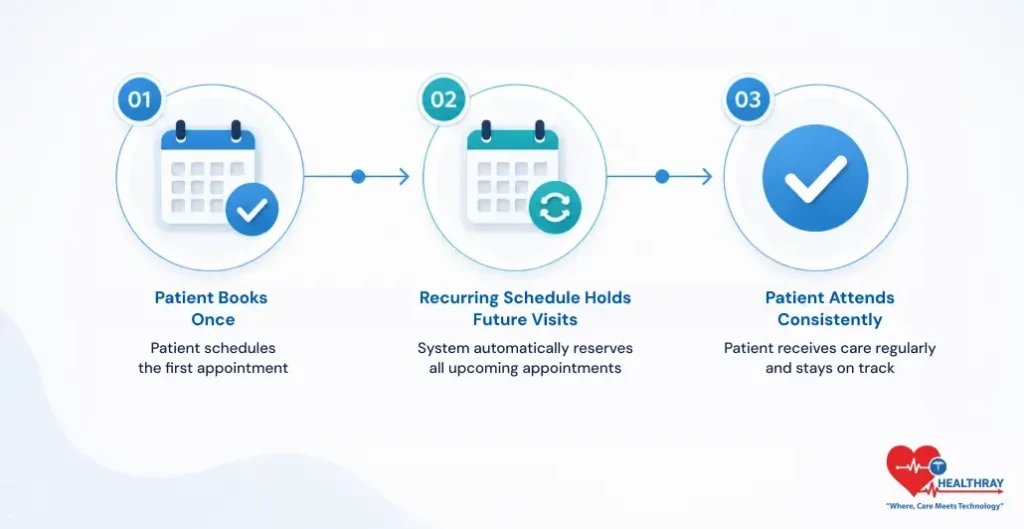
Compliance is not met when it is reliant on will power and memory. Recurring doctor appointment scheduling eliminates such dependency altogether. Rather than reminding a diabetic patient to schedule his/her next review in three months, a recurring schedule pre-sets that visit automatically. Decision-making is not left to the patient, the system retains the structure.
This change is psychologically as much a matter of logistics as it is a matter of logistics itself. The fact that the next visit is already confirmed lowers the low-grade anxiety that chronic patients have about their treatment. It substitutes such anxiety with predictability. Moreover, it makes follow-up an automatic habit rather than a conscious decision: much more likely to be sustained in the long-term as a means of compliance than will power alone.
Every condition will require its own rhythm of visits depending on what is clinically required by the disease:
- Diabetes: Quarterly visits for medication review, with lab draws completed before each appointment
- Hypertension: Monthly check-ins during BP titration, then quarterly once readings stabilise
- Hypothyroidism: TSH is monitored every 3-6 months, based on the stability of the hormone
- Arthritis: Scheduled bi-monthly inflammation assessments and joint mobility reviews to manage progressive flare-ups.
Such disease-specific scheduling can be handled by medical scheduling tools, which ensures that patients never get caught between one appointment and the next.
 PRO TIP
The Real-World Impact on Disease Burden
When the patients have regular recurring visits, there is a measurable change in the clinical outcomes. Tighter-controlled diabetes implies lower average HbA1c, less risk of dialysis and slower development of neuropathy. Stable management of hypertension implies a reduced number of strokes and much less heart damage after a decade of care.
Also, regular follow-ups lower the rate of hospitalisation. An automated appointment reminders for doctors that sends automated reminders and maintains recurring slots actively reduces the emergency admissions that come from unmanaged chronic disease gaps..
The standard of everyday living is also raised, not by leaps and bounds in one day, but gradually over a period of time. Energy returns. Mobility holds. Stability in the metabolism enables improved sleep, mood and day to day activities.
Overall, recurring doctor appointment scheduling does not merely safeguard the health outcomes. It protects the patient’s daily life from the slow erosion that poorly managed chronic disease causes.
Making Recurring Appointments Work Practical Compliance Strategies

One thing is to organize a recurring schedule. Another is its maintenance. The difference that truly occurs in actual chronic care settings is as follows:
- Match frequency to disease reality. An unstable hypertensive patient requires monthly check-ups. Only a quarterly check-in may be necessary to maintain a stable, well-controlled patient. Frequency must mirror existing disease control, not a calendar date in general.
- Bring family into the loop. For elderly patients especially, involving a family member in the scheduling process significantly improves adherence. A common notification or a shared reservation makes it less likely that the appointments are silently missed.
- Connect appointments to visible progress. Displaying a patient with his or her HbA1c pattern progressing steadily over six consecutive visits is much more encouraging than any standard health information. Equally, a sustained BP level of over three months provides a hypertensive patient with a tangible rationale to continue showing up.
- Re-engage patients who have lapsed. Gentle outreach – a call or message acknowledging the gap without blame that brings many patients back into their follow-up rhythm. Doctor availability management software solutions now support automated re-engagement workflows that make this scalable across large patient volumes.
Removing the Barriers That Break Compliance
Despite the presence of the best scheduling structure, there are always some obstacles that take chronic patients out of their follow-up rhythm. It is necessary to directly address them.
- “I feel fine right now.” This is the most common reason patients skip visits. The answer is clear education, helping patients understand that chronic disease damage accumulates silently. Feeling fine does not mean things are stable internally.
- “Treatment fatigue.” Patients who have been in long-term care usually become demoralized over time. When they see some tangible improvement in the form of consistent data, constant readings, a lessening number of symptoms, a decrease in medication dosages, etc., they will have a tangible reason to keep showing up.
- “Cost concerns.” Most patients believe that the more visits a patient has, the more the total costs. The real world experience is that regular preventive care will reduce the lifetime disease burden and the much greater cost of emergency treatment, hospitalisation, and treatment of severe complications.
- “Scheduling friction.” When rebooking requires effort, patients with treatment fatigue simply do not do it. A doctor appointment system that handles recurrence automatically removes the booking effort from the patient entirely and that single change often makes the difference between a patient who stays in care and one who quietly drops out.
Learn more: How a Doctor Appointment Calendar System Eliminates Scheduling Chaos because when scheduling friction disappears, the only thing standing between a chronic patient and their next visit is the appointment itself and that is exactly how it should be.
To Sum Up: Why Recurring Doctor Appointment Scheduling Cannot Wait
Most chronic disease burden in the world is not due to poor treatment but rather due to poor compliance. Recurring schedules of doctor appointments directly addresses this by removing the memory, motivation, and logistics barriers that silently break follow-up habits.
For patients managing diabetes, hypertension, heart disease, hypothyroidism, or arthritis, consistent scheduled visits are not optional. As they are the most controllable factor in preventing disease progression and safeguarding long-term quality of life.
Commit to recurring doctor appointment scheduling today because chronic disease does not wait, and neither should your next visit.