

In This Blog
All you need to know to assess a medical scheduling tools before making a purchase:
- How do most practices end up with the wrong scheduling system and how to avoid it?
- A four-step decision framework to eliminate bias from your vendor selection
- A weighted scoring model to objectively evaluate each option
- Practical ways to stress test vendors before making a final decision
- Who must be involved in the scoring process and why excluding anyone can cost you?
Why Most Clinics Choose The Wrong Scheduling System
Unfortunately, this is the harsh reality: most clinics don’t have a software problem; they have a decision-making problem.
The marketplace is brimming with excellent healthcare scheduling software solutions. From a modern doctor appointment system to online booking tools and patient scheduling software, there are plenty of viable choices. However, the problem is that clinics tend to review them using the same flawed methodology every single time.
Remember the last time you bought new clinic software? You went through a polished demo filled with terms like “seamless integration” and “end-to-end automation” and felt confident. But within three months, front desk staff were dealing with workarounds, EHRs weren’t syncing properly, and the “intuitive” booking flow still took six clicks just to reschedule an appointment.
Here is why making such a selection is so expensive. According to research published by the National Institutes of Health, the implementation of the appropriate system for scheduling patients can help health care organizations reduce their labor expenses, increase customer satisfaction, and minimize no-shows. This is not a technology issue – it’s a business decision shaped by financial consequences. These patterns consistently lead to three wrong decision-making choices.
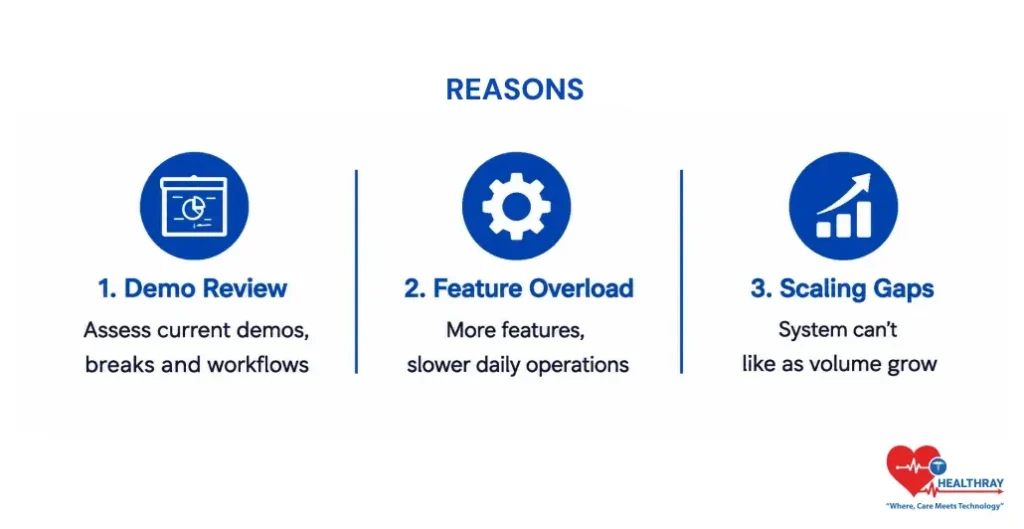
Demonstration Trap: Sales demos rarely show real-world scheduling conflicts such as shared resources or sudden cancellations.
Feature Fallacy: Feature-heavy systems often hide clunky workflows, hidden costs tied to pricing, and slower daily operations.
Silent Scale Risk: Single-practitioner systems often fail to scale across locations or higher patient volumes without proper design.
 NOTE
NOTE
The Decision Framework – Your 4-Step Plan For An Objective Choice
Picking the right medical scheduling tools for your clinic shouldn’t feel like a guessing game or a political struggle. This structured four-step approach turns the process into a clear, repeatable system your entire team can follow and confidently support.
Step 1: Figure out what you are really like to work with, not what you wish you could be based on marketing materials.
Step 2: Prioritize your list by weighting your preferences as percentages prior to talking to anyone who makes the software.
Step 3: Rate each candidate on a 1 to 5 scale to ensure fairness for all candidates.
Step 4: Take the highest rated candidate through a series of stress tests before committing to anything.
The three physicians in a recent family practice in the Midwest utilized the same model, weeding out four of their six finalists before completing the first demo. One of the systems had a resource conflict, while two had a concealed manual sync problem. The last system attempted to avoid signing a Business Associate Agreement by stalling the process. The scoring framework turned what seemed like the longest shortlist into the quickest decision yet.
Step 1 – Building The Evaluation Criteria For Medical Scheduling Tools
There must be no uncertainty regarding deal-breakers even before the first vendor call. Four cornerstones determine whether the appointment booking system will withstand your practice environment, rather than being able to perform well during its best demonstration conditions only.
Operational Fit: Is the application capable of managing your particular rules of scheduling? Room reservations, equipment sharing, provider blocks, automated wait list management – if it fails to prevent two doctors from booking the same procedure room at the same time, you may be already wasting your money.
Workflow Compatibility: It takes how many mouse clicks to book a follow-up appointment, cancel a previously booked appointment, or schedule a walk-in appointment when using your existing front desk interface? Anything beyond three clicks will result in staff developing their own workaround for the task within weeks. The actual “system” created is non-compliant and not supported by the vendor.
Integration Depth: Data exchange between systems should support real-time, two-way synchronization to maintain accuracy and consistency across clinic operations. A product that only supports data exchange from the patient records application to the scheduling system leaves room for serious issues with data integrity, especially when using doctor availability management software that depends on up-to-date scheduling information.
Compliance and Risk Control: The HIPAA Security Rule provides a national standard for security to safeguard certain health information when it is created, received, maintained, or transmitted in electronic form. And your appointment scheduling system falls under this legal purview. If there are any reservations, conditions, or requests from the software vendor for a Business Associate Agreement or an invitation to revisit it after implementation, it poses a significant compliance risk that you cannot ignore.
Step 2 – The Weighted Scoring Matrix For Medical Scheduling Tools
All criteria do not carry the same importance for every medical center. The urgent care center with a large volume of patients has different considerations from the specialty medical center with only two physicians. Fix the weight of the criteria within the team even before you evaluate one vendor pitch deck. Changing the weight midway through the evaluation process is bias itself.
| EVALUATION PILLAR | WEIGHT | SCORE (1–5) | MAX POINTS | WHAT IT ACTUALLY TESTS |
| Operational Fit | 30% | 1–5 | 30 pts | Resource clashes, multisupplier approach, wait list management |
| Workflow Compatibility | 25% | 1–5 | 25 pts | Appointment scheduling speed, appointment re-scheduling process, |
| Integration Depth | 25% | 1–5 | 25 pts | Two-way EHR data transfer, API efficiency, ability to recover from errors |
| Compliance & Risk | 20% | 1–5 | 20 pts | HIPAA compliance, BAA preparedness, audit trail capability, data encryption |
| TOTAL | 100% | – | 100 pts | 85+ proceed · Below 70 reject |
The scoring system uses this formula for each category: score (1–5) multiplied by its weight percentage, then summed across all four categories. A tool that scores 5 in Operational Fit but only 2 in Integration Depth is not balanced. It is a risky investment in a well-packaged shell.
Step 3 – How To Score Medical Scheduling Tools Objectively
However, the greatest challenge for the validity of your overall review is neither a problematic vendor nor the presence of poor quality tools, but confirmation bias on behalf of your team members. And here is what you need to do to make sure the evaluation process remains focused on the evidence and is unbiased from the personality point of view.
Scoring 1–5 Rubric in Practice: Score 1 if the feature creates more hassle than benefits for the user. Score 5 only if the tool seems to have been created specifically for your clinic, rather than for all healthcare facilities alike. Otherwise, 2 through 4 is the normal scoring range.
Evaluation Calibration Rule: Your team cannot have used the feature you’re evaluating on live patient data in a staging or production environment, so it receives a more conservative score – maximum 3 points – regardless of how convincing the sales representative’s demonstration may be. When assigning scores, factors such as doctor queue management software capabilities should also be considered; however, demos conducted by vendors using sample data are marketing materials, not evaluations, and should be treated separately.
Eliminating Evaluation Bias: Root all scores in one metric: clinical friction. Measure it as the degree of increased workload introduced by the tool. A fancy dashboard that still relies on CSV files exported by hand to sync up with your EHR does not get a 4/5 score, even though it looks like a masterpiece. It deserves a 2 for a high-end interface.
 PRO TIP
Step 4 – Stress Testing Medical Scheduling Tools In Real Scenarios
Your matrix helps you identify which software would theoretically be the most efficient. Your stress test lets you know whether it stands up to the stresses that your Monday morning can throw at it. In real-world use, many clinics discover that even a well-scored system fails when the underlying OPD appointment management system cannot handle unpredictable patient flow or sudden schedule changes. Put each one through its paces before you sign any contract!
Peak Load Test: Try booking 50 people for an appointment all at once. Is it a peak time in your facility because of a flu outbreak or vaccine drive or notification of some other issue? Does the scheduling software queue the appointments successfully, or generate errors and duplicates, leaving you to clean up manually?
Learn more: The Silent Assistant: How Automated Appointment Reminders for Doctors Run Clinic on Time helps clinics reduce no-shows, keep schedules organized, and improve daily operational flow.
Shared Resource Test: Put two providers into the same appointment room at the same time, see what happens. Does your booking system automatically disallow this and raise an alert in real time, or does it allow both bookings, leaving it up to your administrator to catch the clash at 8:55 AM?
System Recovery Test: Set up a situation where, at 7:00 AM, one of your providers calls in sick, causing an urgent need for rescheduling all the Tuesday appointments that day. This is when you test how long it will take for your staff to do the rescheduling properly, by only using your booking tool.
Sync Failure Test: Disconnect the EHR API for 10 minutes and observe the system. A reliable practice management system queues changes and syncs them once the connection is restored, while an unreliable one may cause missing front-desk data that goes unnoticed until the patient returns.
Interpreting The Scoring Matrix Results To Find The Best Solution
When all calculations are completed, the highest scoring bidder normally stands out clearly. Regardless of the results of these two criteria, however, use them always. The average can mask a serious mistake.
Score Thresholds: A score of 85 or higher is a firm, decisive winner. Negotiate the contract. A score of less than 70 is a very risky decision even if the demonstration was impressive. Rescind the short list now.
Veto Rule: Any tool that gets a 1 score on either Compliance and Risk or Integration Depth is automatically vetoed from selection. End of discussion. Nothing will save a product that has failed on a critical attribute like this. This flaw will only get worse as it is used more and more frequently.
Tie-Breaker Rule: In the event two products end up within three points of each other, select the higher-scoring Integration Depth tool. Poor integration has proven to be by far the leading cause of unnecessary labor costs, potential legal exposure, and employee burnout with the use of clinic scheduling software. Picking the more integrated solution will virtually always pay off in the long run, even if the other solution was slightly more intuitive at first glance.
Who Should Be Involved In Finalizing Medical Scheduling Tools

A software decision made by people who will not use it lacks the right inputs. Every well-run software evaluation has three roles, each offering unique insight the others cannot provide.
Front Desk Staff: Provides your reality check. The front desk staff uses the patient scheduling software for forty hours a week. Their friction score – how much the software slows them down during their normal workflow – is the most reliable data point in your evaluation process, and it is often ignored.
Practice Manager: Ensures that the evaluation remains firmly based on actual KPIs such as cost per booking, rebooking frequency, and no-show rates, and does not get lost in preference-based discussions about functionality. They stand guard between how the solution looks and what it delivers.
IT or EHR Administrator: Is the only one capable of objectively validating claims about integration depth. Unless they are certain that the API handshake between the scheduling platform and the existing EHR system works reliably, the rating cannot be considered valid.
To Sum Up: Why The Right Framework Matters For Your Clinic
The reason most implementations fail is not because there’s no software available; rather, it’s because of bad decision making. Selecting on the basis of demonstrations and feature sets causes employee exhaustion, workflow problems, and operational drag.
Using an evaluation process corrects this problem. The scoring matrix allows you to objectively compare options, eliminating bias from the equation.
Implement the process, score the alternatives, and validate the choice before moving forward.