


In This Blog,
A clinic appointment system is the silent friend that makes a busy clinic day flow smoothly. So here is what actually makes a difference when the system is strong compared to when it is weak:
- High-performing clinics run on a strong clinic appointment system, not just a busy team.
- The true distinction comes by the hour in the work performed daily, and not just in the one-time recommendation reports.
- A clinic appointment is the engine behind every successful patient visit.
- The blog walks through a full day from 8 AM to 6 PM to show this in action.
- An hour depends on one simple step of the system; it all falls apart when missing.
- It is often the case that the difference between a clinic that struggles and one that performs well can be attributed to the appointment system.
What ‘High-Performing’ Actually Means in a Clinic Context
People often use the term “high-performing” without clearly defining it. In a clinic context, it is not the busiest clinic (you won’t get higher throughput than Bupa if we start charging by the minute), not the most expensive, or the one with the longest patient list. Instead, it’s the clinic that ‘feels predictable, the one where patients come prepared, queues flow seamlessly, staff aren’t fighting fires all over the place, and the day isn’t wrapped up with a 45-minute manual catch-up. The doctor appointment system is the backbone of all this.
1. The Metrics That Separate High-Performing Clinics From Average Ones
In fact, the system differences between high-performing and average clinics exist in 5 directly measurable metrics: no-show rate, average client wait time, call volume at the front desk, number of double bookings, and end-of-day reconciliation time. High-performing clinics improve on all five metrics. It’s not because of the exceptional staff, but their systems block factors that bring them down.
2. Why Most Clinics Mistake Busyness for Performance
A completely booked waiting room appears from the outside to be presenting a show. Inside, it very often conveys the message that behind the scenes is a scheduling system that won’t spread the load, a line that offers no intelligent management, and a clerk team wasting energy not coordinating with patients but wrangling them. Clinics create chaos when they operate without a structured plan. This is why the highest performing clinics tend to be completely still at the landing zone.
3. The Role a Clinic Appointment System Plays in Each Metric
Every metric directly correlates to a system function. No-show rate correlates to reminder automation and waitlist recovery. Wait time correlates to slot capping and queue rebalancing. Call volume correlates with self-scheduling and digital intake. Double bookings correlate to real-time conflict detection. End-of-day reconciliation correlates to automated logging. When any of these system functions is unavailable, the associated metric decreases consistently and predictably.
The Morning Window: 8 AM to 11 AM
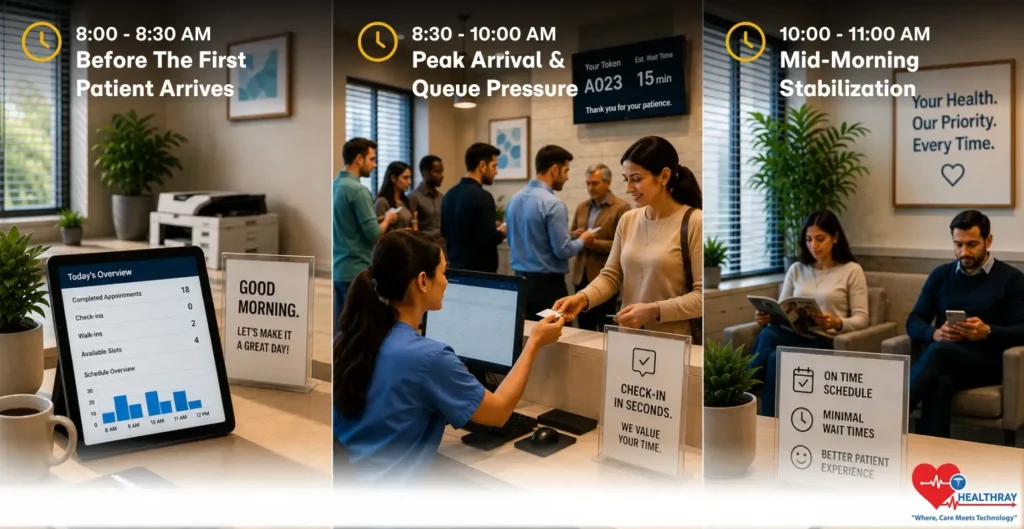
The morning window is where the day is either built or torn down. In a high-performing clinic, the first three hours of the day proceed according to the structure of the doctor appointment system built the previous night. Meanwhile, in average clinics, that structure is built manually under duress, with patients already waiting to go.
1. 8:00 to 8:30 AM: Before the First Patient Arrives
By the time the front desk takes its seat, the system has already identified the patients’ files, brought up the unconfirmed reservations for review, computed walk-in opportunities, and created a real-time dashboard view of the day ahead. The day starts with a clear picture, not a blank slate.
2. 8:30 to 10:00 AM: Peak Arrival and Queue Pressure
This is the pressure window. An average clinic: a line at the front desk, an overflowing waiting room, and everyone on staff simultaneously answering phones, managing tokens, and entering data. A high-performance clinic pre-registered patients check in in seconds, walk-in patients are given an SMS indicating wait time and a new digital token, while staff are busy coordinating and not crowd controlling.
3. 10:00 to 11:00 AM: Mid-Morning Stabilisation or Cascading Chaos
By 10 AM, the two clinic types have diverged. In a high-performing clinic, the queue moves smoothly, and all delays are taken up by the dynamic re-balancing. whereas in an average clinic, the 9 am spike is still collecting backlog, and non scheduled event affects rest of the morning because there is no planner to absorb the impact.
Learn more: Morning queues and schedule delays rarely start at the front desk. Most of them begin earlier in the booking process itself. What Clinic Managers Need to Know About Patient Appointment Booking App breaks down how appointment handling impacts patient flow across the entire clinic day.
The Midday Reset: 11 AM to 2 PM
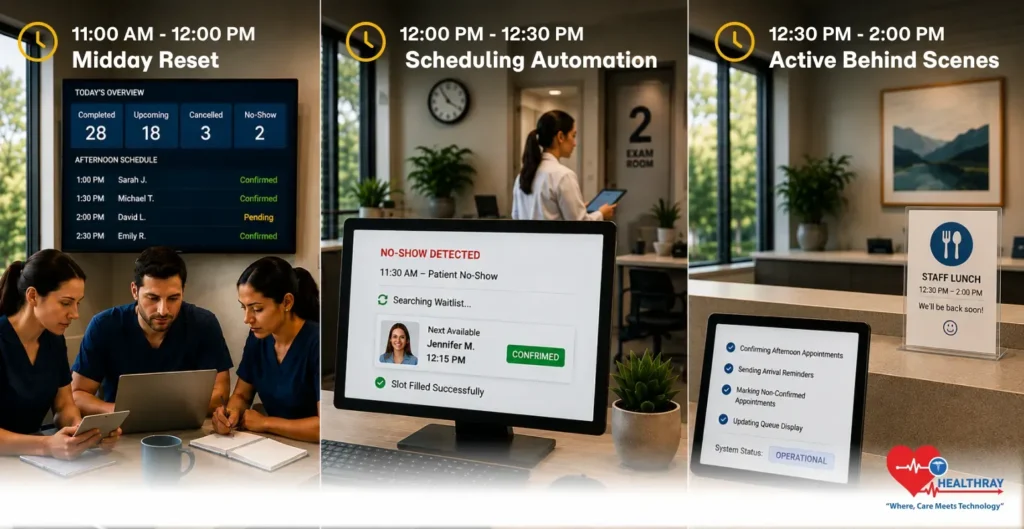
The midday slot is the most under-utilised slot in most clinics and perhaps the most valuable in high performers. High performers don’t merely drift through this time; they take stock, switch mode, and prepare effectively for the afternoon.
1. How High-Performing Clinics Use the Midday Window Differently
On the other hand, in an average clinic, midday is the time when the staff take a breath and do the manual work of entering the morning notes. In a high-performing clinic, the medical appointment program has already taken care of all of that. The staff spends time during midday considering tasks that are still requiring decisions: follow-up calls, scheduling discussions with specialists, insurance authorizations, and pre-planning the afternoon visits.
2. Automating Smart Scheduling to Recover No-Shows
All clinics have a no-show. What differentiates high-performing clinics from others is what happens next. As soon as they have a no-show, an automated wait list scan is initiated immediately. As a result, the first patient who is ready to come in is informed within minutes. If he agrees, the slot is filled before the doctor even finishes his treatment with the previous patient. Slot recovery runs without a single staff phone call.
3. What the System Is Doing While Staff Take a Break
In the period 12:30 pm to 2:00 pm, while the staff are on lunch, the system is confirming bookings for the afternoon, reminding people who have arrived, marking non-confirmed appointments, and updating the queue display. The clinic remains operational but unattended at the reception.
 NOTE
NOTE
The Afternoon Run: 2 PM to 6 PM
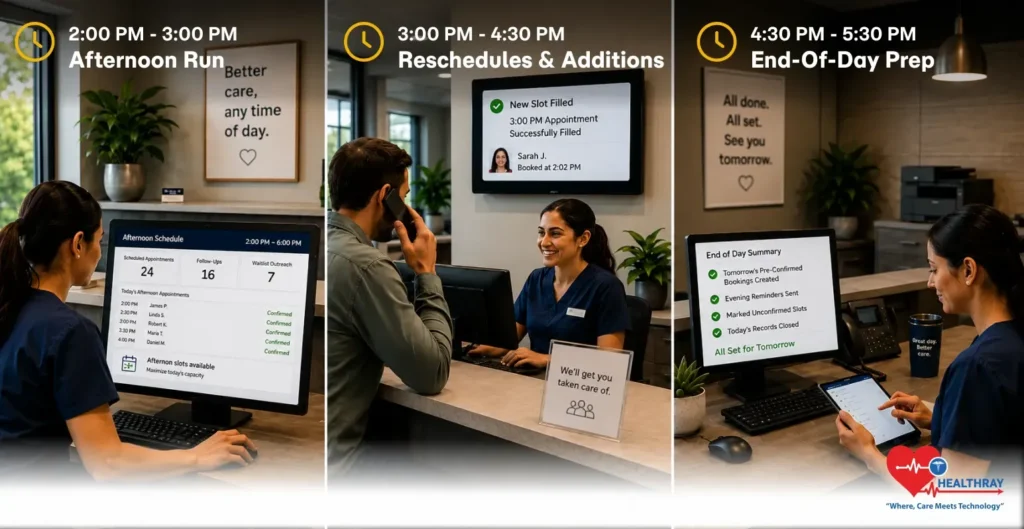
The afternoon plays out differently; fewer walk-in patients, more scheduled follow-ups, and different types of patients. High-performing clinics treat it as a separate scheduling environment. The doctors appointment system adapts accordingly.
1. Afternoon Booking Patterns: Why This Window Is Underutilised
The rest of the day is generally booked only lightly, partly out of habit and partly because patients are accustomed to thinking of the morning as the more urgent time frame. Successful practices are aggressively shifting demand into the afternoon, proactively contacting waitlisted patients, offering time in the afternoon during the same day for those patients who have overflowed into the morning, and reserving the time for established follow-ups. An effective tool will make this available.
2. How the System Handles Late Reschedules and Same-Day Additions
For the patient who calls at 1:30 and reschedules their 3 PM appointment, the same auto-recovery process occurs as in a morning no-show at a high-performing clinic. The system books the alternate patient before the original caller hangs up.
3. End-of-Day Prep: What a High-Performing Clinic Looks Like at 5:30 PM
By 5:30 pm, the system has already created tomorrow’s pre-confirmed booking list, sent the evening reminders, marked on unconfirmed slots, and has already closed the attendance record for today. Staff go home exactly on time. No 45-min reconciliation. Tomorrow is already organized before the team goes home.
The Compounding Effect of System Performance Over Time
The hourly breakdown, however, tells us what a system of one-day clinic appointments would feel like; it does not tell us how the effect of this day-to-day would snowball into weeks and months.
1. Patient Trust Is Built in Micro-Moments, Not Grand Gestures
Patients judge clinics by how smooth the appointment experience feels, how frictionless the booking experience was (if you had to wait and were told so – how), every time a reminder was sent on time, every time you received a queue update, every time your appointment was smoothly rescheduled, those micro-moments add up. Systems can consistently produce these effects; humans cannot.
2. Staff Retention and the Hidden Cost of System Failures
Manual clinics have a constant front desk attrition. Calling phone queues, editing paper waitlists, manual billing and ID reconciliation, and dealing with patient complaints all wear down staff; most of it is unnecessary. The best clinics keep staff longer as this drudgery is reduced. A clinic booking system that saves at-risk daily frustrations will keep your staff.
3. How Operational Consistency Becomes a Clinic’s Competitive Advantage
In a competitive market, operational consistency becomes a differentiating factor. An operationally well-functioning clinic that is punctual, communicative, and simple to book will retain patients and earn referrals that an excellent clinically clinic that is operationally chaotic will not. The system ensures that consistency is reproducible, not dependent on any person’s effort on a particular day. Also, clinics invest in good SEO services so patients can find them, and smart systems ensure that once they do find them, they stay on schedule.
 PRO TIP
Conclusion
A clinic appointment system is the engine behind a smooth clinic day. It sets up the schedule before opening, manages morning queues, fills empty midday slots, and closes the day so tomorrow is ready. The gap between an average clinic and a high-performing one is not talent but the strength of this system and how reliably it keeps operations on track.