


In This Blog
Everything your medical practice should know about patient scheduling – before losing patients becomes an issue:
- Why patients rate your clinic during the booking process, not when they get to their beds
- How patient appointment booking software reveals unseen operational inefficiencies
- The clear connection between booking hassle and financial loss
- The real meaning behind the patient data in your booking system
- Why hassle-free access has become the ultimate patient retention strategy
Patients Start Judging Your Clinic Before They Ever Visit
The patient appointment booking app of a clinic is not merely a handy tool anymore. Instead, it is the digital entry point of your clinic where people decide whether to visit within 90 seconds of discovering your clinic online. A well-designed doctor appointment system shapes this decision long before patients have seen your ratings, spoken with your staff, or stepped into your clinic’s waiting area. For clinics that still treat scheduling as a back-end operation, it means missing the opportunity to manage one of the most important first impressions patients experience.
Booking Delays Create Doubt Earlier Than Most Clinics Realize
When a person cannot get an available appointment fast enough, he or she does not call your reception desk but rather leaves. The difficulty of booking becomes a particular form of skepticism: “If it’s that difficult to get an appointment, how will the actual treatment be?” This skepticism arises much faster than you may think, and most clinics never experience it since the patient has vanished.
Patients Compare Your Scheduling Experience To Every Other Industry
In today’s world, people can make airplane reservations, table reservations, and haircut appointments within two minutes. And these same patients walk right into their clinic visits with these expectations already in mind. If your website takes the patient back to 2007 when making an appointment, calling during normal business hours, on-hold music, and callback appointments are standard protocol, you aren’t competing only with other clinics.
Most Patient Frustration Happens Long Before The Actual Appointment
In the AHRQ Clinician & Group CAHPS survey, “Getting Timely Appointments, Care, and Information” is recognized as its own composite measure of patients’ experiences, which is scored independently of measures of communications and coordination. Among all the practices that have been studied, this particular composite has always received the lowest scores compared to other areas. The problem is not only in wait times; patients are indicating that access is an area where health care fails.
First Impressions Now Begin At The Digital Booking Stage
The clinics that prioritize patient experience but ignore the digital doorstep of their medical practice are doing something quite stupid. Digital access is often the first point of contact between your practice and a potential patient. Fail here, and your patient experience will never get a chance to shine. Discover the relation between digital access and clinic success.
How A Patient Appointment Booking App Reveals Operational Truths
After learning how your patients interact with the booking process, the next thing you need to ask yourself is: What is my scheduling information telling me about the health of my practice? Many practice managers consider their scheduling information simply as documentation. Instead, it should be seen as an indicator of your practice’s health.
Overbooked Days Usually Point To Deep Internal Workflow Imbalances
When overbooking becomes an issue, it typically doesn’t mean that your demand is just very high. Instead, it indicates that your appointments aren’t timed properly, that some of your provider sessions aren’t being booked appropriately, or that your intake process takes longer than your allotted time frame.
Empty Time Slots Often Reflect Gaps In The Patient Experience
Empty slots for certain days or even certain providers can seldom be a reflection of the lack of demand. There are some messages that need to be deciphered. Possibly, there is a problem with search engine listings for the available time slots. Perhaps, there is an issue with the information provided by the service provider’s listing.
Repeated Rescheduling Is A Strategic Signal, Not Random Behavior
If the same client repeats the process of scheduling three times without showing up – or never arrives at all – there is a need to understand why. Such behavior may indicate visit anxiety, unclear instructions, or scheduling that does not fit the patient’s routine. A well-configured patient appointment booking app can identify these patterns early, helping clinics respond before the patient is lost permanently.
Manual Coordination Pressure Usually Peaks During The Busiest Hours
Clinics that still rely heavily on phone bookings and overloaded call centers often see their reception desks become overwhelmed during peak hours. This is an additional challenge since the people who most need assistance get the least attention. However, a clinic software system will take care of such tasks and give you time for more important matters.
These are the signs you should look out for when scheduling appointments, and their requirements are:
| RED FLAG | WHAT IT REVEALS | FIX IT |
| Always Overbooked | Slots don’t match real visit lengths | Audit slot durations by appointment type |
| Slots Sitting Empty | Patients can’t find or book your provider | Fix provider profiles and booking visibility |
| Same Patient, Again | Anxiety, wrong timing, or unclear instructions | Send automated pre-visit guidance instantly |
| No-Shows Climbing | Zero proactive appointment confirmation | Launch a multi-step confirmation sequence |
| Late Night Booking Rush | Patients want access after office hours | Enable 24/7 self-booking or extend hours |
| Mid-Booking Dropoffs | Too few slots, wrong timing showing first | Surface same-week slots at top of selection |
Doing this analysis on a weekly basis will give you greater insight into the operational well-being of your practice than you could ever get from a monthly management meeting.
The Patient Journey Has Changed And Clinics Must Adapt
Knowing what your data means is one thing. Knowing why your patients are behaving the way they are is another – and it involves recognizing that the patient journey has undergone a transformation that goes beyond mere evolution. The behavior of healthcare scheduling has transformed for good. Discover how successful practices are evolving their approach to patient access.
Modern Patients No Longer Have The Patience To Call And Wait
Here is some data that proves it is a necessity that cannot be overlooked. The report from CDC’s National Center for Health Statistics says that 41.5% of American adults use the Internet to reach out to their doctors, while 58.5% use it to search for information regarding health or medicine. This is not something only technologically inclined people do; those are regular patients who have grown to expect basic digital services.
Self-Scheduling Options Give Patients The Control They Now Expect
Trust and autonomy go hand-in-hand in healthcare, and seamless digital scheduling plays an important role in supporting both. The ability to choose a healthcare provider and schedule an appointment at a convenient time without having to speak to anyone gives patients a sense of respect that often leads to long-term loyalty. A patient appointment booking app with self-scheduling features does not remove the human element – it simply gives patients more control over their healthcare experience.
Fast Confirmations Reduce Patient Anxiety Before The Treatment Begins
Fear or worry before visiting the doctor is almost inevitable. The instantaneous nature of these automated confirmations alleviates some fear because there is no uncertainty left. A system where an automated confirmation takes place in seconds along with receiving a reminder 24 hours before is conducting some excellent clinical work from behind the scenes.
Late-Night Booking Spikes Reveal When Patients Actually Want Access
Retrieve your scheduling times. When you observe an increase in demands between 9 PM and midnight, your clients are conveying a message to you that they would like to handle their healthcare needs outside regular working hours, not within. Clinics that ignore this trend keep scheduling appointments based on their convenience, not the clients’.
 NOTE
NOTE
Treat Your Scheduling Friction Like You Track Your Revenue
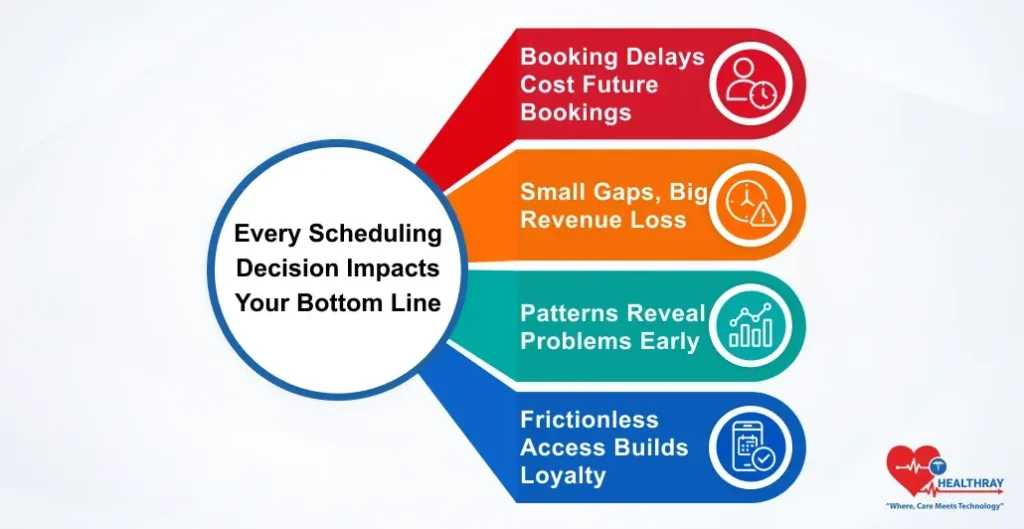
It is important to have a clear understanding of patient behavior only if the knowledge is applied directly in managing your practice. The link between healthcare scheduling conflicts and financial performance is more immediate than you think.
Booking Delays Affect Repeat Booking Rates More Than Operations
The cost of delayed booking in terms of operations can be seen. The cost of not having a patient back due to lack of follow-through cannot be seen until it accumulates. A patient who has waited for three days before being called back usually goes to a competitor by then. Losing the connection is much more costly than the one missed appointment.
Small Scheduling Gaps Quietly Create Massive Revenue Leakage
An idle time of 10 minutes between two appointments translates to many hours annually. This is where an appointment booking app for patients, which utilizes slot filling, helps minimize these idle times by giving patients appointment slots with a smaller window in case of cancellations.
Scheduling Patterns Reveal Clinic Pressure Points Early
In well-managed clinics, there is no need to wait until signs of staff burnout or patient dissatisfaction appear. Such clinics analyze their schedules on a weekly basis. Information regarding waiting time trends, cancellations, and particular doctors’ inefficiencies will serve as early warning signs – before minor issues become major concerns.
 PRO TIP
Frictionless Access Drives Long-Term Patient Retention
Prior to loyalty schemes, follow-up calls, and personalized care packages, the one thing that can make the biggest difference when it comes to retaining patients is the ease with which another appointment can be scheduled. When it involves effort, it just doesn’t happen. They will seek out a medical appointment scheduler that is already in use elsewhere.
The Most Valuable Scheduling Insights Come From Patient Behavior
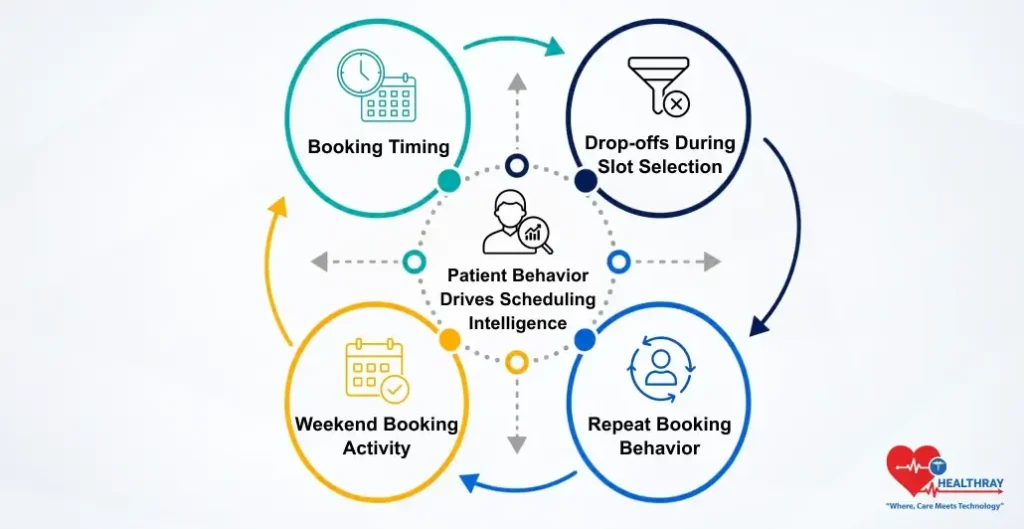
Income and process are what the manager sees through. But beyond both is the behavior of the patient – and therein lies the actionable information of your booking system.
Booking Timing Reveals How Patient Lifestyle Expectations Are Shifting
Do you have a full schedule on Monday mornings but no bookings on Thursday afternoons? There is a reason for that. Booking times indicate the working hours of patients, their educational calendars, seasonal demands, and lifestyle factors. Adapt to these realities by scheduling accordingly.
Drop-Offs During Slot Selection Show Exactly Where Patients Lose Interest
When patients begin the booking procedure but exit while choosing a slot, your availability may not be meeting their requirements. Too few slots, no same-week availability, or overly complicated filters could all contribute to the problem. A patient appointment booking app for doctors helps identify exactly where patients abandon the booking process, allowing clinics to fix friction points before they lose potential appointments.
Repeat Booking Behavior Serves As A Primary Indicator Of Loyalty
The number of people who have rescheduled their appointments three or more times is called the retained patient number. This number should be monitored actively. The clinics that achieve high levels of repeat booking are not only efficient but also creating a referrals database at zero cost.
Weekend Booking Activity Signals A Need For More Flexible Availability
Should weekend booking demands continually surpass your availability on weekends, don’t assume that the problem is simply inconvenient timing. Consider whether a select few appointments on Saturday, telemedicine appointments, or increased availability on Friday can open up the market for those who feel underappreciated.
Why Booking Experiences Define Your Clinic Visibility And Access
Everything that is said above about each point of this article leads to one thing – the process that takes place before the meeting influences the whole interaction between you and your patients. People, whose experience with making appointments is poor, not only won’t come to your practice anymore but will leave a review describing their experiences. Sometimes people won’t even write a negative review, but rather will stay silent. The mere absence of any feedback can become a message about your practice.
A convenient and easy-to-use online appointment booking system eliminates such an undesirable effect completely. A clinic, which takes into account how much importance their scheduling plays, will convey the right message to every new patient they meet.
Learn more: The Complete Guide to a Doctors Appointment System for Modern Healthcare which explores how modern scheduling solutions improve patient access, reduce no-shows, and streamline clinic operations.
The Bottom Line: Waiting On A Booking App Is Already Costing You Patients
It is poor scheduling and not poor treatment that is quietly causing the loss of patients from clinics worldwide. The most alarming factor about this trend? It goes unnoticed. No one complains about difficulty accessing appointments. Instead, they simply do not turn up. A patient appointment booking software eliminates precisely these hidden barriers to patient satisfaction that prevent clinics from forming an initial relationship with patients at all. Patients with chronic illnesses, hectic schedules, or health anxiety do not see easy appointment booking as a luxury – they see it as an essential part of building trust with a clinic.
Every appointment booked also tells clinic managers something important about how their practice operates and where value may be slipping away unnoticed. From a management perspective, scheduling reflects operational efficiency. From a patient’s perspective, it reflects the quality of care. This is why the patient appointment booking app lies between them both. Clinics that understand its real power don’t just stagnate; they thrive.
Because once you start thinking of your appointment scheduling tool as the source of revenue that it already is, you’ll know that patient loyalty happens way before you even get them into the room.