

Summary
The only thing that makes a hospital billing system good is features. The claims submitted to the time they are denied are safeguarded by the right tool at each step. This is what any provider ought to seek and the reason why not getting this right quietly is more expensive than most CFOs will admit until it reflects in the numbers at the end of the month.
Introduction
The poor billing structure hurts hospitals through three avenues, namely, missing charges, rejected claims as well as failure to comply. Collectively, the three gaps drain millions of dollars annually and none of them scream. The HIPAA Security Rule mandates that hospitals should have administrative, physical, and technical security measures to guard electronic information about patients, and billing systems fall right in the middle of the mandate.
Meanwhile, according to Grand View Research, the U.S. revenue cycle management market reached USD 172.24 billion in 2024 a number that reflects just how much financial pressure sits inside hospital billing operations every single day. So the features inside your medical billing software matter far more than the brand name on the invoice. This blog breaks down exactly what those features are and why each one earns its place.
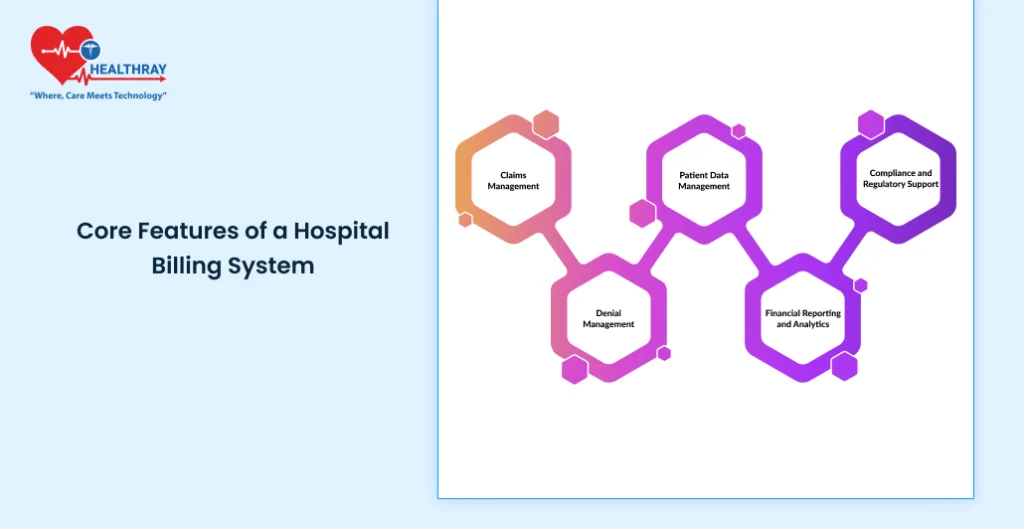
Core Features of a Hospital Billing System
Claims Management
Claims management takes care of the entire life cycle of all claims made by a hospital. Since care occurs at the time a payer makes a payment, a powerful claims management system automates the process between care and payment. It scrubs claims prior to submission, verifies ICD-10/11 and CPT codes with payer rules, and alerts of errors before submission to a clearinghouse. Thus, the levels of rejection become lower and the resubmission turnaround becomes shorter, of weeks to days. In its absence, the billing personnel will be spending their days on pursuing correctable errors instead of making appeals.
Denial Management
Denial management is in which the revenue either gets back or is lost permanently. The powerful denial management hospital billing module groups all the rejections according to reasons, finds the patterns between the payers, and recommends the corrective response to each denial code. In addition, it maintains a real time dashboard of denial rates to ensure that finance teams can identify spikes beforehand and respond to trends instead of responding to individual denials.
Patient Data Management
It begins with accurate records to achieve accurate billing. Patient data management keeps demographic details, insurance credentials, prior authorisation history, and visit records organised and instantly retrievable. It also minimises the possibility of billing the wrong payer or with obsolete information that will result in unnecessary denials.
Automated Charge Capture
Automated charge captures document all services in real time, in clinical workflows. The system records every procedure, supply, and visit, rather than having to be entered manually at the end of a shift. This means that there is no billable service that goes through. This is also directly related to EHR integration, where what clinicians document will automatically transfer to billing without the need to enter the data twice.
 NOTE
NOTE
Together, these features form the operational core that the rest of the system builds on. Understanding each step in the medical billing process helps clarify exactly where each feature does its work.
Features That Protect Compliance and Data
Compliance Tools
The billing system that is compliant with HIPAA does not consider compliance a check box. Rather, it integrates regulatory requirements into operations. In-built controls ensure that claims are in line with CMS requirements, and only then submitted. Automatic updates push regulatory changes – new codes, revised payer rules, ABDM updates into the system without requiring manual intervention. As HHS outlines in the HIPAA Security Rule, covered entities must periodically evaluate their security safeguards to demonstrate compliance and a billing system that automates this removes a significant burden from staff.
Data Encryption
All hospital billing systems have sensitive patient and financial information. Encryption also ensures that data at rest and in transit remains secured as information stored in servers and information transfer between systems are both secured. A single compromise would leave the practice vulnerable to regulatory fines and reputational harm that are exponentially more expensive than the feature itself, in the absence of end-to-end encryption.
Audit Trails
An audit trail keeps a record of all logins, all data changes and all access events throughout the billing system. In addition, it logs every action and associates it with a particular user account. This is important in internal audits, payer audits and external compliance auditing since in the absence of a full record, the providers will not be able to document what and when it occurred.
Access Control
Access controls visibility. Role-based permissions imply that a front-desk coordinator can view patient scheduling information and a billing specialist can view claims and payment records and never view any other data. Multi-factor authentication adds another layer, so stolen credentials alone cannot open the system. Different types of medical billing software handle these controls at different levels of depth so it is worth confirming exactly what your chosen platform includes before signing a contract.
 PRO TIP
Features That Improve Financial Visibility
Financial Reporting and Analytics
A medical billing analytics dashboard consolidates billing trends, revenue sources, and denial rates. Instead of retrieving data on three different tools, finance teams can view the entire picture within one interface. Therefore, decisions about staffing, payer contracts, and service lines get made with current numbers not last quarter’s spreadsheet.
Revenue Cycle Analysis
Revenue cycle analysis determines the precise location of money stalling. It also follows the payment cycles by payer, identifies the service lines that have the most denials, and indicates where the accounts receivable ages are beyond acceptable levels. Additionally, it separates clinical revenue leakage from administrative leakage so leadership targets the right problem with the right fix.
The trend analysis of denial is more than the number of rejections. A robust healthcare revenue cycle has module breaks that separate denials into root causes that lack authorisation, mismatched coding, and failure of eligibility in which billing teams remedy the cause of the issue, rather than merely the symptom. Denial rates decline over time as the system exposes patterns that are not present when the system is reviewed manually.
Customisable Reporting
All departments are not the same when it comes to reporting. Reporting can be customized to enable finance teams to create department-level breakdowns, time period comparisons, and payer/service line filters. Moreover, it allows executive-level summaries and granular drill-downs such that a CFO and a billing coordinator can share the system without stepping on each other. As the best medical billing software with EMR continues to evolve, the reporting layer is becoming one of the fastest-moving areas in the entire platform.
Additional Operational Features
Scheduling and Appointment Integration
In cases where the scheduling is linked to billing, a billing event is created with each appointment. No gaps between front desk bookings and what the billing team sees so missed charges on appointments not reaching the billing queue no longer occur.
Mobile Accessibility
Mobile access is required by the billing teams that operate at more than one location. A mobile access system allows employees to update records, check the status of claims, and review payment data using any device and ensure that workflows do not halt when the teams are not at the desk.
Integrated Payment Options
Patient-facing payment features—including online portals, flexible payment plans, and automated statements—reduce the time between billing and collection. They also cut inbound calls because patients can review and settle balances without picking up the phone. When conventional payment plans are not enough, patients may explore community fundraising options for medical expenses.
User-Friendly Interface
An interface is clean and user friendly which makes the training process shorter and minimizes entry errors. Novice employees can be onboarded quicker, and seasoned employees commit fewer errors when under pressure. In a department where one wrong code triggers a denial, interface design directly affects revenue.
Learn more: The Future of Medical Billing Software in 2026 because the operational features that feel optional today are becoming the baseline expectation faster than most clinics realise.
Conclusion
A hospital billing system only works best when all its features are not isolated. The claims management, denial tracking, compliance tools, analytics, and patient-facing payment options safeguard revenue at various points. Providers that treat feature selection as a strategic decision rather than a procurement one consistently see stronger collections, fewer denials, and cleaner audits. To see how these features come together in a single platform, explore what Healthray’s billing solution offers your team.