

Summary
Medical billing software in 2026 is no longer a back-office cleanup tool. The use of AI, cloud computing and real-time compliance are changing how hospitals and clinics in India and the US operate their complete revenue cycle. The earlier the adaptation of the providers, the more they have, the less they will dispute, and the better they will serve the patients.
Introduction
Over the years, it was customary to bill after care. One patient abandoned a stack of paperwork, and somebody hand coded, submitted and waited. As a result, the refusal to pay claims and backlogs became a norm rather than something exceptional.
By 2026, that model will be finished.
Modern medical billing software bridges the first touch not the final touch with the patient. Registration initiates eligibility checks. Clinical notes feed directly into coding engines. Claims go out clean, not corrected after rejection.
The US revenue cycle management market heads toward $300 billion by 2030. In India, ABDM mandates, GST compliance, TPA settlements, and PMJAY reimbursements have added complexity that manual billing cannot handle. Consequently, the same trend in both markets is that providers are shifting to a proactive and automated revenue cycle that begins the moment a patient enters the premises, rather than reactive billing.
AI-Driven Autonomy: The Touchless Claims Era in Medical Billing Software
Recently AI in billing referred to autocomplete patient names. As of today it is what means that your system foresaw a denial before it occurred.
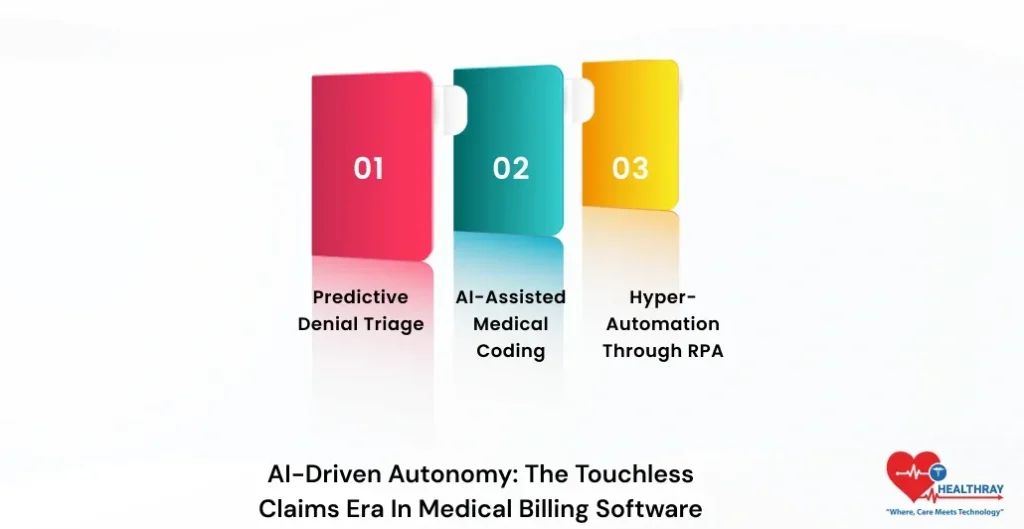
Predictive denial triage involves historical data on claims to identify high-risk submissions during their hospital stay. Lack of modifiers, lack of authorisation, improperly ordered code the software will automatically recognize these and not when the insurer declines them.
AI-assisted medical coding takes this further. NLP analyzes physician notes and proposes correct CPT and ICD-10 codes in real-time, preventing human coding errors by more than 20%. In India, the same NLP capability maps documentation to ABDM-compliant codes critical for hospitals participating in Ayushman Bharat.
Hyper-automation through RPA adds the third layer. Software bots handle eligibility verification, payment posting, and prior authorization requests 24 hours a day without fatigue. To US practices, this eliminates one of the most time consuming manual processes in the revenue cycle. It does so in the case of Indian hospitals that direct TPA claims with PMJAY patients.
According to Precedence Research, the global AI in medical billing market reached USD 4.70 billion in 2025 and is on track to hit USD 45.38 billion by 2035 at a CAGR of 25.44%.
Before choosing, explore how different types of medical billing software handle AI integration architecture matters as much as features.
 NOTE
NOTE
Patient-Centric Financial Experiences
In 2026, patients will demand the same of their hospital as they already demand of their bank transparency, speed and no surprises.
The majority of billing systems continue to send out invoices that patients cannot read, weeks after receiving care that they have already forgotten. Such a disconnect spurs arguments, time wastes, and write-offs that, silently, dim revenues.
Pre-care cost estimation changes this entirely. Software calculates a patient’s out-of-pocket responsibility upfront before the appointment factoring in insurance, deductibles, and co-pays. The US providers that have this feature record an increase in collection rates of up to 30%. In India, the equivalent is real-time TPA cashless confirmation at registration before treatment begins, not after.
Frictionless payment design matters equally. Apple Pay and Google Pay integration have become a standard in the US. WhatsApp bill reminders and UPI integration minimize payment delays in India best. Also, automated payment plans would boost collections without the need to follow up by billing staff.
CollaborateMD reports that 91% of consumers now prefer electronic payment methods for medical bills meaning any platform still relying on paper statements actively works against patient payment behaviour in 2026.
 PRO TIP
Understanding how medical expense tracking software connects to patient billing gives providers a fuller picture of where revenue is earned and where it quietly disappears.
Security: Blockchain and Zero-Trust Architecture
Security in medical billing is no longer just about HIPAA certificates and password policies.
Blockchain can now generate unchangeable records of all billing transactions that are immutable – records that cannot be changed by anyone in the future. In the case of the hospitals in the US that handle Medicare and Medicaid claims, this removes huge chances of fraud. Simultaneously, as institutions secure their data, individuals are turning to a medicaid planning trust to safeguard their family assets and meet strict eligibility criteria before requiring long-term care. In the case of Indian hospitals, which handle high volumes of TPA settlements, it leaves an audible record that can settle disputes in days instead of weeks.
Zero-trust architecture takes this further. Rather than trusting anyone inside the network by default, zero-trust systems verify every user, every device, and every access request every time. Billing staff access only what their role requires. Auditors get logs without manual report generation.
This is not negotiable in both markets due to regulatory pressure. HIPAA requires written access controls. The Digital Personal Data Protection Act 2023 in India has the same expectation. The two requirements are natively built into modern billing software.
Compliance, Interoperability, and Value-Based Care
The regulatory requirements of 2026 cannot be optional and software that processes them natively is the winner.
The minimum requirements in the US are HIPAA, FHIR-based prior authorisation APIs and CMS value-based care requirements. ABDM and GST e-invoicing requirements, as well as PMJAY settlement requirements, are equally non-negotiable to Indian providers. Both markets are supported by the medical billing process that will not use workarounds to deal with all of these.
Interoperability solves a connected problem. Using billing software that links directly to your EHR, pharmacy, and lab systems and does not require data bridges in between, the number of unbilled services decreases significantly. It is possible to reconstruct in minutes rather than days. This level of integration is the result of teams creating the leading healthcare software that treats interoperability as a core architectural decision, not a feature added after launch.
Value-based care adds the third dimension. Fee-for-service charges are counted. Value-based billing monitors the results, quality indicators and long-term health gains of the patients. Providers not using software to capture outcome-linked billing codes will be leaving reimbursement on the table in the US within CMS requirements and in India within PMJAY frameworks by 2026. Live dashboards indicate denials by payer, revenue per department, and bottlenecks warnings before they strike the cash flow.
Learn more: Knowing what compliance requirements your billing software must meet is one thing – finding software that actually handles them natively is another, and 10 Best Medical Billing Software To Try Out narrows that down by market.
What This Means for Indian and US Healthcare Providers
The complexity in both markets exists but the form of the complexity is different.
US providers contend with the delay of prior authorisation, multi-payer contracts, and value-based care transitions of varying speeds. The right platform manages all payer formats natively, integrates with major EHR systems, and automates denial appeals end to end.
Indian providers deal with TPA claim routing, ABDM integration, GST e-invoicing, and PMJAY settlement timelines simultaneously. Platforms built for the Indian market with ABDM compliance and UPI payment integration handle the full cycle without workarounds.
In both cases, outdated billing systems create revenue gaps. Those providers who upgrade in 2026 can avoid the costly migration that results when they wait too long.
Conclusion
Medical billing software of 2026 has passed a line. It is no longer a back-office tool. Rather, it is an active engine of revenue that raises red flags prior to submission, takes payments prior to a dispute, and links clinical care to financial outcomes in real time.
Technology will not supplant billing professionals; it gives them the power to concentrate on strategy and the decisions that realistically move the revenue needle.
Such practices adopting AI-enabled and patient-centred billing tools at present will be on the forefront of efficiency, compliance, and patient trust by the year 2030. Discover the complete end to end billing of Healthray solution to Indian and US providers without the gaps.