


In This Blog
Where your 10-hour clinic day is silently leaking time – and how workflow automation for clinics gives those hours back, category by category.
- The five desk-level task categories are stealthily draining 3.5 hours out of every working day
- How ambient intelligence, routing systems, and referral management software restore each of these categories
- The Physician Time Recovery Index, a quantifiable model for restoring physician hours
- The financial reality of reclaiming physician hours in terms of actual revenue generated
- Why removing administrative inefficiency also guarantees diagnostic precision and personal time
You didn’t spend a decade in training to spend your best clinical hours buried in EHR dropdowns, chasing faxed lab reports, and retyping everything you just said out loud to the patient in front of you. In fact, this is what happens daily for most physicians across the globe, except this process does not happen all at once – instead, it happens through the invisible aggregation of hundreds of 30- to 180-second distractions during the day until it is already 7 p.m. and you are still working on the notes. The issue here is not one of motivation; it is an issue of workflow.
The Clinical Time Leakage Model: Where Physician Hours Disappear
True inefficiencies do not necessarily call themselves out. They lurk in the discrepancies between how your schedule looks and what you manage to attend to. Modern clinic management software can capture these discrepancies automatically, tracking time spent on documentation, prescription writing, referrals, test results, and administration, and helping physicians reclaim hours lost to inefficient processes.
In total across these five categories, the daily average for a physician at the clinic is giving up 375 minutes. Physician workflow automation is designed to recover 210 of those minutes. And here is the full list before discussing each category individually.
| TASK CATEGORY | DAILY TIME LOST | MINUTES RECOVERED |
| Clinical Notes & Documentation | 120 min | 60 min |
| Prescription Refills & Renewals | 45 min | 30 min |
| Specialist Referrals & Letters | 60 min | 40 min |
| Chasing Results & Lab Follow-Ups | 90 min | 50 min |
| Billing, Coding & Admin Inbox | 60 min | 30 min |
Category 1 – The Note Tax: Why Documentation Consumes Clinical Hours
Charting takes up the most single effort by far for any physician. Documenting a structured history, following the strict EHR form, and manually documenting the encounter takes an average of two full hours out of your day in the clinic. You do not have to make clinical decisions here; you document those that you’ve already made during the encounter.
Ambient AI-powered documentation technologies resolve this issue at its root cause. All you need to do is just engage in your normal patient discussion, and the system will do the rest of the work by itself: capturing the important bits of the discussion, filtering out the noise, and generating the structured clinical note in its specialty format.
Moreover, about an hour of time is gained back each day, making it the biggest personal win from this audit process. The American Medical Association has reported on AI scribing applications where doctors demonstrated clinically meaningful declines in note-writing time, appointment time, and off-hours documentation. As a result, the time that doctors previously spent working in their pajamas has been essentially eliminated.
 NOTE
NOTE
Category 2 – How Workflow Automation For Clinics Reduces Prescription Fatigue
Looking at medication histories, checking for interactions, and manually approving normal renewal orders takes about 45 minutes each day. The vast majority of these will be long-term medication renewals for stable patients – easy clinical decisions but administratively repetitive tasks. This task requires using your training as a clinician to approve what could easily be handled by rules.
Asynchronous routing engines handle standard, low-risk renewals and auto-approve them with a single click. If a request involves clinical complexity, such as a new medication, interaction issue, or off-cycle patient, the system routes it directly to your queue for review.
The automation of this workflow process for physicians saves around 30 minutes each day in writing prescriptions without taking the decision-making responsibility away from the doctor, even when such a decision was necessary.
 PRO TIP
Category 3 – Referral Friction: Turning Specialist Letters Into Faster Workflows
Preparing the summary of care, extracting pertinent data from disparate sections of the EHR, and drafting formal letters for other specialists takes about one hour daily. Physicians are especially frustrated with these tasks because the data is already in the system; it must be compiled manually from five different sources each time. This is where clinic system interoperability becomes critical, allowing EHRs, labs, and specialist systems to communicate seamlessly so information flows automatically instead of being reconstructed by hand.
This is where workflow automation for clinics enables one-click referral integration tools that automatically pull text from your completed encounter note, including working diagnosis, medical history, medications, clinical questions, urgency, and more, and insert it into a specialty-specific template in seconds. A task that once required 15 minutes of manual writing now takes under three minutes to review and approve.
This results in about 40 minutes being saved throughout the course of an entire clinical session, all of which were once spent on backend logistics, yet without any decline in the quality of the referral. Your letter is written better. Your time is reclaimed.
Category 4 – Diagnostic Follow-Ups: Ending The Cycle Of Chasing Results
Reviewing external findings and calling patients with normal lab results pulls 5–15 minutes out of your day, repeatedly. Unlike documentation, which follows a predictable rhythm, lab follow-ups arrive without warning and fracture your focus every time. The consequence is that doctors never get any undisturbed time for their patients.
Exception alerting EHR algorithms turn this situation upside down. Normal test results are automatically redirected to the patient portal in the appropriate context. In addition, clinic patient engagement tools automate communication with patients through reminders, follow-up messages, and result notifications, reducing the need for manual phone calls and repetitive outreach. The system sends any abnormal test results directly to your alert list by the end of the visit, eliminating “telephone tag,” one of the most distracting administrative tasks for physicians.
This saves around 50 minutes each day. More importantly, restored focus improves the quality of your thinking after lunchtime, when you have already used up your morning concentration reserves.
Category 5 – Billing And Inbox Drag: The Weight Behind Physician Burnout
After-encounter corrections address billing errors, incorrect ICD-10 codes, and the management of diverse inboxes. These activities are among the biggest time killers in this clinical model of practice. workflow automation for clinics extends beyond documentation into administrative tasks that consume physicians’ time every day. Physicians spend at least one hour daily on such activities.
Moreover, real-time billing engines analyze the doctor’s conversation during each session and generate correct codes before errors occur. Inbox triage separates clinical and non-clinical emails, routing the latter to office assistants. This saves doctors about 30 minutes of work daily.
More than just saving time, however, this is important because the United States Department of Health & Human Services October 2024 report on the national health workforce recognizes that “administrative burden,” such as paperwork and coding burden, is a key structural reason behind physician burnout and early workforce turnover. Workflow optimization for physicians is the systemic solution to a federal crisis.
Learn more: 6 Staff Scheduling Conflicts Clinic Software Resolves Automatically. It shows how automated systems detect and fix shift overlaps, last-minute absences, and double-bookings in real time.
The Physician Time Recovery Index: Measuring The Hours Automation Returns
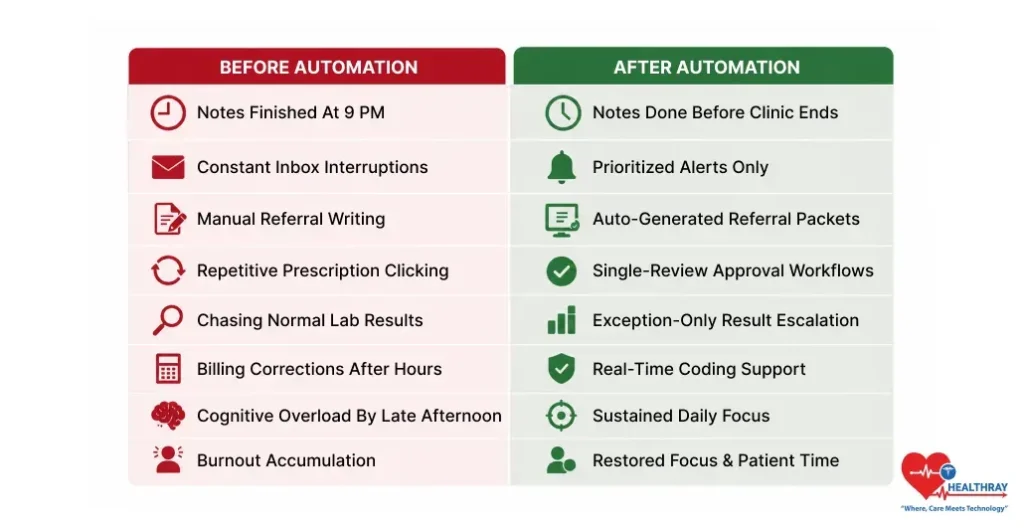
Add up all the gained minutes across each category: 60 + 30 + 40 + 50 + 30. The total is 210 minutes — that’s 3.5 hours of operational time reclaimed per day for every physician. This is what we refer to as the PTRI or Physician Time Recovery Index – an index formulated with the express purpose of quantifying precisely the amount of operational time regained by physicians as a result of automation. The statistics are telling: automation not only speeds up processes for physicians but also recaptures operational time, which was always intended to be theirs in the first place.
Use the reclaimed 3.5 hours to add seven extra half-hour patient consultations without extending your workday. This is what it will cost you financially, assuming 200 days of clinic attendance per year:
- General Practice At $100 Per Visit: 7 additional slots add $700 to daily gross revenue, resulting in a total additional $140,000 in annual gross revenue per physician.
- Pediatrics At $150 Per Visit: 7 additional slots add $1,050 to daily gross revenue, resulting in a total additional $210,000 in annual gross revenue per doctor.
- Dermatology at ~$300 per visit: 7 additional slots add $2,100 to daily gross revenue — $420,000 in additional annual gross revenue per physician.
The numbers do not even take into account the cost of turnover among physicians due to burnout, which further strengthens the point. However, from a purely mathematical standpoint, the decision is obvious. Gaining three-and-a-half hours of productivity per day over 200 clinic days is not a marginal improvement.
This level of efficiency is only sustainable when supported by structured operational controls such as role-based access clinic software, ensuring that administrative staff, nurses, and physicians operate within clearly defined permissions while maintaining workflow speed, security, and accountability across the clinic system.
What Happens When The After-Hours Documentation Shift Finally Ends
Notably, workflow automation delivers an often-overlooked benefit for medical professionals that standard time audits rarely capture. It is the things that physicians no longer need to do once they leave the clinic.
Doctors who document 100% of patient encounters on schedule avoid working an extra shift at home. They leave the clinic with a clear mind, freeing their evenings from unfinished tasks. This protects physicians’ health and prevents errors, as decision-making declines when they work while tired.
The “U.S. Surgeon General’s Advisory: Building a Thriving Health Care Workforce” directly addresses the need to improve technology to maximize time spent by health professionals working with patients, putting the burdens of EHRs and inefficient workflow at the top of the list of high-leverage solutions for our health care system. Workflow automation is not something that vendors will use to sell their solutions.
Avoiding constant digital task switching preserves continuous clinical thinking throughout every hour of training. Doctors who avoid managing incomplete referrals, lab results, and billing issues can fully focus on patients. This allows them to make precise decisions at 4 p.m., just as they do at 9 a.m.
To Sum Up: Why Workflow Automation For Clinics Is Operationally Essential
It is administrative overload, not lack of clinical competency, driving burnout and early clinician retirement. The Clinical Time Leakage Model quantifies this, showing up to 375 minutes lost daily. It also shows 210 minutes recoverable through workflow automation and $140,000 to $420,000 in potential gains.
Automation of doctors’ workflows does not alter your medical practice. It frees you from all those tasks that were never meant to be part of being a physician, such as typing, chasing documents, clicking, and making corrections. This allows you to focus fully on what you know best.
Those doctors who implement automation will see more patients and increase their earnings. They will also reduce diagnostic errors and safeguard their professional accuracy. Those who delay will continue wasting 3.5 hours daily on tasks automatable before lunch. This is the choice your audit is presenting to you.
Doctors know they are overworked. The real issue is whether clinicians are still losing 3.5 hours daily to tasks that could be automated before lunch.