

In This Blog,
You’ll see how clinic CRM software closes six costly patient relationship gaps and reshapes HIPAA compliance and total cost for your clinic:
- Why generic CRM is built for sales pipelines instead of patient relationships
- Six patient relationship gaps that appear in the first 90 days on generic or no CRM
- The clinic CRM features that systematically close each of those six gaps
- Where the real boundary lies between generic CRM and purpose-built clinic CRM
- What HIPAA compliance and total cost look like with a CRM layer on clinic software
A clinic that adopts a generic CRM platform, or skips CRM entirely and relies on spreadsheets and sticky notes, doesn’t notice the gap on day one. Eventually, the gap becomes visible in month three. The clinic misses a patient recall, loses a referral, and cannot explain what happened. This blog walks through exactly where those gaps appear and what closes them.
Why a Generic CRM Was Never Built for Patient Relationships
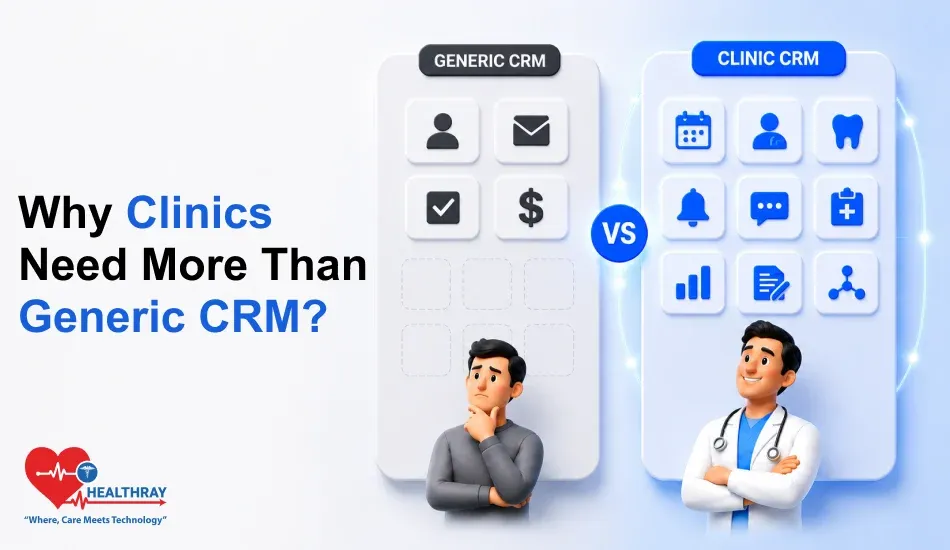
Many clinics adopt their CRM mindset from industries other than healthcare by picking up generic CRM or clinic management software that was created for sales teams, and then they expect the software to manage a patient relationship in the same way a sales relationship is managed. However, they are two different things, and the difference becomes apparent quickly.
What Generic CRM Gets Right, and Where It Stops
Generic CRM software is very capable of monitoring a limited sales pipeline. That model does not work for continuous patient relationships that require regular recalls, referrals being tracked, and care gap alerts. Clinic CRM is a unique category. It treats the patient record as an ongoing clinical relationship. That relationship includes history, referrals, and recall schedules that span several years. It does not focus on a single sales cycle.
The Gaps That Surface Within the First 90 Days
Most clinics don’t choose to skip a CRM outright. They default to whatever clinic management software they already have, or a general-purpose CRM that a staff member set up because it was familiar.
As a result, six major gaps usually appear. They often surface in the same order. First come, missed recalls, and untracked referrals. Next come missing care gap alerts and disconnected appointment histories. Finally, clinics struggle with fragmented patient records across locations and broken EMR sync. I’ll examine each through one patient’s journey over a year.
 NOTE
NOTE
What Patient Relationship Gaps Can Clinic CRM Software Help Fix?
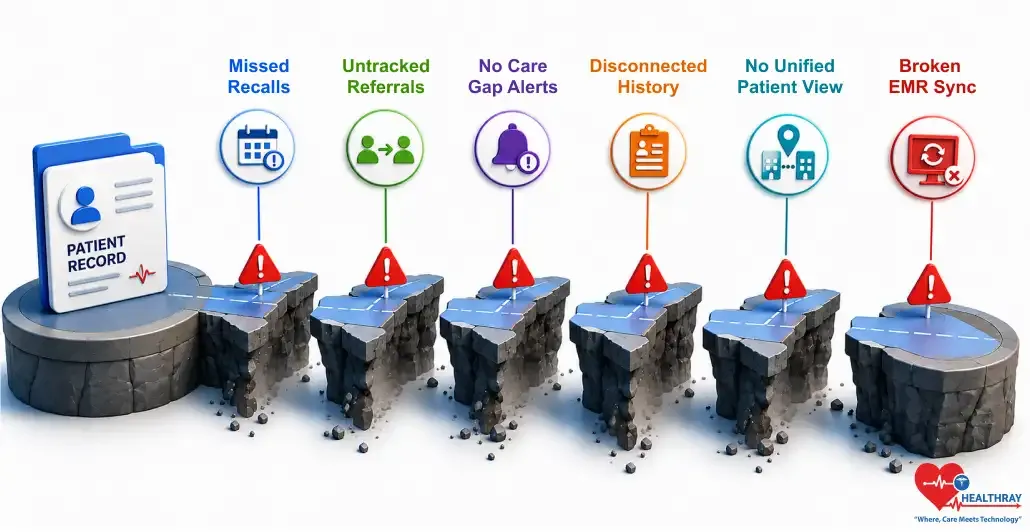
Sarah Mitchell’s year of care unfolds all six gaps in sequence. None of them is dramatic on its own. Together, they reveal exactly what a generic system overlooks and what a purpose-built clinic CRM is structurally designed to catch.
Gap 1: Missed Recalls
Recalls represent the most fundamental CRM functionality in any healthcare setting, and also the one most prone to silently failing without a structured system to back it up.
The Scenario:
Sarah Mitchell, 54, is a patient of Dr. Coleman for managing hypertension. They usually follow up on this every six months. Sarah visits the clinic for a consultation in January, and her doctor changes her prescription. She goes out with only a verbal message, “See you in six months.” However, nobody has recorded the recall date. By July, the clinic had forgotten the appointment as well as Sarah, and it was only in October that she came back with dizziness symptoms, after being four months overdue.
The Capability:
This is the most common and most serious gap in clinics without patient recall software. In contrast, a generic CRM only offers manual follow-up tasks that staff must remember to create and check. CRM software builds recalls into the workflow, automatically generating recall triggers from each care plan and flagging patients on a daily dashboard instead of hiding them in a task list.
This is exactly the gap that real clinic feedback confirms. Dr. Bhaumik Rathore of Vibrant Multispecialty Hospital described the difference structured reminders make:
| “Appreciate the notification and reminder attribute of Healthray; they make appointment management stress-free and reduce the need for additional workforce.” – Dr. Bhaumik Rathore, Vibrant Multispecialty Hospital, India |
Gap 2: Untracked Referrals
The moment a referral leaves the building on paper, it is a referral the clinic has basically lost track of as soon as the patient leaves the door.
The Scenario:
In March, Dr. Coleman refers a patient, Sarah, to a cardiologist for an irregular heartbeat and writes the referral on a slip of paper. No one logs it in the system. Six weeks later, Dr. Coleman does not know whether Sarah attended the referral or what the specialist found. He tracks the referral through memory and a paper note. Either one can fail.
The Capability:
A generic healthcare CRM has no true referral record, only tasks or notes that get buried as new contacts are created. A clinic CRM tracks referrals through statuses such as sent, scheduled, completed, and results received. If six weeks pass with no update, the system automatically flags the referral for follow-up. So the doctor does not have to remember, and the gap is visible on a dashboard instead of disappearing into silence.
Gap 3: No Care Gap Alerts
Preventive care intervals are easy to track on paper for one patient and nearly impossible to track reliably across hundreds.
The Scenario:
Sarah’s care plan includes an annual A1C test because borderline pre-diabetic readings appeared two years ago. However, no one tracks the interval against her risk profile, so the clinic never flags the test as overdue. A new physician finally notices the gap eighteen months later, after a year and a half without the test. The A1C was not missed because someone forgot; it was missed because no one owned the interval.
The Capability:
Care gap management does not exist in generic CRM, which cannot handle clinical risk profiles or preventive care intervals. CRM software cross-references each patient’s diagnosis history, age, and risk factors with care guidelines. It then flags overdue preventive measures as clinically meaningful alerts. Unlike generic reminders, these alerts stay tied to the patient’s record. Similar workflow discipline also applies to operational tasks such as clinic inventory module setup, where accuracy depends on structured processes rather than manual follow-up.
Gap 4: Disconnected Appointment History
A patient’s history is only useful to the next clinician if it exists somewhere they can actually see it in one place.
The Scenario:
After a referral to a cardiologist raised a new concern, Sarah decided to change her schedule from a couple of times per year to visits every three months. Half a year after that, an NP preparing for her visit discovers that only the two most recent appointments are visible, while the rest of the visits are in a separate PDF module that is not linked. The NP is unable to easily recognize the trend in Sarah’s blood pressure over the last year due to the absence of a single timeline.
The Capability:
Installing a generic CRM alongside separate appointment and EMR systems will divide patient relationships into isolated pieces without a single timeline. A clinic CRM keeps every appointment, note, and outcome linked to a single patient record. Because of this, the clinic gets a continuous history across all visits, departments, and providers.
Gap 5: No Multi-Location Patient View
A clinic chain is only as connected as its weakest link between branches, and that link is usually the patient record.
The Scenario:
Sarah moves to another part of the town, and after that, she starts going to the second branch of the clinic that was opened a year ago. The people at the reception desk in the new branch have no idea who she is. Her medical records are only available in the original location’s system. As a result, they treat her as a new patient. Her high blood pressure, cardiology referral, and the alert for her overdue A1C were not transferred. The new place has nothing of her history.
The Capability:
Many generic CRM systems, by default, operate as separate instances at every clinic branch, leading to division of patient records across locations. An exclusive clinic CRM maintains one consolidated patient record for all branches, so that when Sarah arrives at a different branch, the personnel will have access to the history, flags, and the referral status of the patient without any re-entry or lost context.
Gap 6: Broken EMR Sync
A CRM and an EMR that don’t talk to each other in real time are effectively two separate sources of truth competing for the same patient.
The Scenario:
Sarah’s cardiologist sends results back to Dr. Coleman electronically, and the data lands in the EMR. The CRM manages her care gap alerts and recall reminders. However, disconnected systems prevent it from receiving the update. The EMR shows a completed result, while the CRM still shows the referral as pending, so her record tells two different stories.
The Capability:
This is the most technical of the six gaps, and often the last clinic discovers, because it is invisible until someone compares both systems side by side. With proper clinic software EMR integration, the CRM and EMR share data in real time, so results in the EMR updating referral status and recall flags in the CRM automatically. Otherwise, a clinic runs two systems that each hold a different version of the truth.
 PRO TIP
Generic CRM vs Clinic CRM Software: Where the Line Actually Sits
Once the six gaps are visible, the difference stops being abstract. Instead, it comes down to the data model underneath.
What “CRM HIPAA Compliant” Actually Requires
Generic CRM mainly focuses on a sales pipeline: lead, opportunity, and deal. But a clinic CRM software focuses on a clinical relationship: patient diagnosis, care plan, recall interval, referral chain. It is impossible to convert one into the other without losing the logic that closes the six gaps above. And any CRM handling patient data is handling protected health information, which makes CRM HIPAA-compliant status non-negotiable.
- Encryption at rest and in transit
- Role-based access controls
- Complete audit logging
- A signed Business Associate Agreement
What This Means for Total Cost and Setup
The Clinic software total cost shows up the moment a CRM has to connect to everything else in the clinic, and vendors who treat it as a bolt-on rather than a core integration point tend to underestimate what implementation actually involves.
- Connecting the CRM to your existing EMR
- Configuring recall intervals against your specialty’s guidelines
- Aligning with your clinic inventory module setup, if supplies are tied to recall visits
Learn more: A CRM rollout has the same phase-by-phase risks as any clinic software implementation. Clinic Software Implementation Phase Risks and How to Prevent Each One – This guide covers the failure points worth planning around in advance.
Key Takeaways for Clinics
Sarah Mitchell’s care journey revealed six gaps. These included a missed recall, lost referral, overdue test, fragmented history, location reset, and EMR mismatch. Ultimately, one issue caused them all. Her systems stored information but did not manage patient relationships like a clinic CRM.
Patient relationship management software is different from patient engagement tools and generic CRM. Each system is designed to solve a different problem. So, the six gaps mentioned above are the usual outcome of a clinic using a system that is incapable of truly remembering patients, as is necessary for clinical care.