


In This Blog
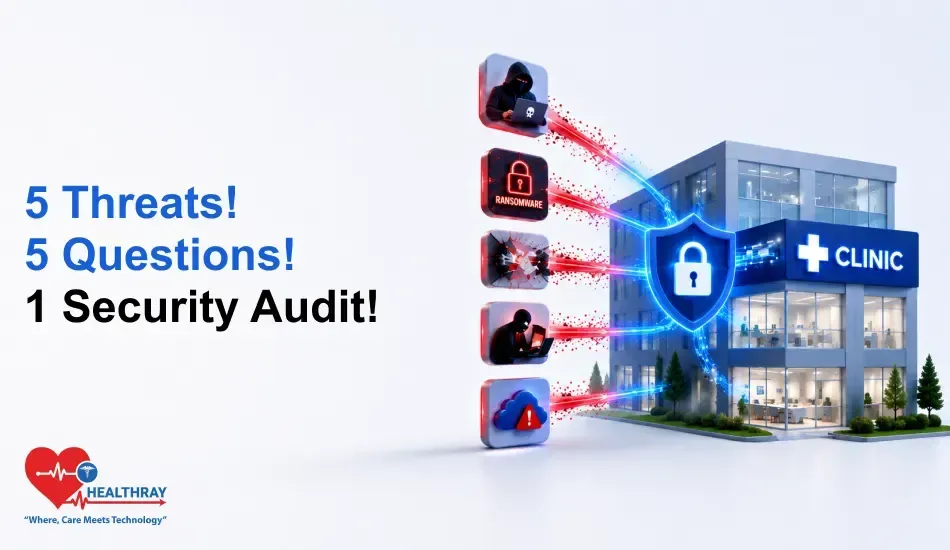
Five real attacks against clinic cloud data and their respective probing questions to reveal if your vendor really has got you covered:
- The cyberattacks that your clinic wasn’t expecting until they happened
- Why the security of your staff logins is not as strong as you think right now
- How poor API design can quietly leak patient information without a trace
- The configuration error is pretending to make things easy and save you time
- How your trusted clinic vendor’s third-party software can be the greatest risk
- The audit questions needed to reveal these vulnerabilities before it’s too late
Cloud clinic software security lies at the threshold of your practice’s safety. And very few practices have ever confirmed that the vendor delivers it. This is especially concerning because the average cost of a healthcare data breach reaches $9.8 million in recovery expenses for the thirteenth consecutive year, making healthcare the most costly industry in IBM’s Cost of a Data Breach Report. For small clinics, the number is not bad news, but the end of your practice. Hence, this guide will discuss five attack vectors currently plaguing cloud platforms in clinics.
Threat 1: “The Tuesday Morning Lockout” – A Cyberattack That Locks Your Clinic’s Data
Imagine this scenario: your front desk team comes in at 8 AM. Your scheduling is down, the EHR won’t come up, and your billing queue is empty. By 12 PM, all patient-facing software locks you out. A simple scan, not a clever hacker, uncovers a six-month-old vulnerability.
This is no hypothetical scenario. In reality, many cyberattacks that lock clinics out of their own data begin with stolen passwords and unpatched software. For clinics using clinic management software, even a brief outage can disrupt patient care and daily operations. Hackers don’t need to be particularly sophisticated; they only need your vendor to drag their heels.
Once attackers gain access, the cyberattack can spread across the network, preventing staff from accessing scheduling, billing, and patient records. According to 2024 estimates, the average recovery cost after a major cyberattack is about $2.57 million, with a survey conducted by Sophos revealing that almost 67% of all health organizations had been affected, up from 38% in 2021.
Exact Vendor Audit Question: “Are you able to give us an independent SOC 2 Type II report about your patching policy and your maximum time window in which you will apply any critical vulnerabilities?”
What Proof To Demand:
- Critical patches applied within 24 hours, as stated in the SOC 2 report
- 24×7 Security Operations Center operation with incident reports on request
- Recovery Time Objective within four hours for the clinical databases
 NOTE
NOTE
After you have your answer for the patch management question, you need to ask yourself another question. This concerns the activities post-login.
Threat 2: “The Stolen Session Takeover” – Session Hijacking And Cookie Theft
Your receptionist accesses the cloud-based clinic at 9 AM, but by 9:15, a hacker from another country has hijacked the session, without ever having had to enter a password.
This attack occurs when malware steals browser session tokens from employee devices. Secure VPN services for remote connections can help reduce the risk. Hackers may otherwise take over active sessions without triggering alerts, making session hijacking a major challenge in healthcare cybersecurity.
Hackers do not knock on the front door. Poorly configured security credentials will do, and when CISA conducted their penetration tests within an actual healthcare facility, they discovered this to be the case. Once the attacker has made their way into your network, the use of MFA does nothing for you because the attack has occurred from a legitimate user’s perspective. The login process was never even on their agenda.
Exact Vendor Audit Question: “Are your MFA sessions secured from phishing attacks through FIDO2 or WebAuthn technologies, and what is your policy regarding user session time-outs?”
What Proof To Demand:
- First, that FIDO2-based authentications are required and backed by a security mechanism
- Second, explicit rejection of SMS MFA tokens as a separate means of user authentication
- Third, compatibility with NIST SP 800-63B – the national identity standard
 PRO TIP
Patched infrastructure and authentication methods secure your front door. Yet, your patient information may escape via another door unnoticed by most audits.
Threat 3: “The Silent Data Leak” – Broken Access Controls Inside Medical APIs
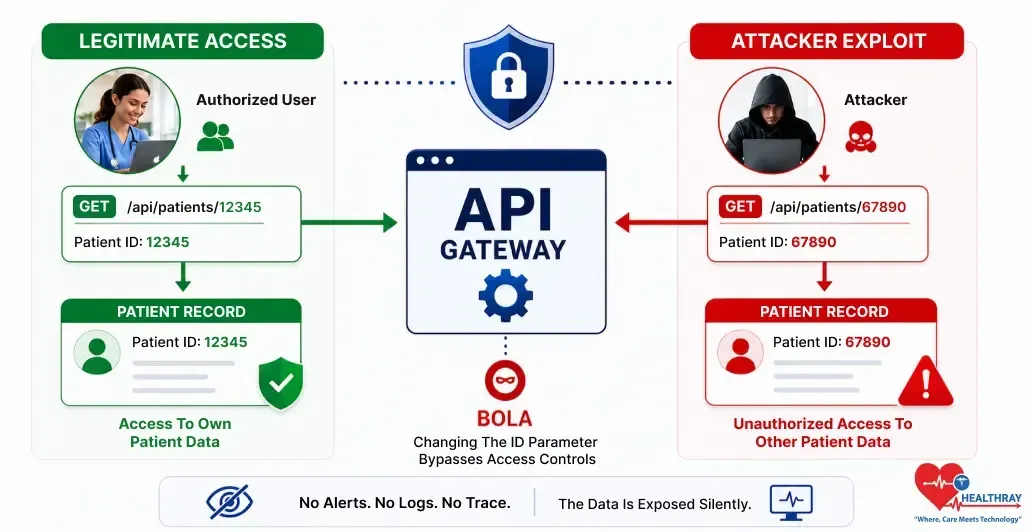
Clinics rarely detect this type of attack. They only notice it after the attack occurs. Clinic software uses APIs to connect schedules, invoices, prescriptions, and patient records. However, weak access controls can create Broken Object Level Authorization (BOLA) vulnerabilities. As a result, unauthorized users may access sensitive files simply by modifying a URL parameter.
The data is not erased but duplicated without being noticed. Everything in your clinic will look perfectly fine. Moreover, a medium-sized practice group was able to uncover this because of their security audit. Patient billing information could be retrieved through just one API endpoint manipulation for many months, creating additional cloud clinic software downtime risk during remediation efforts. There have been no notifications about it whatsoever.
Thus, protecting clinic data is impossible using only perimeter firewalls. Effective healthcare data security requires protection at the application level as well. Also, the risk of medical SaaS security threats, such as BOLA, is not covered by any standard vendor questionnaire.
Exact Vendor Audit Question: “Does your development team validate your API endpoints according to OWASP Top Ten API Security Risks, and what is your executive summary from the latest external penetration test?”
What Proof To Demand:
- First, a third-party penetration test was conducted within the past year
- Secondly, ongoing automated scanning of your APIs’ vulnerabilities, and not merely annual testing
- Thirdly, HIPAA 164.312(a)(1) compliance is verified through test results, which prove that BOLA vulnerabilities were scanned for, not simply mentioned. This supports HIPAA cloud security.
That’s three threats down and only two more to go. In addition, the next threat has absolutely nothing to do with hackers – this one is on your vendor.
Threat 4: “The Default Disaster” – Misconfigured Cloud Clinic Software Security Settings
This threat does not come from a technically competent attacker; rather, it is a consequence of a configuration flaw that your vendor put into the onboarding process.
Vendors often prioritize convenience over security. This issue is frequently overlooked when comparing clinic software vs hospital software, even though both face similar risks. As a result, clinics often assume security is built in, while simple misconfigurations, such as open storage buckets, expose patient records.
Clinic owners tend to believe that the vendor is responsible for security while the IT department takes care of everything else. This approach may seem logical at first until it fails. The main takeaway from NIST’s cloud computing security guidance is that security of your data in the cloud is still your responsibility – you simply cannot delegate it. Selecting a vendor doesn’t mean relinquishing responsibility either. This is a fundamental principle of healthcare cloud security.
Cloud security starts with your provider, not your front desk staff. Here’s what secure-by-default should look like:
| SECURITY CONTROL | DEFAULT ON | LEFT MANUAL |
| Zero-Trust | Yes | At many vendors |
| MFA Enforcement | Yes | Usually optional |
| Encryption | Yes | Toggle switch |
| Bucket Exposure | Yes | Automated rarely |
| Drift Detection | Yes | Add-on typically |
Exact Vendor Audit Question: “Which security settings can be set up by default, and which need some manual work from our clinic’s IT department?”
What Proof To Demand:
- First, zero-trust architecture is implemented by default without any further manual configuration required on behalf of the clinic.
- Second, confirmation in writing that no storage buckets exist publicly in the vendor’s environment.
- Third, an automated system that will monitor for misconfigurations and notify us when there are any changes.
Risk of Misconfiguration is possible separately. But the fifth risk adds to the danger because it utilizes not only the platform, but also the environment of the vendor.
Threat 5: “The Supply Chain Backdoor” – Third-Party Integration Vulnerabilities
Assuming that your clinical solution is 100% secure, how is the e-prescribing solution interfacing with it? What about the billing solution? Even worse, what about the telemedicine solution?
Each of these integrations poses a security risk, as an attacker could possibly use one of these solutions to access the system. It is another potential security threat that clinical owners will never ask the software vendor about. Hackers always attempt to exploit third-party solutions just because of their connection to the clinical chain process.
One example is the Change Healthcare cyberattacks that took place early in 2024. The attack led to the exposure of the health data of 100 million people. In addition, it led to disruption of the provision of health services across the country. Analysts also estimate that a secure integration process costs $2.4 billion in reaction expenses. One partner. One weak link. One disaster.
Thus, organizations must guarantee the security of cloud clinic software at all stages of the integration process, including when integration occurs outside the software itself.
Exact Vendor Audit Question: “Explain your risk management model concerning your sub-processors. Also, what is your recovery time if a cyberattack affects one of your integrated sub-processors?”
What Proof To Demand:
- First, the attestation for the SOC 2 Type II or ISO/IEC 27001 security standard from all of your sub-processors, not only from the prime vendor
- Secondly, a system of backups, made daily, that are air-gapped and cannot be altered from any other network segment
- Thirdly, the recovery time objective for each sub-processor, and not just your core infrastructure
Five threats. Five audit questions. And here begins the test of whether you asked the right questions.
Final Verdict: Run These Five Audits Before Trusting Any Vendor With Patient Data
However, the majority of data breaches are not initiated by some highly skilled hacker. The majority of data breaches occur through a vendor that was never checked and subsequently gained access to patient information. These five security vulnerabilities are real; they are the exact ways through which the largest patient data breaches have occurred in the past three years. And they all have a test available right now.
Your cloud clinic software security shouldn’t be an item on your provider’s checklist. This is something that needs to be verified in writing and with specific numbers and dates attached. The five audit questions outlined in this article will provide you with guidance on what you should look for. In fact, between 2018 and 2023, data breaches in the healthcare industry have increased by 102%, and the number of victims has surpassed 1000. Your supplier must share their SOC 2 report right away and include their RTO clause in the agreement. This vendor is the one you can trust.
It pays to ask the right questions before committing to any deal and checking everything prior to launch. A data breach happens when it wants, not when it suits you.
Learn more: Clinic Software Usability Testing: 12 Tasks to Score Every Vendor Demo to ensure your chosen platform is as easy to use as it is secure, efficient, and reliable for daily operations.