





Summary
Software provides control and customization. Outsourcing provides expertise and the ability to adapt and the hybrid model balances the risks. The solution that serves best for one clinic will not necessarily work best for the other clinics. Simply put, a single medical billing solution for clinics is not a suitable option for all. This blog will help clinics build a clear decision framework so that they can objectively evaluate software, outsourcing, and hybrid models as per their clinical context. Making the right choice involves more than just system upgrades; it also involves streamlining ground-level workflow.
Introduction
One common question that many clinics have is, “How can medical billing be improved?” Whether they should purchase software or go with outsourcing and a hybrid model. At surface level, it seems a simple choice. However, in reality, this is not an “option selection” decision; it’s a matter of decision framework. If clinics lack this clarity at the outset, regardless of which model they choose, the problem will undoubtedly reoccur.
Many clinics here make mistakes by simplifying the decision–”Software will give more control,” or “outsourcing will save time,” or “hybrid is a safe option.” But these assumptions don’t reflect ground reality. Every medical billing software model will work perfectly if they properly adapt to clinic workflow, team performance, and volume patterns. Actual focus should be on running the billing process, not on popular models.
Why Is it Incorrect to Ask the “Best Solution” Question?
1. “Best Solution”: A Wrong Perception
The majority of clinics look for the “best medical billing solution for clinics,” relying solely on the “best solution.” This is completely wrong! As this approach is completely generic, every clinic’s working method, teamwork, and obstacles vary. Therefore, a fixed best solution does not exist.
2. What Should Be the Right Question?
The right approach should be buying software that aligns perfectly with the clinic’s current stage and setup. Further, this approach makes the decision practical and helps clinics focus on their real needs that actually matter in the practices.
3. Every Model’s Focus Is Different
Software, outsourcing and hybrid models all have their different purposes. In-house software provides control, outsourcing provides expertise, and a hybrid model creates balance. That’s the reason a single medical billing solution for clinics is not equally effective in every situation.
4. One-Size-Fits-All Doesn’t Work in All Reality
Many clinics make decisions by relying on competitors’ strategies. However, the solution, which is perfect for one clinic, might create problems for other clinics. Therefore, clinics should not blindly follow other strategies. They should evaluate their own needs prior to deciding.
 NOTE
NOTE
Medical Billing Solution For Clinics: 4 Key Factors That Define Decision
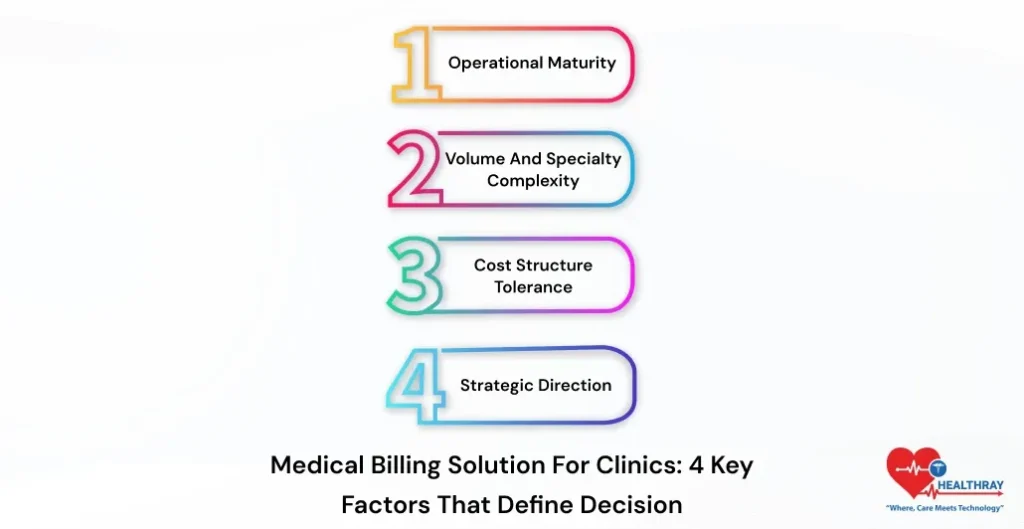
Clinics should evaluate these 4 important angles before making a decision. Further, these factors will help clinics determine which model will be the perfect fit. Let’s elaborate:
Dimension 1: Operational Maturity
Operational maturity is all about how clinics can effectively manage, monitor and improve their billing function. Further, clinics shouldn’t just rely on staff count; they should equally consider the staff expertise, process transparency and leadership involvement. Let’s check more about it:
Clinics Should Ask These Practical Questions
Firstly, the clinic should evaluate the following:
- Whether they have dedicated staff.
- Do your staff have CPC and CCS certification?
- Do you have clear ownership for denial management and appeals?
If clinics lack this clarity, then your system is weak.
Outsourcing Is Better For Low-Maturity Clinics
If your internal capability is not strong, then outsourcing is a practical starting point. Outsourcing approach is not just about services; here clinics are building expertise, structured processes, and experience that they were lacking in their internal system.
Advantages for High-Maturity Clinics
If clinics have a trained team, proper workflows and strong processes, then they can opt for in-house billing software with emr integration or a hybrid model to leverage the full benefits of their abilities.
A Balanced Approach for Mid-Maturity Clinics
Some clinics possess capability but have some gaps in their workflow; a hybrid model is the best fit for them. In this approach, routine work is handled by the internal team and complex billing is managed by the outsourced partner.
Final Insight: First Capability, Then Model
Most importantly, first you should consider your operational maturity, then select a medical billing solution. Further, if clinics fail to recognize their operational maturity, then models will not provide expected results in the future.
Dimension 2: Volume and Specialty Complexity
While choosing a medical billing solution, just relying on software is not enough. Further, clinics claim volume and specialty complexity will help them determine which model is viable financially and operationally. Lets check more about it:
Low-Volume Clinics (Under 500 Claims/Month)
If your clinic is handling fewer than 500 claims per month, then buying full-scale software is not a viable decision. Licensing, training, IT setup and the overall cost of management effort are not justified here. Moreover, outsourcing provides better ROI in such cases.
Mid-Volume Clinics (500–2000 Claims)
This range is an inflection point, where decision-making is not simple. Here, build vs. buy completely depends on specialty type and payer mix. At this point, many clinics face confusion.
High-Volume Clinics (2000+ Claims)
When volume is high, then in-house software economically makes sense. Fixed costs get spread, then they become cheaper than outsourcing in the long term if operational maturity is strong.
Ignoring Specialty Complexity Can Be Risky
Specialty complexity is equally important along with volume. Behavioral health, oncology, cardiology and physical therapy possess complex billing rules and coding.
Final Insight: Volume + Complexity = Right Fit
A clinic can choose perfect billing software when they evaluate both volume and complexity. Relying just on a single factor will eventually create inefficiencies in the practices.
Dimension 3: Cost Structure Tolerance
When choosing a medical billing solution for clinics, just discovering features and convenience is not sufficient. Each model’s cost structure is unique, and whether clinics can financially sustain it is the primary decision-making factor. Let’s check more about it:
In-House Software = Fixed Cost Commitment
In-house billing setup costs are mostly fixed–software licensing, staff salaries, training and IT overhead. Here is the problem: Costs are never easily adjusted for volume, even if your claims get reduced.
When Using a Fixed-Cost Model is Risky
If your clinic is seasonal, or if you are in a growth phase where volume fluctuates and referrals become unpredictable, then a fixed billing cost will create financial pressure. Even if your revenue is less, the cost remains the same.
Outsourcing = Variable Cost Advantage
Outsourced billing is usually percentage-based (around 4%–9% of collection). The biggest benefit is a clinic’s cost moves parallel with revenue. If a clinic’s volume becomes low, cost will automatically get reduced. Also, check the blog of healthcare billing software vendors to know more deeply about it.
Variable Model is Best for Growing Clinics
Clinics whose revenue is not stable, but they are proficient in managing cash flow. In such cases, outsourcing is the best option for clinics. It provides financial flexibility without the need to invest heavily upfront.
Final Insight
A right medical billing solution is one that perfectly aligns with your cost structure and revenue pattern. A wrong cost model creates financial stress in the long term, no matter how many advanced features your software includes.
 PRO TIP
Dimension 4: Strategic Direction
Before choosing a medical billing solution, first, it is crucial to determine where clinics will reach in the next 3-5 years. If direction is not clear, then billing models will provide more restriction, rather than growth and support. Let’s check more about it:
In-house Is Strong Option For Scaling Clinics
If your clinic is growing towards a multi-location and group practice model, then in-house software importance continues to rise. A centralized billing system gives clinics more control, consistency and better financial visibility.
Outsourcing Cost is Heavy on High revenue
When your clinics grow, your revenue increases. And percentage-based outsourcing fees also increase proportionally. In the long term, this cost is significant; this makes the in-house model highly attractive.
Dont Ignore Opportunity Cost
Managing billing internally is not just the question of cost; it is the question of time and cost as well. Every hour clinics spend on billing operations is diverted from growth and patient engagement.
Final Insight
A right medical solution is one that aligns with a clinic’s long-term strategy. If clinics just rely on current convenience and market trends to make decisions, then the certainty system will become a bottleneck in the future.
Applying the Framework: Three Decision Paths
When clinicians clearly understand their operational maturity, volume, cost and strategy, the next step is to apply this framework. From here, the decision for purchasing medical solutions is clear; now clinicians can make concrete and structured decisions.
Path 1: Outsource – When Internal Setup Is Not Strong
If you are an early-stage clinic with low maturity and deal with a claims volume of 1,000/month, then outsourcing is a practical option. This helps clinics achieve stable collections without taking on the stress of building infrastructure. Partnering with a reputable medical collections company can also improve revenue recovery, reduce administrative burdens, and allow staff to focus more on patient care and daily operations.
Path 2: In-House Software – When Capability Is Strong
If clinics have an experienced and certified billing team with a volume of 1,500–2,000+ claims/month and stable growth, then in-house software is a strong option. This approach provides both control and scalability.
Path 3: Hybrid Model – Balanced Approach for Mid-Level Clinics
If clinics have partial internal capability but lack full expertise and run multi-specialty setups, then a hybrid approach is the best option. It creates balance in both control and expertise.
Conclusion
Medical billing solution for clinics does not have any universally best option. Clinics should use models that align with their operational reality, claim volume, specialty needs and long-term strategy. Long-term performance is decided on workflow alignment, not on features and trends. A right billing model is one that solves both current needs and future growth. This balance is the base for long-term success.