


Summary
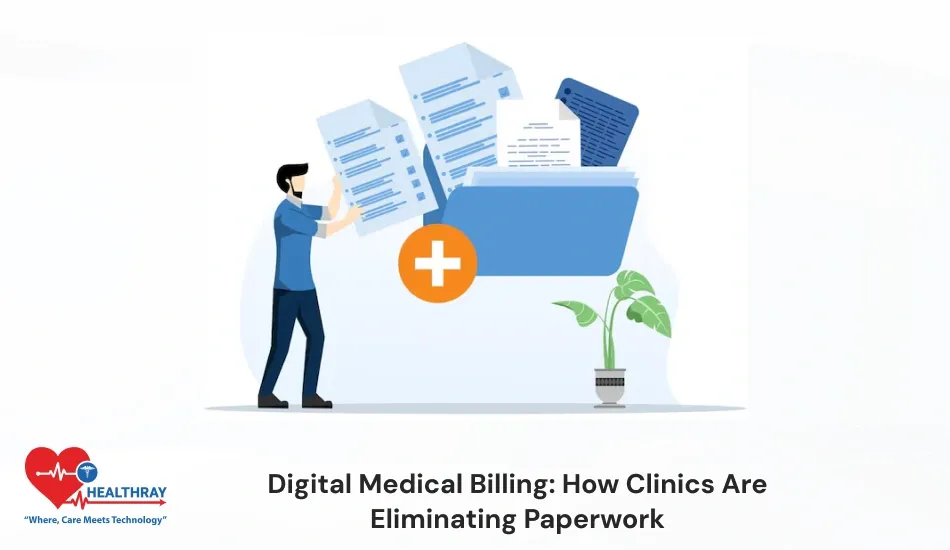
In this blog post, we will examine the transition from manual to digital medical billing in clinics, where everything becomes digital without involving any paper. We look into each step in this process, beginning with data collection when patients check in and ending with changing old records to a paperless system, explaining why there should be no paper left in modern-day clinics.
Introduction
Visit any institution still using manual processes, and this is what you will see: filing cabinets bursting at the seams with papers, superbills unsigned, and EOBs not there, all when the billing process could have been automated many years ago.
Electronic medical billing is no longer a future concept – it is a reality today. Paper-based medical billing systems are becoming obsolete due to late payments, claim denials, and other inefficiencies. In contrast, modern medical billing software systems can detect and flag these issues within seconds, allowing clinics to correct errors quickly and improve overall revenue cycle performance. The change to digital medical billing is revolutionizing the way clinics work, and processes have become more effective because of it. Our guide will offer you an all-inclusive path from your current process to an electronic one.
Breaking Down The Traditional Paper-Based Billing Workflow
1. Track the Claim: From Clipboard to Filing Cabinet
Getting rid of paper starts with understanding its location. A single piece of information written on one page of paper within a paper system will touch at least eight or nine hands – assuming everything goes smoothly. Paper intake forms are filled out by the patient at the reception desk. The intake form is collected and inputted by hand into the computer (possibly even transcribed onto another sheet of paper), after which the doctor writes his notes down, selects the codes by hand for the superbill, and passes the actual superbill off to the billing department, where it is copied and either mailed or faxed away to the clearinghouse.
2. Audit the Paper Trail: Every Touchpoint, Every Document
A thorough audit of all paper-based touchpoints in intake, coding, and submission is key to a successful transition. In reality, almost all medical practices find through their audits that there are far more places where paper is involved in touchpoints than they initially thought – from sign-in sheets to hand-written charges. Here’s a simple breakdown of where paper shows up in a clinic – and how each step is replaced in a digital workflow.
| Paper Touchpoint | Where It Is Found | Digital Replacement |
| Patient intake form | Clipboard at front desk | Patient portal or digital patient registration form before visit |
| Copied insurance card | File folder in front desk office | Electronic eligibility verification in real time |
| Hand-written super bill | Exam room/billing desk | Integrated charge entry process with EHR |
| Printed clinical note | Provider desk / billing inbox | Automated data extraction between EHR and billing system |
| Paper claim | Mail/fax queue for outgoing documents | Electronic submission of claims through EDI |
| Paper Explanation of Benefits/Check | Mailbox/file cabinet for billing department | Remittance advice posting by automated ERA |
| Paper denial letter | Incoming mail/filing cabinet | Automatic denial flagging in billing system |
| Paper storageArchival filing cabinet | Paper storage room | Document imaging with OCR indexing |
Phase 1: Digitizing The Point Of Entry
1. Go Digital: From Paper Forms to Direct Entry
Clipboard use can be described as the original sin when it comes to paper-based billing. Any information written on the patient’s side will always have to be keyed in again by an administrative staff in digital format, doubling workloads and the chances of mistakes. The technology behind patient portals does away with this process altogether. Patients fill out the necessary forms such as demographic data, insurance details, and medical histories through a patient billing system prior to attending the facility. This automatically gets imported into the EHR.
2. Instant Eligibility: From Card Copies to Real-Time Verification
Just copying the insurance card itself doesn’t mean anything. In fact, it doesn’t confirm whether the patient’s insurance coverage is valid, whether you are in their provider network, or whether your services are covered under their plan. Electronic verification answers all these questions instantly when a patient enters your institution, making it one of the key benefits of digital medical billing.
Phase 2: Connecting Clinical Documentation To The Billing Queue
1. Digital Charge Capture: From Exam Room To Billing – No Paper Needed
Superbills are a thing of the past. The physician draws circles around codes, and the person who deciphers them enters them into a billing program, where errors can occur at each stage. Instead, digital charge capture eliminates this process by allowing providers to select codes at the point of care within the EHR itself. Based on the findings by the ONC regarding EHR adoption nationwide, around 96% of non-federal hospitals had implemented certified EHRs by 2021, which is an enormous increase from the rate a little more than a decade earlier. In simple terms, most healthcare providers already have the digital tools they need, so they can completely eliminate paper superbills when they set up billing workflows correctly. Once a provider codes a procedure using CPT and ICD-10, the information is instantly added to the system. It then moves directly to the billing queue without printing or manual steps.
2. Skip The Print-And-Scan: Direct Electronic Transfer To Billing
This is by far one of the most costly invisible costs within a clinic that heavily relies on paperwork. In this case, documentation is printed in order to be used in making claims, but after scanning the documents back into the computer system, more money and time will have been wasted in the process. An optimized configuration of the EHR to billing software will ensure that there will be no printing at all.
Phase 3: Executing The Digital Claim Submission Process
1. Go EDI: Direct Data, No Paper
As a result, clinics no longer mail claims because this process is outdated and belongs in a medical history book. With EDI technology, they can submit claims to clearinghouses almost immediately after charge capture. Modern insurance billing software healthcare solutions automate submission, validation, and real-time tracking, reducing delays and minimizing manual effort in the billing workflow. Real-time scrubbing checks for common errors before the claim reaches the payer, reducing denials and speeding up reimbursements. This is a key advantage of digital medical billing, helping clinics work faster and more efficiently than paper-based systems.
 NOTE
NOTE
2. Automate Payments: EOBs → ERA
Payers usually send Explanation of Benefits (EOB) forms several days after they process a claim. As a result, staff still need to manually review the documents and enter the details for posting. ERA files will eliminate this process. According to the CMS EFT and ERA Operating Rules webpage, ERA and EFT operating rules went into effect on January 1, 2014. These rules make it easier for healthcare organizations to automate the exchange of payment information and save time and resources as compared to reconciling paper remittances. ERA files deliver automated structured data that will reconcile payment amounts without using any paper.
Phase 4: Managing The Migration Of Legacy Paperwork
1. From Paper To Digital: Transform Old Files Into Digital Archive
Becoming digital from this point onwards is merely half the challenge since you will still have legacy paper records dating as far back as decades which will need to be scanned, digitized and indexed for compliance purposes in a digital format. This includes a well-planned scanning process, usually involving Optical Character Recognition (OCR) technology which enables indexing of documents through names, dates of service rendered and claim numbers.
 PRO TIP
2. Reclaim Your Office: Say Bye To Filing Cabinets And Hello To Space
After record verification within your digital system, the physical destruction of the paperwork must follow HIPAA guidelines. Typically, this involves a professional paper-shredding company that provides a certificate of destruction. Once staff destroy the records, they can remove the filing cabinets. They can then use the newly freed space to treat more patients or conduct telemedicine consultations.
Finalizing The Digital Medical Billing Ecosystem
1. Audit Smarter: Digital Tracking Replaces Every Paper Sign-Off
Meanwhile, compliance in a paper world relies on signatures and filing procedures. In contrast, a technology-based billing system automatically logs everything by date and user. If a claim is adjusted, a code is changed, or a payment is posted, the system automatically records who made the change and when it happened. This secure recordkeeping process is infinitely more powerful in its compliance stance than a mere signature on a paper document.
2. Deny Delays: Real-Time Error Alerts Replace Mailed EOBs
Payers send denial letters by mail, and they often take weeks to arrive, explaining the issue in complex payer jargon. As a result, by the time the letter arrives, the window of opportunity for appeals has already passed for several days. Meanwhile, the denial management system instantly identifies mistakes when staff submit a claim and suggests solutions, enabling easy resubmission.
Conclusion
Modernizing the medical billing process is not just about adopting technology it is a complete transformation of clinical, administrative, and financial workflows. In fact, it is a systematic process that encompasses all operations within your practice, from booking an appointment to posting payments. As a result, practices that have gone through the transition benefit from prompt reimbursements, fewer claim rejections, better compliance, and a workforce that is free from mountains of paperwork. Meanwhile, those who haven’t made the transition are still using an outdated, costly, inefficient, and risky system.
These phases described in this article are very practical in nature. In fact, clinics across the United States are already implementing these processes. Your practice is going to undergo a change. The question is not whether it will happen, but when. It could happen either by choice or by force. Get ready for the audit. Chart your progress on paper. Ultimately, make sure that digital medical billing becomes your only reality.