

Summary
Medical Invoice Software makes the billing process of diagnostic labs fast, accurate, and hassle-free. Invoice software helps with cash flow and also makes work easier for employees. This guide will explain how medical invoice generation software functions, what features are important to take into account, and how it improves the efficiency, transparency, and scalability of your invoicing process. Keep reading!!!
Introduction
In the healthcare industry, focusing only on diagnosis and treatment is not sufficient. Smooth invoicing and revenue tracking are equally important. Healthcare organizations spend a significant amount of money on billing tasks. However, many hospitals make little effort in actual patient care.
This problem is not about negligence; rather, it’s about a lack of visibility and outdated manual systems. When invoices are created manually, tracking becomes highly difficult, and error risk increases considerably. Medical invoice software effectively bridges this gap. It treats an invoice not as a simple transaction but as a continuous process where every step is interconnected, from patient registration to final payment.
Through automated calculations, predefined templates, real-time data tracking, and integrated payment systems, medical invoicing software improves both accuracy and speed. Keep reading this blog to learn how the invoice process works in medical billing software. The exact mechanism applies in the system to make the billing more trustworthy and effortless.
A Brief Overview of Automated Invoice Generation
Automated invoice generation is the backbone of medical billing software. Further, this system automatically converts raw clinical data into financial records (invoices). This minimizes manual errors and makes the billing process fast and highly accurate. Let’s discuss more about it:
1. Process Starting Point – Clinical Trigger
Clinical triggers are the starting point from which the automated invoice generation begins. Further, when doctors finalize the prescription in EHR and HMS, or enter the lab reports. The system automatically starts the billing process.
2. Data Capture
As the entry gets saved, the system automatically captures important data such as patient ID, service codes (CPT codes), timestamps, doctor specifics, and consumable quantity. Further, these data are present in a structured format. Thus, the entire system becomes highly fast.
3. Smart Parsing & Workflow Automation
Hospital billing software parses the prescription and lab entries. Further, the system identifies drug names, dosages, and notes and matches them with the standardized price catalog. The system can easily identify the correct charges from the assigned services.
4. Auto Mapping with Tariff & Insurance
Lab tests, such as CBC and lipid profile, automatically get converted to billing items. Further, medical invoice processing software uses dynamic rate cards that include pricing as per insurance and corporate plans. System checks the patient’s eligibility through the API.
5. Zero-Draft Invoice in Seconds
After completion of the entire process, the system generates the “zero-draft invoice.” In which 90% of the details are already filled, such as line items, pricing, taxes (such as diagnostics GST-exempt), and subtotal. Staff just need to check special cases.
 NOTE
NOTE
How Does Medical Invoice Software Ease the Process?
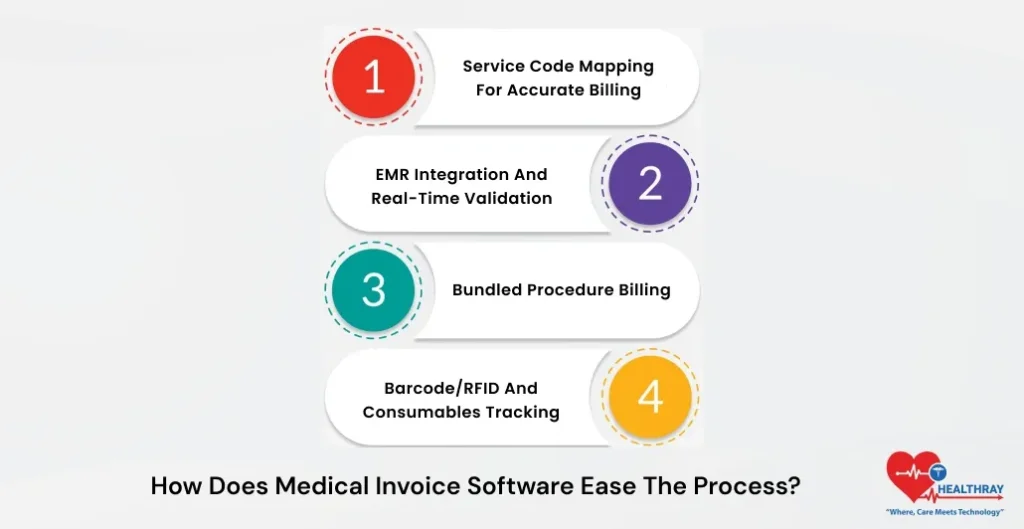
Modern medical billing software automatically captures all the consultation details. Further, this makes the billing process accurate. Without requiring manual labor, the system automatically creates a bill for all of the doctor’s services.
1. Service Code Mapping For Accurate Billing
Medical billing software automatically aligns the consultation type with the appropriate standard cost. For example, higher fees for “New Patient” consultations, normal charges in follow-ups, and extra urgency charges during emergency cases automatically update in the system.
2. EMR Integration and Real-Time Validation
Software automatically integrates with EMR and scans doctor notes and appointment details. Further, this ensures that whatever services are assigned should have the correct billing code.
3. Bundled Procedure Billing
At the time of the medical procedure, the system automatically tracks doctor charges and consumables (such as syringes, gloves, and bandages). At the end, a single consolidated bill includes all the standard wares. This makes it easy for patients to interpret it.
4. Barcode/RFID and Consumables Tracking
Medical invoice-generating software can easily scan consumables with a barcode and RFID and automatically add them to the bill. Further, a hospital billing system increases the billing transparency and ensures that no item gets missed. It reduces confusion in the practices.
How Does Medical Invoice Software Create Smart Test Bills?
Labs are performing more than a thousand tests daily. Therefore, accurate and fast billing is highly imperative for hospitals. Smart software ensures that billing is accurate for every piece of software.
1. Panel-Based Billing
Sometimes, hospitals perform multiple tests on a single package. Medical billing software smartly prevents duplicate charges for the same sample. Further, this creates a clean and simple bill that patients can easily understand.
2. Home Collection
When a lab professional collects the sample from home, the system automatically calculates the distance charges from GPS and updates the same in the system.
3. B2B Billing
When labs collaborate with hospitals, they produce unique “credit invoices.” Further, it already comprises discounted rates, purchase order numbers, and payment terms. This approach reduces the complexity of the collaboration. Also, read our blog on billing departments in hospitals to know more deeply about it.
 PRO TIP
Technical Elements of the Generated Invoice
Modern medical invoicing software automatically creates bills that include tax, payment, and verification. Staff no longer need to work hard to generate standardized bills. Let’s check some of the technical elements of invoices:
1. Tax Rules
Software automatically decides which items will come under government taxes. Blood tests and X-rays do not require GST. However, medicine requires a 12–18% tax. All the operations automatically get organized in a proper format.
2. Organized Bill
In bills, tests, medicines, and charges are displayed in separate sections. Further, patients can easily understand all the billing details, and the clinic no longer faces challenges with GST filing.
3. Easy Payment
Every bill includes a QR code and a payment link. Further, patients can now easily scan the bill through PhonePe, Razorpay, etc. It takes a few seconds to complete the billing procedure.
4. WhatsApp Billing
Clinics can now send the bills directly on WhatsApp. Further, the patient can conveniently activate the link and submit the entire amount in just a few seconds. This approach expedites the billing procedures and prevents unnecessary follow-up calls.
5. Digital Signature
Medical bill-generating software automatically inserts the doctor’s e-signature and lab certifications. This declares the billing process genuine, and most insurance companies can approve it.
7. Tamper-Proof Bill
Medical bill software makes the billing process highly safe and reliable. Further, no one can formulate a change in the invoices. Every invoice includes special hash protection that defines its uniqueness. The system can immediately spot any changes. This ensures complete safety and fosters credibility in the system.
Learn more: Understanding the Basics of Billing Hospital Services
How Does Medical Invoicing Software Close the Billing Loop?
Closing the billing loop is all about completing the entire process of billing, from generating bills to receiving and approving payments. Let’s understand how invoice software accomplishes the billing process:
1. Unique ID
The system creates a unique ID for every invoice generated in the clinics. Further, this becomes a permanent identity. Just like an Aadhaar card. It does not matter if your clinic deals with thousands of bills daily. System securely automates every single step. Clinics can now track the bills easily without stumbling blocks.
2. Full Tracking
Invoice software records every step. They record every activity, like the time of billing generation, who modified it, and the time of payment confirmation. Clinics can easily uncover any illicit activities and take urgent and corrective measures to combat them.
3. Smart Dashboard
Dashboard is a simple and user-friendly screen where hospitals can view all the bill statuses in a single place. Further, staff can easily view which bills are unpaid, which are pending, and which are overdue. This expedites the billing process. Staff no longer need to check every billing requirement manually.
4. Auto Payment Matching
When the user pays the payment through UPI, a card, or insurance. Medical invoice software automatically matches the payment with the correct bill. Staff no longer need to check the bill manually. This saves time and results in fewer errors.
5. Overdue Bills Tracking
Medical billing software automatically detects which bills are pending for 30, 60, and 90 days. Further, staff can send reminders to patients and partners for pending payments. This helps hospitals to collect overdue payments easily.
Conclusion
A medical invoice software converts a complex and messy billing process into a more automated and trustworthy system. Digital prescriptions and test entries automatically get converted to invoices. Software map consultation and services charges; this makes the invoice accurate and avoids the issues of overcharging and undercharging. A platform like Healthray offers AI-based claim checking, real-time dashboards, and multi-branch capabilities, which are highly useful for high-volume labs and clinics. Connect with Healthray to know more!!!