

Summary
Healthcare invoice application is not just a billing platform. It’s an end-to-end financial ecosystem that connects all the steps of a patient’s first interaction to final payment closure. A healthcare billing system ensures a predictable revenue flow and fewer errors. In this guide, I will explore the full ecosystem of billing workflows in different departments. By the end, you can easily understand how billing software can reduce workloads across different divisions. Keep reading!!
Introduction
Most of the time, we think of healthcare billing software as a routine back-office task that begins only after treatment. However, the reality is entirely different. Every patient interaction, whether it’s about appointment booking or final payment settlement, is a part of a continuous financial journey. Still, in 2026, many hospitals, clinics, and labs work on fragmented processes where the critical step of billing mostly gets disconnected, delayed, and becomes completely invisible.
Healthcare revenue loss is not about the lack of patients; it’s all about the billing inefficiencies. Rejected claims, ongoing invoice corrections, and a delayed payment process are not the result of improper handling. This occurs as a result of inadequate coordination and real-time visibility.
The claim virtually disappears as it is submitted. Providers are not aware of this until they encounter system delays and rejections. This type of approach creates unnecessary rework and wastes both time and resources. Here, a modern healthcare billing system becomes a game-changer. The medical billing software does not treat billing as isolated transactions; it considers it an integrated, end-to-end workflow. Continue reading this guide to know how a healthcare invoice system works in different departments and how healthcare professionals can use this software to reduce errors and make the billing process fast.
Healthcare Billing System: Where Revenue Begins
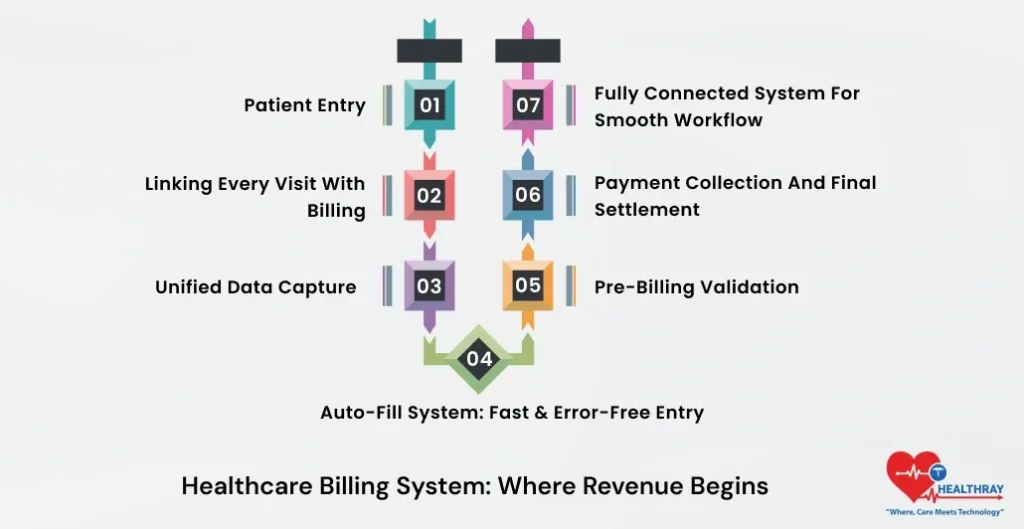
Healthcare billing actually starts when the patient enters the hospital and clinic. From this point, the revenue journey begins.
1. Patient Entry
When a patient fills out forms, books time slots, or walks in, the billing process takes place. Further, the healthcare medical system creates a unique case ID and tracks every visit.
2. Linking Every Visit With Billing
Unique case ID connects all the patient services, such as consultation, test, and treatment, in one place. Further, this reduces the chances of revenue loss.
3. Unified Data Capture
All the essential details of patients, such as name, DOB, contact, and insurance info, are automatically captured in the HMS, EHR, and billing system. Further, this reduces confusion and duplicate entries.
4. Auto-Fill System: Fast & Error-Free Entry
Through FHIR-enabled APIs, data automatically gets filled. Further, this reduces the hectic workload of manual typing and reduces errors by 50%.
5. Pre-Billing Validation
Before initiating the treatment, the healthcare billing system checks:
- Whether insurance is active or not
- Evaluate Copay and deductible
- Authorization is required or not.
6. Payment Collection and Final Settlement
After receiving insurance payment, the system collects the remaining balance through portals and reminders. Further, the system reconciliation procedure ensures the case should be closed at zero balance.
7. Fully Connected System for Smooth Workflow
FHIR-based integration ensures all the department data are synchronized in real time. Further, this prevents data silos and the billing process remains smooth.
 NOTE
NOTE
How Does the Healthcare Billing System Capture Charges From Different Departments?
The healthcare invoice management application works smoothly and accurately when all the department data are properly synchronized. Further, software ensures no charges associated with a consultation, lab, pharmacy, or procedure are left out. Let’s check more about it.
1. Clinical-to-Billing Integration
Doctor appointments, OPD/IPD paperwork, and procedures are directly interconnected with the billing system. As the doctor provides the services, the insurance billing software healthcare application automatically converts them into billable items. Moreover, this integration reduces manual entries and simplifies billing errors that occur.
2. Centralized Capture of Lab, Diagnostic, and Pharmacy Charges
Lab tests, imaging services, and pharmacy-dispensed medicine conveniently get captured in the patient billing account. Further, every department is connected in a unified standardized . This eliminates the need for separate tracking. Overall this makes the billing process fast and accurate.
3. Automated Coding and Standardized Billing Process
The healthcare billing software automatically assigns ICD-10 and CPT/HCPCS codes when services are entered in the system. Further, a standardized coding approach reduces the possible risks of claim rejection. It ensures every billing service has a correct billing structure.
4. Package & Surgery Billing Management
Healthcare billing applications bundle surgical services and treatment packages and convert them into a single fixed price. Further, it calculates all the charges of surgical procedures, pharmaceuticals and rehabilitation services in a single package. This makes the billing transparent, as hospitals are no longer required to calculate the billing manually.
5. Long-Stay Patient Billing Cycles
When patients stay in hospitals for long periods of time, healthcare medical software handles a combination of interim bills and final discharge billing for such patients. This approach minimizes revenue leakage and handles long-term cases accurately.
6. B2B and Walk-in Billing Management
Healthcare invoice software handles bulk billing and credit terms (like 30 days) for lab corporate clients. Further, it handles instant billing for walk-in patients. Overall, medical invoice software efficiently manages both the workflows.
Pricing & Billing Logic Across Facilities
Healthcare billing software uses smart logic to ensure accurate and consistent pricing across all departments. Further, this system automatically handles different scenarios and reduces billing errors in the system.
1. Dynamic Pricing Models Across Services
As we know, pricing is not fixed for every hospital. Further, packages vary for OPD consultation, IPD stay, and emergency cases. Medical invoice software automatically applies correct pricing in accordance with service level, scheduled time, and patient health condition.
2. Insurance And Cash Billing Logic
Medical billing system automatically recognizes the insurance and self-pay patients. Further, software automatically applies contracted rates or copay for insurance cases and standard or discounted pricing for self-pay patients.
3. Automatic Split Billing (Insurance + Patient Share)
Billing system automatically splits the total bill that includes insurance and patient share. Further, this makes the billing transparent and reduces payment confusion.
4. Standardized Pricing Across Facilities
Software applies different rules for hospitals, clinics and labs. This makes the billing consistent at every location and management can easily supervise it.
5. Configurable Rules for Different Setups
Urban hospitals include complex pricing and packages and small clinics use simple pricing. Further, medical invoice systems are flexible and set rules in accordance with every setup.
Learn more: Hospital Billing Systems: Key Features Every Provider Should Know
How Does a Healthcare Billing System Ensure End-to-End Flow Across All Facility Types?
1. Same Procedure Applied in All Facilities
Healthcare payment systems follow a standardized approach in all the departments from registration to payments. Whether a patient arrives at a clinic or is admitted to a hospital, the software follows the same steps. This makes the practices simple and staff no longer need to learn different software.
2. Data Flow From One Facility To Another
Patient data are automatically synchronized to multiple departments through FHIR APIs. For example, clinic consultation data can be directly used in hospital IPD billing without the need to enter the same details again in the system. Further, this approach saves time and mitigates the risks of standard errors.
3. The Billing Structure Remains the Same For Every Facility
Medical billing application keeps the system pricing, coding rules (ICD-10/CPT), and invoice in standard format. Further, the billing format remains the same for hospitals and clinics. This reduces uncertainties and mismatch concerns.
4. The System Adjusts in Accordance With Different Facilities
Hospital billing software uses smart logic, such as simple OPD billing for clinics. It automatically applies complex IPD and package billing for hospitals. In this way, a single system can accommodate the different needs of hospitals and clinics.
How Does Healthray Ensure Seamless Billing Continuity Across Hospital Departments?
1. Centralized Patient Data as Single Source of Truth
Healthray billing software maintains a centralized record where all data such as demographics, insurance, and departments (OPD, IPD, lab, and pharmacy) are stored in a single location. Further, every team uses the same data; this removes any ambiguity and mismatch complications.
2. Real-Time Data Synchronization Across Departments
The Healthray medical invoice system reflects updates in real time. As the lab test gets approved or the procedure gets completed, the system automatically enters the update in the billing. This approach minimizes delays and keeps track of the invoice based on the latest information. Also, read our blog on hospital billing system to know more details about it.
3. Automated Alerts for Billing Accuracy
Built-in alerts in Healthray medical software notify the team if any services get missed or any inappropriate data are entered accidentally in the system. Further, the system can spot any errors immediately and makes the billing process accurate and reliable.
 PRO TIP
Conclusion
Healthcare billing system manages the complete journey from patient registration to final analytics. It connects every step and simplifies the hectic workflow of registration, services, billing and payments. Billing software smartly captures data of multi-department systems consultation, labs, pharmacy and procedures and adjusts it according to pricing criteria for OPD, IPD and emergency scenarios. A connected billing ecosystem provides predictable revenue and helps hospitals in better control and sustainable long-term growth.