


Summary
The hospital market in India is worth almost 99 billion dollars and it is expanding, however, much of this money is silently stolen by billing lapses, manual entries, and TPA claims that were rejected. In 2026, the best medical billing software in India will not just generate invoices. It links up your pharmacy, lab and OPD into one revenue stream so that nothing is billless. This guide specifies the 10 best medical billing software in India, narrowed to ABDM compliance, GST automation, and integrated revenue cycle management. And, whether it is a single clinic or a multi-specialty hospital, this list will help you identify the tool that really counts every rupee.
Introduction
The digital health market in India is expected to reach up to 47.8 billion by 2033, as IBEF states. But despite hospital expansion, billing error and missed consumable, and disconnected systems still cause revenue to leak out before it can hit the ledger.
The issue is not necessarily blatant. A lab report is reported and not billed. A drug request is not attached to the end invoice to the patient. A TPA claim is rejected due to incomplete documentation when it was submitted. On an individual basis, they appear as small holes in operations. Combined, they constitute a trend, which Grant Thornton research on Indian hospitals explicitly singles out as one of the strongest forces propelling the facilities to billing automation and digital transformation.
This is precisely why selecting the best medical billing software in India will be even more crucial in 2026 than it was even two years ago. The devices on this list are not only billing platforms, but revenue protection systems designed to suit the Indian healthcare environment, where GST compliance, ABDM integration, and TPA claim accuracy must coordinate in real-time.
Top 10 Hospital Billing Software In India
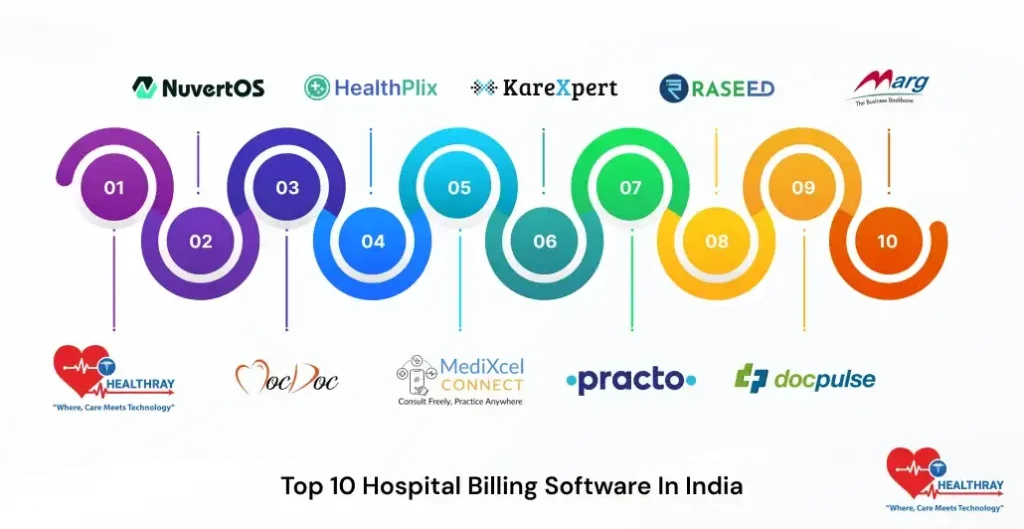
1. Healthray – Unified Billing Meets AI Automation
Healthray is not a billing tool, but a complete revenue cycle platform. It links the pharmacy inventory, lab report, and OPD consultations into one billing engine, i.e. when a laboratory report is created or a drug dispensed the relevant line item is automatically activated without having to be typed in by hand.
As a result, the gap between clinical activity and financial accounting closes significantly. The platform also provides AI-driven recommendations of financial strategies, denial management and HIPAA-compliant billing templates. In the case of hospitals with large patient numbers and multiple departments, such automation saves a lot of billing errors and resource needs are significantly lowered.
- Key strength: Pharmacy-lab-OPD billing unification with AI-driven denial management
- ABDM ready: Yes – ABHA scheme compliant
- Best for: Multi-specialty hospitals, clinics, labs and pharmacy wanting one platform for clinical and financial operations
- Pricing: Custom; demo available
2. NuvertOS – Cloud-First, Zero Infrastructure
NuvertOS establishes itself as an integrated health ecosystem – a single platform which brings together all departments, OPD scheduling, pharmacy, billing, etc, without the need to have heavy on-premise infrastructure. As a result, facilities with limited IT staff can deploy and manage it without complicated setup.
Moreover, its cloud-sync architecture means billing data from any department updates in real time. Front desk, pharmacy counter, and billing section staff operate on the same live data and thus minimize the possibility of missed charges or duplicates.
- Key strength: Fully web-based, real-time multi-department sync
- ABDM ready: Yes
- Best for: Modern hospitals and clinics that want zero server dependency
- Pricing: Subscription-based; free demo available
3. MocDoc – Deep LIS Integration for Diagnostic Heavy Hospitals
MocDoc is unique in how it goes about Laboratory Information System (LIS) integration. Lab findings and billing in most hospitals do not intersect, MocDoc fills that gap by connecting the diagnostic process to the final bill of the patient.
It also includes NABH-ready workflows and automatic monitoring of quality indicators, so it would be a good option in mid-sized hospitals that are getting ready to achieve accreditation. Since diagnostic centres may have to process high numbers of tests and insurance claims at the same time, such an organized integration minimizes the number of errors and time.
- Key strength: NABH-ready LIS-to-billing integration
- ABDM ready: Yes
- Best for: Mid-sized hospitals and large diagnostic chains
- Pricing: Custom quote based on modules
4. HealthPlix – AI for the OPD-to-Bill Pipeline
HealthPlix is an AI that converts clinical prescriptions into formal billing codes – lessening the manual translation process that usually occurs between a doctor consultation and the final invoice. This is the point of greatest billing delays and errors in the case of OPD-heavy practices.
Additionally, it follows longitudinal patient trajectory, implying that one visit is based on the past records. It provides smart drug recommendations and clinical decision support, so it can be useful to individual practitioners that require both clinical and billing efficiency in a single tool.
- Key strength: Prescription-to-billing AI with longitudinal patient tracking
- ABDM ready: Yes
- Best for: OPD-heavy setups and individual practitioners
- Pricing: Subscription-based
5. MediXcel – Insurance and TPA Billing Specialist
The complexity that most generic platforms have difficulties with is managed by MediXcel when it comes to TPA billing software in the case of India. It unites patient registration, EMR, billing, insurance, lab and radiology into a single workflow – and its TPA management module is designed specifically to the cashless claim process that Indian hospitals are navigating day in day out.
Moreover, it facilitates referral management and real-time analytics that provide billing teams with insight into the status of claims, without manually following up on changes. The structured approach to insurance workflows that is offered by MediXcel is likely to be of great use to multi-specialty hospitals and clinic chains that work with a high number of insurance patients.
- Key strength: End-to-end TPA and insurance claim automation
- ABDM ready: Yes
- Best for: Hospitals with high TPA and cashless insurance volumes
- Pricing: Subscription; custom enterprise plans
 NOTE
NOTE
6. KareXpert – Multi-Location, Mobile-First Billing
KareXpert operates on a mobile-first, cloud-based model with more than 60 pre-integrated modules – encompassing all the telemedicine to home care to billing. This type of centralised visibility is truly beneficial to clinic chains or hospital groups that have to handle billing in more than one location.
It is interesting to note that it is supported by Jio, which provides it with infrastructure stability and reach that small platforms might not be able to achieve. Billing dashboards, patient records, and financial reports are accessible to staff no matter what device they use, and this is important in the environment that not all staff are at a fixed workstation.
- Key strength: 60+ modules, multi-location billing from any device
- ABDM ready: Yes
- Best for: Hospital chains and facilities targeting a fully paperless workflow
- Pricing: 30-day free trial; subscription post-trial
7. Practo Ray – Simplest Entry Point for Small Clinics
Practo Ray is still the most user-friendly with small clinics and one-doctor practices that need to have appointment-based billing with a minimal learning curve. The interface is minimalistic and a majority of the staff can learn it in a short time-span – important where time to train is limited.
Moreover, it links patient appointments with billing thus allowing the charges to be added when the appointment is made instead of being added later. Practo Ray provides a low-friction point of departure to clinics that are switching to non-manual registers for the first time.
- Key strength: Intuitive UI, appointment-to-invoice automation
- ABDM ready: Yes
- Best for: Small clinics and solo practitioners
- Pricing: Subscription; free trial available
8. Raseed – Speed Billing for High-Volume OPD
Raseed is a product that is founded on a single concept, which is speed. In high volume OPD centres where large numbers of patients are charged and queues can not afford to slack, the GST compliant invoice generation of Raseed takes only seconds. It automatically calculates tax slabs of consultations, medicines, and lab tests.
In addition to speed, it brings together UPI, credit cards, insurance TPAs and cash payments under one dashboard. It also supports real time synchronization across the devices hence the front desk, pharmacy and billing can all view the same live information. This makes it a very convenient option to medical retailers and pharmacy-attached clinics.
For those running medical shops specifically, billing-software for medical shops covers this segment in detail.
- Key strength: 5-second GST-compliant invoicing with multi-payment consolidation
- ABDM ready: Yes
- Best for: High-volume OPDs and pharmacy-attached clinics
- Pricing: Subscription-based
9. DocPulse – Nursing Home Billing in One Folio
DocPulse helps fill a certain gap that nursing homes frequently encounter, namely the integration of room charges, nursing fees, doctor visit charges and pharmacy dispenses into one patient folio. In the absence of such unification, nursing home billing is usually associated with the retrieval of data in various registers that introduce delays as well as errors.
In addition, it facilitates the integration of telemedicine and easier appointment booking, which is why it is a viable upgrade, whether in smaller facilities that just need to switch to digital or those that transition to digital for the first time.
- Key strength: Unified patient folio for room, nursing, pharmacy, and doctor charges
- ABDM ready: Yes
- Best for: Nursing homes and small inpatient facilities
- Pricing: Cloud-based subscription
10. Marg ERP – Inventory Heavy Practices and Tally Integration
Marg ERP 9+ takes a unique place in this list. Instead of concentrating on clinical billing in isolation, it connects deep inventory management to financial accounting – and that it integrates with Tally implies that billing data is in the form that most Indian CAs and accountants already deal with.
In hospitals/medical stores where billing and pharmacy inventory management and financial reporting cannot be separated, Marg offers such a connection without the need to execute separate export-import processes.
 PRO TIP
- Key strength: Inventory-to-billing integration with native Tally sync
- ABDM ready: Partial
- Best for: Pharmacy-heavy setups and hospitals that want direct CA-friendly accounting sync
- Pricing: One-time license + AMC model
Revenue leakage and billing inefficiencies are among the top pressures pushing Indian hospitals toward digital transformation, as Grant Thornton’s research on Indian healthcare directly identifies making the comparison below more than just a feature checklist.
Comparison: Best Medical Billing Software In India At A Glance
| SOFTWARE | BEST FOR | AI/AUTOMATION | ABDM READY | GST BILLING |
| Healthray | Unified RCM, multi-specialty | Strong | Yes | Yes |
| NuvertOS | Cloud-first, zero infrastructure | Strong | Yes | Yes |
| MocDoc | Diagnostic chains, LIS integration | Moderate | Yes | Yes |
| HealthPlix | OPD, prescription-to-billing AI | Strong | Yes | Yes |
| MediXcel | TPA and insurance-heavy hospitals | Moderate | Yes | Yes |
| KareXpert | Multi-location, mobile-first | Moderate | Yes | Yes |
| Practo Ray | Small clinics, first-time users | Basic | Yes | Yes |
| Raseed | High-volume OPD, speed billing | Moderate | Yes | Yes |
| DocPulse | Nursing homes, inpatient billing | Basic | Yes | Yes |
| Marg ERP 9+ | Pharmacy inventory + Tally sync | Basic | Partial | Yes |
For a deeper look at the different categories these tools fall into, the guide on medical billing software solutions breaks it down by type and use case.
Conclusion
The selection of the most suitable medical billing software in India is not a matter of selecting the one that has the most features. It is about discovering the instrument that bridges the divide between the clinical practice and financial recognition – such that every consultation, every lab finding and every drug dispensing device think about the ultimate bill.
The tools on this list will span the entire spectrum, whether you are operating a single OPD or a chain of hospitals. Here the filters that are India-specific and which will be the most important in 2026, including ABDM compliance, GST automation, TPA accuracy, and real-time departmental sync will all be reflected here.
Prior to booking a demo, pose the following one vendor question to each one: can you demonstrate where your system would have identified a billing gap in my current workflow? It is more than the feature list.
To grasp the entire medical billing process and then judge software, that background will assist you in asking better questions in demos.