

Summary
In today’s healthcare environment, it is no longer practical for organizations to rely on information produced only at the end of each month. In this regard, a healthcare billing dashboard allows one to know in real time the status of the claim, the claims that have been rejected, and the amount collected. This helps healthcare organizations remain proactive instead of reactive.
Introduction
The fact that monthly reports take 30 days to generate is both an inefficient process and a costly one. This is because by the time the monthly reports are generated, there will be denials and recovery time windows will have elapsed, and the finances will definitely be affected. A healthcare billing dashboard which will help in monitoring revenues on a real-time basis through key performance indicators (KPIs) is the solution to this problem.
Think about the practical application of such visibility: there was a medium-sized orthopedic practice that was operating with an average of 48 Days in A/R without knowing the root cause. After 90 days of implementing real-time dashboard reporting within their existing medical billing software, they discovered two underpaying insurance carriers and a front desk eligibility issue that was causing avoidable claim denials each day. The number of Days in A/R decreased to 31 with no additional staff or process changes. Don’t wait for things to blow up when you close the month. Address issues the minute they arise.
Driving Operational Speed With Healthcare Billing Dashboard Systems
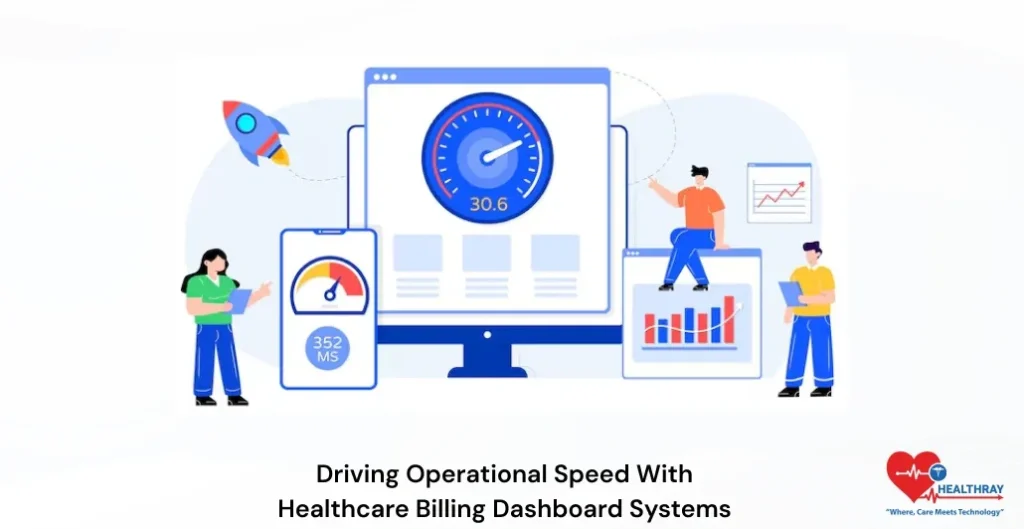
In fact, speed means the difference between a claim recovery and a bad debt write-off. Today’s modern billing dashboard is API-based and integrates seamlessly with your EHR and clearinghouse, enabling a more connected and efficient digital medical billing environment without the typical 24-48 hours delay in data transmission associated with older technology.
What is more, resolving a denied claim within just one day increases the likelihood of recovering money by 50% and above. Time is of the essence here. The real-time dashboard will make you aware of any rejection once it happens; it won’t take a weekly review to identify such rejections.
That is what data velocity is all about – handling revenue while it is still in the air before anything goes wrong. By using the continuous approach to monitor any issues, your billing department will detect sudden spikes in denials and determine what caused them whether it was payer policy changes, problems in the coding process, or eligibility issues at the front desk.
This is not merely an enhancement but a revolutionary change in terms of maintaining financial wellness for practices.
Monitoring Mission-Critical KPIs With Real-Time Data Visibility
Therefore, not all metrics carry equal weight. A focused set of core revenue cycle KPIs should be continuously monitored through a healthcare billing dashboard to enable real-time operational and financial control.
| KPI METRIC | INDUSTRY BENCHMARK (TYPICAL RANGE) | WHY IT MATTERS |
| A/R Days Outstanding | 30–40 days (<35 days high performer) | Represents the speed of payment collection and prevents claims from falling into unrecoverable territory (60+ days) |
| Clean Claims Rate (CCR) | 90–95% (>95% high performer) | Assesses initial claim accuracy to identify issues in registration, coding, or eligibility |
| First-Pass Denial Rate | 5–10% (<5% high performer) | Detects problems related to coding accuracy, payer policy, or process flow issues |
| Net Collection Ratio (NCR) | 92–98% (>95% high performer) | Assesses revenue capture efficiency post-write-off adjustment |
| Reimbursement Time in Days (A/R by Payer) | 10–30+ days (payer type dependent) | Monitors the speed of payments and allows for variance management and budgeting |
These KPIs act as warning signs in the entire revenue cycle process. In other words, any change in a particular KPI indicates problems within the revenue cycle, including patient eligibility, charge capture, accurate coding, claims submission, or new payer policies.
The Net Collection Ratio shows how effectively an organization collects reimbursed revenue after contractual adjustments.
 PRO TIP
Preventing Revenue Leakage With Automated Real-Time Audit Tools
This is because revenue leakage becomes very difficult to detect if there is no real-time surveillance, where coding problems, late submission, and underpayment continue to lower revenue daily. The use of a billing dashboard makes it easy to detect such problems.
Under Coding Diagnosis
A lower percentage of E/M services delivered by a physician compared to the specialty average may indicate undercoding, which real-time audits can identify. People often underestimate the importance of such issues; however, the truth is that it may lead to heavy financial losses for any organization. For instance, according to the report of the Centers for Medicare & Medicaid Services (CMS) on Medicare Fee-for-Service, 49.1% of E/M claims were improper payments amounting to $3.9 billion.
Timely Filing Safeguards
Automated notifications ensure the timely filing of claims before the payer’s deadline, which usually falls between 90 and 180 days. It is particularly critical under Medicare, where the CMS program “Targeted Probe and Educate” reviews providers for recurring billing errors, thus filing past the deadline not only means loss of revenue but also compliance issues. After the deadline expires, the revenue is typically no longer recoverable.
Contractual Underpayment Detection
Moreover, contracted rates are not always reimbursed correctly, which can lead to unnoticed revenue loss over time. A billing dashboard helps compare actual payments against agreed fee schedules in real time, ensuring every claim is paid accurately. As a result, underpayments are flagged before payment posting, allowing teams to correct discrepancies early instead of discovering losses during reconciliation.
Unbilled Encounter Tracking
Consequently, visits that do not get converted into claims can quietly result in significant missed revenue. A healthcare billing dashboard helps identify these unbilled or missing encounters in real time, ensuring that every patient visit is properly captured, documented, and billed. By tracking encounters as they happen, healthcare organizations can reduce leakage and make sure no billable service goes unaccounted for.
 NOTE
NOTE
Customizing Actionable Intelligence: Dashboard Views For Every Role
A generic dashboard works wonders for no one. The most productive dashboard provided by billing systems within healthcare is the one that offers role-specific dashboards to users.
The CFO’s View: It involves an understanding of high-level trends, net collectibles, month-to-month comparisons to plan, and future growth forecasting. Ultimately, it represents the “big picture” that influences capital spending and hiring plans.
The Billing Manager View: The dashboard provides insights into predicted denial scores, daily denial logs, clearinghouse error queues, and payer performance breakdowns. In fact, it serves as the nerve center where revenue hemorrhaging can be stopped in its tracks.
The Front-Desk View: Offers eligibility verification effectiveness, cost estimator at the point of service, and collection tools. Giving front-desk personnel access to this information helps to increase patient payments and simplify subsequent billing processes, especially in practices that rely on streamlined doctor billing software to manage day-to-day operations.
If everyone can clearly see their specific responsibility, decisions get made much quicker, and accountability becomes more intuitive. As a result, the dashboard ceases to be a document to read and instead becomes a means of workflow.
Conclusion
A healthcare billing dashboard helps organizations manage finances and anticipate problems without extra work. As a result, teams spot denied claims immediately, catch underpayments the same day, and flag eligibility issues early. In addition, monitoring KPIs helps prevent revenue leakage from undercoding, unbilled visits, and late filing. An orthopedic practice reduced A/R days from 48 to 31 without hiring staff or changing processes; it achieved this through better visibility. As a result, organizations across roles – from the CFO to the front desk – receive the right information instantly, enabling decisions that no longer wait until month-end.