


Summary
It is not the patient that the solo practitioner is struggling with but the paperwork. Here in this blog you will find out how the doctor billing software can assist you to come out of the paper prison that is choking your practice, taking away your mind and wasting your money. You will gain an in-depth understanding of how to make your practice paperless without closing it down through an actual 30-day paperless transition; improved GST billing or through easy family accounts management.
Introduction
But on the other hand, you wouldn’t have spent ten years studying medicine to become just a bookkeeper. But for the thousands of family physicians working solo in India, work doesn’t end after seeing their last patient; it ends only when the last entry has been made on paper in the clinic’s dim lighting, usually around 8 PM. This is exactly where medical billing software becomes relevant, as it removes the need for manual end-of-day bookkeeping entirely.
This problem is of immense importance. As per the estimate by the Press Information Bureau, there are about 13,08,009 allopathic doctors enrolled in India. Furthermore, the vast majority of these doctors use outdated systems such as handwritten registers and cash memo for their record-keeping system. This is particularly significant in a country where the doctor-to-patient ratio is already quite high.
It’s not about patient numbers; it’s all about paperwork. You end up working yourself up against the number of receipts that you can produce, payments that you have to keep track of, and dues that you have to juggle, which may mean neglecting the important things. This article will walk you through the process of moving from traditional billing to online doctor billing software.
1. Administrative Ceiling: How Manual Systems Limit Growth
And now comes the realization when all GPs working alone come to realize that generally, they are capable of handling only 20-25 patients in a single day. But all of the above concerns have nothing to do with the expertise of the GP in his field of medicine. It is the extra documentation work on the backstage that creates trouble.
When working in the OPD while handling patients, one encounters certain situations that are difficult to understand: paying and going home without taking the receipt, patients claiming that they had already made their payment when there was no such record, small cases where treatment like dressings and nebulization takes place for free of cost. Such instances take place very often, and apart from these, the patient payments made via UPI, who haven’t made their payment, and consultations that took place without charging anything are some of the other instances of recording that need to be maintained. It is a system similar to a patient billing system, where there are certain billing processes that are followed to reduce mistakes and increase accuracy. Hence, along with consuming the precious time of the GP, the manual entry of information stops future growth.
2. Reclaiming The “After-Hours” With Doctor Billing Software
Let me explain what the conventional system consists of: It is 7 p.m. Your last patient left an hour back, but you are still working on your computer, comparing slips with an account book by hand to verify that your collections for the day are indeed sensible. It is a tedious process, and it is totally redundant.
In the current times, the transaction can be documented instantly, whether it is paid in cash, through UPI, or card, and the bill will immediately reach the patient’s cell phone before they leave the clinic. This comparison demonstrates how both systems work in terms of everyday tasks at the clinic.
| Daily Task | Paper-Based Billing | Doctor Billing Software |
| Generating a Patient Invoice | By hand, leading to errors | Generated automatically within seconds |
| Cash/UPI Payment Tracking | Manual entry; separate registers | Automatic tracking through real-time dashboard |
| Unpaid Patient Charges Collection | Manual process that feels intrusive | Automatic alert at every subsequent visit |
| Small Procedures (Dressings, Nebulization) | Often overlooked | Reminded by a list of services |
| GST / tax compliance | Manual calculations, compliance risk | Pre-set configuration, automatic application |
| Daily reconciliation | 60-90 minutes manual calculations | Under 5 minutes, computer-generated |
| Patient is provided with a receipt | Paper forms are easily misplaced. | Invoice generated on patient’s phone |
| Searching previous patient balances | Scanning old books | Instant check-up via patient’s name |
It’s not a minor modification; it’ll save you an hour each day without impacting your income. Billing software that caters to independent GPs can compile your daily report with just one click.
3. Real-Life Use Case: A Solo Gp’s 30-Day Pivot From Ink To Digital
Dr. Mehta is a solo GP in Surat and has operated his local clinic in the same way for seven years, using a ledger book and pre-printed receipt pads. However, when the number of his patients per day was about 22, the paperwork was overwhelming. Unpaid bills began to accumulate, there were patient conflicts due to billing mistakes, and he was working at least 90 minutes a night to take care of accounts after the clinic closed. To evaluate this properly, he chose to test billing software for one complete billing cycle – 30 days. This wasn’t random. A 30-day period encompasses all categories of patients: first-time patients, follow-ups, long-term patients with a family account, and minor surgeries that are often under-billed. As a result, it provided him with sufficient real-world data on how the system worked in his actual practice, not just in theory.
At the end of the first week, Dr. Mehta realized he had regained revenue he did not even know he was losing. This improvement came from adopting digital medical billing, which ensured that every consultation and minor procedure was automatically recorded and billed. The software had the ability to automatically capture small services like nebulization or dressing that had previously been recognized but were not billed. His collections were growing monthly, and he had not seen a new patient.
His time was the greatest change by week four. He reduced his post-clinic work to less than 10 minutes. The software had done what manual systems had failed to achieve- it bridged the gap between the care he gave, and the revenue he earned.
4. Professionalizing The Small Clinic – Aligned With ABDM
Unwritten issues arise in solo GP practices in the form of perception problems. In particular, people may believe that a handwritten receipt makes a medical institution appear small or unprofessional. Using modern tools such as a Medicine Reminder with Expiry system can improve patient confidence by helping track medications, expiry dates, and reminders while giving the practice a more organized and professional image. This is not necessarily true, but it influences patient perception. Doctor billing software eliminates this problem. It replaces handwritten receipts with clear digital invoices and organized records. It follows principles similar to software for hospital billing used in hospitals for structured financial management.
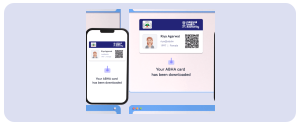
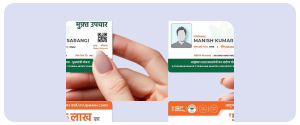
The Ayushman Bharat Digital Mission in India has systematically developed this infrastructure. At the time when this project was completing its three years, a press statement released by the PIB suggested that 67 crore Ayushman Bharat Health Accounts had been created, 42 crore health records had been integrated in a digital manner, and 1.3 lakh healthcare facilities had been already enabled for ABDM, which includes more than 17,000 private clinics.
The solo GPs message is very simple: the nation is going digital in healthcare and the patient is starting to demand it. The electronic invoice, combined with your professional branding, helps maintain your credibility as well. You get your clinic name, consultation detail, and proof of payment all packed into one invoice, thus creating the same level of credibility that a multi-doctor hospital does, even when you are the lone practitioner there.
 NOTE
NOTE
5. Financial Safety For The Non-Accountant Doctor
This is one question that most solo GPs will dread asking, quietly: “Should I charge GST on this consultation? The calculation of taxes in the middle of the OPD is not only distracting but a real compliance risk. GST or discount error can cause under-billing, over-charging and headache during tax filing at year end due to manual errors. With billing software, this can be totally removed through what can be referred to as zero-math billing within the medical billing process. Once you set it up, the system automatically applies GST rates, discounts, and service charges to all transactions without any manual calculation.
More to the point, it seals what could be termed as the pocket leak – the unconscious tendency to drop little billable services since it feels uncomfortable to bill them at the point in time. Such add-ons as wound dressings, nebulization, or ECG interpretations can be found in the service catalog of the system. The system prompts you to add these services during billing, ensuring nothing goes uncharged.
 PRO TIP
6. Managing The “Family Account” Without The Ledger
For instance, when it comes to a typical clinic in a neighborhood, chances are quite high that one will find a lot of requests for delayed payment from people they know and have taken care of for a long time – whether it is the family who has been visiting for a couple of years, a senior citizen, or simply someone they know around the town. However, keeping track of such payments can prove to be a rather complicated matter if paper-based means of registration are used.
Hand-written data is likely to get lost very soon, which means that recalling the remaining payments when the client visits next time will not be an easy task at all. A healthcare billing system helps solve this by keeping all patient dues and family account records structured and easily accessible. With the help of billing software, however, one does not have to look for any particular data. Instead, they can easily find out what their patient owes them and act professionally in terms of money transactions.
Conclusion
The idea of changing to doctor billing software is not to transform your clinic into a company. It’s about giving yourself (a skilled, trained medical professional) the liberation to give 100 percent of your attention to what you actually trained: to take care of patients. Consider it like this: investing in digital billing is like having a virtual receptionist that never takes a sick day, never makes a calculation error, never loses a receipt, but silently works behind the scenes the first patient to walk in and long after you have gone home. The age of paper was over. However, in the case of a lone GP who needs to grow sustainably, profitably and without going out of business, the only way to go is digital. Your drug is contemporary. Your billing ought to be as well.