



Summary
Most clinics believe that digital scheduling means a cold and impersonal experience. However, the issue is not related to technology; rather, it is a matter of friction. Manual booking, scattered calendars, and lack of follow-ups bog the workflows and disrupt the entire patient experience. Therefore, choosing a doctor appointment system is a strategic decision. In this blog, I will discuss how the best doctor appointment system improves turnaround time and automatically reduces error in the system. Also, I will discuss what features clinics should look for and which system eliminates friction, handles growth without anarchy and makes the clinic’s workflows stable, fast, and confident in 2026.
Introduction
When clinics and hospitals compare doctor appointment systems, they mostly focus on surface-level features such as online booking, reminders, calendar view, etc. However, this is not the actual issue. Appointment chaos often isn’t caused by using the wrong tool; instead, it is the result of fragmented workflows, manual coordination, and systems that are not properly aligned with real clinical operations. In India, clinics handle high patient volume, walk-ins, and frequent rescheduling with limited front desk staff.
In USA clinics, practices follow strict compliance, documentation, and billing-linked scheduling rules. Despite the differences, both countries face the same issue: appointments are disconnected from clinical or operational workflows. That’s why choosing a doctor appointment system is not just a technical decision; it’s a strategic decision.
A strong system not only books slots but also creates rhythm in daily operations and reduces dependency on calls or spreadsheets and brings clear visibility among different departments. With the best doctor appointment system, staff no longer react to the problem; instead, they manage the patient flow with clarity. While comparing doctor appointment systems, reviewing only the feature checklist is not sufficient. It is highly important to understand which system improves efficacy, makes the patient experince better and ready to scale clinics in the long term.
How Leading Systems Tend To Differ
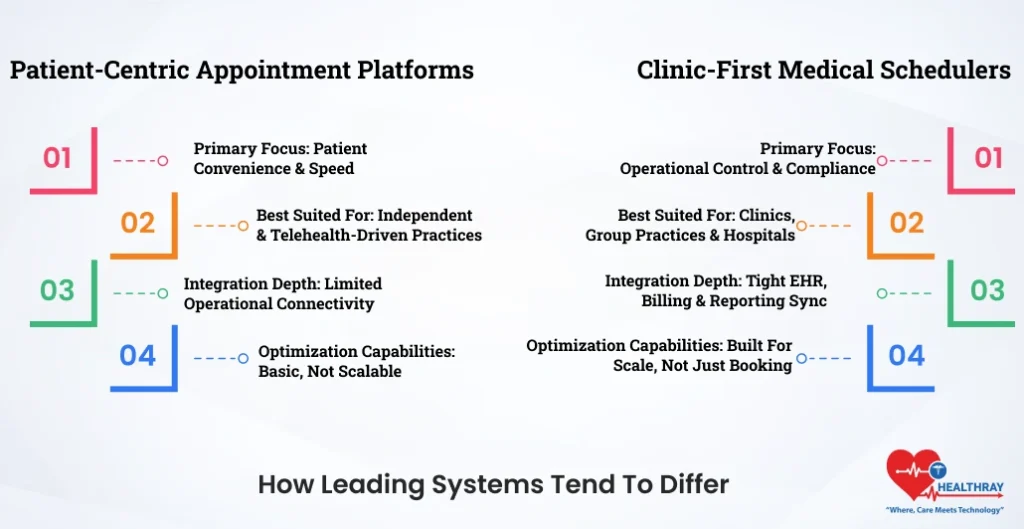
Below we will compare the two leading platforms:
Patient-Centric Appointment Platforms
Let’s check out:
Primary Focus: Patient Convenience & Speed
The main focus of the patient-centric appointment platform is on convenience and speed. Furthermore, their design is completely centered on patient perspective, such as doctor discovery, quick booking, reviews check and confirming appointments with minimum steps. This approach improves clinic visibility and reach, particularly for independent doctors and telehealth-heavy practices.
Best Suited For: Independent & Telehealth-Driven Practices
These platforms are optimal for practices where accessibility is the biggest priority. Furthermore, patients get fast access and clinics get discovery benefits. However, as the patient volume increases, only convenience-based recurring doctor appointment scheduling is capable of handling operational pressure.
Integration Depth: Limited Operational Connectivity
When it comes to deeper clinical workflows, patient-centric software is inadequate. Moreover, integrations are confined to teleconsultation and payment options. Furthermore, it lacks strong linkage with EHR, billing, and internal coordination, resulting in data fragmentation.
Optimization Capabilities: Basic, Not Scalable
Features like reminders and no-show reduction work at a basic level. However, advanced capabilities like scheduling optimization, load balancing, and utilization control are still limited. It seems workable for the short term but for long-term growth, it lacks operational control and structure, which is highly imperative. Now, let’s talk about clinic-first medical schedulers.
Clinic-First Medical Schedulers
Let’s dive in:
Primary Focus: Operational Control & Compliance
Clinic-first medical scheduler approach relies more on clinic operations than patient convenience. Further, its primary focus is on doctor utilization, complex calendars, waitlists, and regulatory compliance. Here, scheduling is not an administrative task, but it’s a controlled operational process.
Best Suited For: Clinics, Group Practices & Hospitals
This Doctor Appointment Calendar System is suitable for multi-specialty clinics, group practices, or hospitals where internal coordination is critical. Further, as it involves multiple doctors, departments, and locations, it provides clinic-first schedulers stability and predictability.
Integration Depth: Tight EHR, Billing & Reporting Sync
Along with EHR/HMS, billing, and reporting, tight integration is the strong foundation of this system. Further, data is not scattered in different parts ; instead, it moves in a single flow. This minimizes manual handoff and improves visibility.
Optimization Capabilities: Built for Scale, Not Just Booking
Here, scheduling is not just limited to slot booking. Further, it helps clinics scale AI-driven slot optimization, load balancing, and analytics without anarchy. Undoubtedly, growth is inevitable. However, clinic-first systems mainly handle growth in a well-organized way.
What Actually Matters While Comparing
“Which platform is better?” shouldn’t be the focus of a comparison of medical appointment systems. Further, clinics should mainly focus on platforms that can reduce their daily operation friction. Patient-centric platforms attract growth; on the flip side, clinic-first schedulers sustain growth. In the long run, the system that keeps the information flow uninterrupted, helps the team to work in the same rhythm and keeps the clinics stable, compliant, and confident is a successful one.
Pricing, Scalability, And Future-Proofing
Let’s find out:
Pricing Models: Cost Beyond the Entry Point
Automated appointment reminders for doctors range from low-cost, per-user SaaS tools to enterprise platforms. Also, it includes custom pricing. If your system is incapable of handling patient volume, workflows, or HIPAA compliance needs, then the hidden cost of staff overtime and patient churn slowly accumulates. Real costs are the ones that impact daily operations.
Scalability: When System Works Parallel with Volume
As the clinic’s size increases, the appointment system should be able to grow with it. The system that is handling immense load presently may fail to handle the future pressure if it’s composed with excessive rigidity. Scalable system helps clinics maintain consistency even with patient volume, doctors, and other location variations.
Future-Proofing: AI-Ready and Modular Architecture
AI-driven features like smart routing, predictive no-show scoring, and automated phone-based booking are rapidly gaining ground. Platforms that invest in modular or flexible architecture morph in accordance with clinic operations. These systems not only support current needs of clinics but also build a strong foundation for growth, complexity, and confidence for the upcoming years.
User Experience For Patients And Staff
Let’s check out:
Patient Experience: Simplicity Builds Trust
Adoption fails regardless of how strong your system is if it is still vague. Best-in-class appointment systems provide clear communication to patients regarding mobile-friendly booking, easy reschedule or cancel options, and location, provider, or visit type. When the process is simple, patients feel confident. This naturally minimizes no-shows.
Staff Experience: Clarity Drives Consistency
User experience is the fundamental aspect of operational stability for staff. The system provides intuitive dashboards, color-coded calendars, and quick actions like bulk rescheduling, drag-and-drop updates, and ready message templates to help clinics manage their daily workload. When tools are clear, staff do not contend with systems; instead, they operate in the same flow.
Adoption & Training: Fast Learning, Faster Impact
Training requirements should be practical and manageable. Leading appointment systems are set up in such a way that receptionists or care coordinators become proficient in just a few days, not even a week. When the learning curve is short, clinics adopt better scheduling habits without disruption and maintain long-term consistency.
 PRO TIP
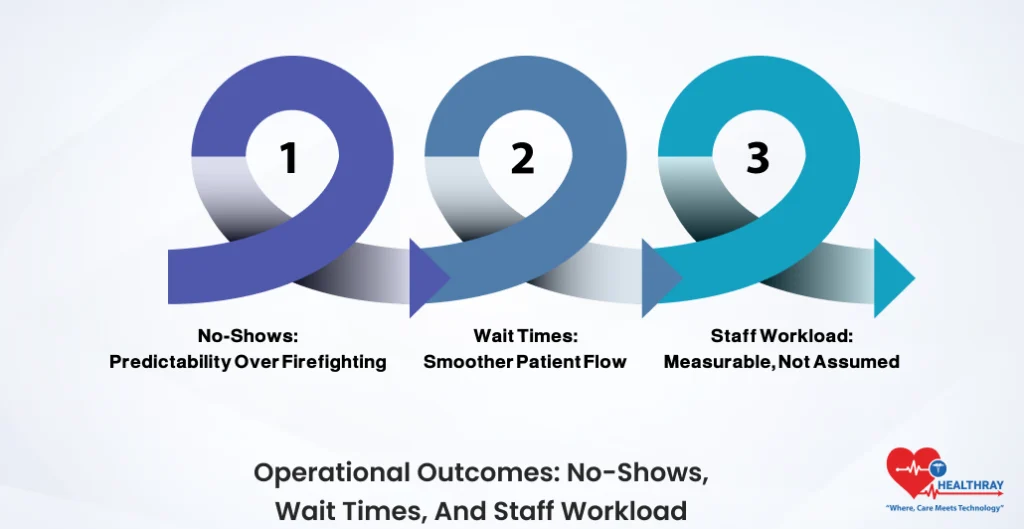
Operational Outcomes: No-Shows, Wait Times, And Staff Workload
Let’s check out:
No-Shows: Predictability Over Firefighting
In 2026, doctor appointment systems are not weighed based on features. Clinics are expecting valuable outcomes, especially no-show rates. When clinics configure automated reminders, AI-based waitlist fill, or smart follow-ups perfectly, then missed appointments will significantly go down. This relieves staff from last-minute firefighting and makes schedules more cohesive.
Wait Times: Smoother Patient Flow
Average wait time is the direct indicator of scheduling quality. Real-time schedule accessibility and optimal slot consumption help clinics maintain smooth patient flow. When clinics are capable of spotting bottlenecks before they occur, this helps minimize delay and fosters patient fulfillment.
Staff Workload: Measurable, Not Assumed
Physicians and staff can easily measure the time on daily appointment volume. Doctor appointment system provides analytics dashboards and detailed reports and also empowers clinics to consistently refine their rules and templates. When workload becomes visible, decisions are no longer based on speculation; rather, they depend on accurate data. This naturally boosts the productiveness and performance.
 NOTE
NOTE
Best Doctor Appointment System: A Practical Checklist To Choose The Right System
Let’s find out:
Clinical Fit: Real Workflows and Support
Firstly, the system should be capable of adjusting to your clinical reality. Does your system support your specialties, different visit types, and multiple locations without workarounds? For adjusting scheduling, if you need extra staff members, then your system already creates friction.
Automation Depth
Automation should not be limited to implementing reminders. Strong appointment systems smoothly handle recurring visits, waitlists, and rule-based slot control. The deeper the automation, the less you require daily coordination or follow-ups.
Step towards digital era with our healthcare solution
Revamp your hospital facilities and embrace change for better healthcare management. Ease in managing and organizing large medical datasets leads to effective analysis. Seize the opportunity now!
Integration Stack
An appointment system is effective only when it is securely working with EHR/HMS, telehealth tools, and payment systems. When data flow is seamless, chances of replication are smaller. It evades the staff’s need to constantly seek insights.
Final Perspective: More than Generic Ranking
Your doctor’s appointment system is no longer a “vague top-10 label” when you use this checklist. Instead, it becomes a specific and viable decision for your clinical environment that delivers reliability, efficiency, and long-term certainty.
Conclusion
The best doctor appointment system does not stand out just by delivering online booking. The real difference you will perceive when your system efficiently fits in your clinic’s workflows, smoothly integrates with your existing tool, reduces no-shows and securely protects patient data. When clinics are capable of spotting bottlenecks before they occur, this helps minimize delay and fosters patient fulfillment.