

In This Blog
All you need to make an informed Build vs Buy choice for your clinic. Get insights on how to analyze your processes, integrations, compliance requirements, and expenses to make your selection.
- The six parameters that define whether or not your clinic would benefit from the development of a custom clinic platform
- An analysis scoring tool based on mathematics rather than a list of factors to consider intuitively
- Red flags indicating when your clinic’s current SaaS solution may actually be more expensive than you realize
- The three recommendation zones and the implications of each
- Cost factors that do not factor into licensing cost comparisons but tend to rise over time.
The majority of the clinics’ leadership gets the answer to this question wrong, but it’s not because they are dumb. They are comparing vendor demos rather than considering their needs. This framework lets you assess six weighted factors and determine whether to Build, Buy, or Blend.
Criterion 1: Proprietary Workflow Uniqueness With 25% Weight
This is where the most emphasis lies in the overall structure – and rightly so, since it forms your clinic’s competitive edge.
Now, be truthful with yourself: Does your clinic operate exactly like a traditional primary care office? If any other clinic can easily replicate the processes you follow down the street, then off-the-shelf clinic management software will work just fine. However, if your clinic’s uniqueness is in service delivery, forcing an out-of-the-box solution may hinder operations.
Score Your Clinic:
- 1–2 Points: Standard workflows easily mapped to mainstream SaaS → 25–50 Points
- 3–4 Points: Multi-specialty or specialized onboarding requirements → 75–100 Points
- 5 Points: Proprietary workflows creating measurable competitive advantage → 125 Points
Architect’s Insight: If you need your workflows to be your competitive differentiator, you’re not just limiting yourself – you’re boxing yourself in.
Criterion 2: Ecosystem Integration Complexity With 20% Weight
There is no single solution to the problem of a modern clinic. The real issue here is the complexity of your integration map and how much it gets exacerbated with time.
Basic tools such as staff scheduling software for clinics, payment gateways, e-prescription APIs, and email platforms are well-handled by SaaS solutions. When integrating with legacy PACS, lab systems, or custom diagnostics, custom clinic software development becomes essential.
Score Your Clinic:
- 1–2 Points: Standard integrations – payments, email, e-prescribing → 20–40 Points
- 3–4 Points: Mix of modern APIs and legacy healthcare systems → 60–80 Points
- 5 Points: Deep integrations with medical devices, imaging, or custom hardware → 100 Points
Architect’s Insight: All the workarounds created around a limit to your SaaS application integrations represent hidden technical debt in your operations budget.
Criterion 3: Custom Clinic Software Development With 15% Weight
The solution is economical in the first month of software development implementation, but the numbers don’t scale the same way for larger organizations.
For $200 per seat per month, a clinic with three providers is affordable. In comparison, a clinic with 40 providers spending $10,000 to $15,000 per month for licensing fees, with annual increases included in the vendor contract, is an entirely different ballgame. While software development requires more upfront costs, the advantage is that the fees do not keep piling up, and you will own the solution.
Health care clinics assessing the software during the period of 5 to 7 years should not only look at the costs associated with licenses but also take into account the operational efficiency, taking into consideration the advice provided by HealthIT.gov on the advantages and disadvantages of health information technology. Although SaaS lowers initial costs, the ongoing fees, per-user costs, and integration expenses can be high after some time.
Score Your Clinic:
- 1–2 Points: Licensing costs remain predictable and manageable → 15–30 Points
- 3–4 Points: Software costs scaling faster than operational revenue → 45–60 Points
- 5 Points: High-volume operations where ownership creates real savings → 75 Points
Architect’s Insight: The payback period for custom software in mid to large-sized clinics generally comes around within the first 24-36 months.
Criterion 4: Regulatory Data Compliance Sovereignty With 15% Weight
Compliance is no longer an item to check off. Compliance is now risk architecture, and the consequences are far greater than many clinics think until disaster strikes.
If the clinics have to deal with patient data that covers various geographic locations, then compliance features provided by SaaS software cannot be sufficient in such instances. Compliance, coupled with workflow automation for doctors, would require a lot of planning and even customizing of infrastructure based on various data residency laws, as well as GDPR compliance needs in various regions.
Clinical systems developed for environments that need to be regulated can sometimes require more control over security and auditing than typical systems. There is a guidance system called the NHS Data Security and Protection Toolkit, which helps organizations manage the handling of patients’ data.
Score Your Clinic:
- 1–2 Points: Standard HIPAA or GDPR SaaS compliance is sufficient → 15–30 Points
- 3–4 Points: Requires data residency controls or multi-region governance → 45–60 Points
- 5 Points: Requires complete ownership of security architecture and audit trails → 75 Points
Architect’s Insight: Compliance architecture control is a competitive advantage that software-as-a-service platforms lack.
 NOTE
NOTE
Criterion 5: Operational Launch Window Urgency With 15% Weight
Deployment speed is a concrete factor of operation that cannot be ignored after you have already made a decision, especially within the tense setting of healthcare facilities.
If your facility is struggling with scheduling, billing, or patient communication, you will need a solution quickly. Clinics searching for the best clinic management software often find that off-the-shelf systems address immediate operational challenges without waiting for custom development. In contrast, custom clinic software development typically takes 6–18 months, which makes it unsuitable during an ongoing operational crisis.
Here, working with a seasoned software development partner will guarantee that the development process adheres to clinical goals, regulations, and long-term sustainability, instead of focusing on temporary solutions.
Score Your Clinic:
- 1–2 Points: Immediate need – operational challenges require a solution now → 15–30 Points
- 3–4 Points: Can support a phased rollout across several months → 45–60 Points
- 5 Points: Leadership committed to building a future-ready, highly tailored platform → 75 Points
Architect’s Insight: Timing is critical; selecting Build without taking urgency into account poses an operational risk.
 PRO TIP
Criterion 6: Platform Commercial Value Asset With 10% Weight
This is precisely the test by which a clinic will differ from a healthcare business and thereby determine the nature of software as a strategic growth enabler.
Software that simply helps manage scheduling, billing, and record keeping can be viewed as an expense center, and a good SaaS solution can help manage such expense centers well. However, software developed through custom clinic software development that has the potential to shape the patient experience, improve retention, and even enable franchising or white-labeling for other clinic organizations is indeed a profit center.
Score Your Clinic:
- 1–2 Points: Software serves as an administrative support tool only → 10–20 Points
- 3–4 Points: Software contributes to patient experience and operational efficiency → 30–40 Points
- 5 Points: Software is a strategic asset – potential for franchising, white-labeling, or new revenue → 50 Points
Architect’s Insight: When the platform itself is part of the offering, developing it isn’t considered an IT cost. It’s an investment that has an ROI.
Each of the criteria emphasizes a distinct factor involved in deciding whether to build or buy. After evaluating the six factors, use the formula below to determine whether buying or building is best for your clinic.
Master Score Evaluation & Recommendation Matrix Framework
Mathematical Multiplier Formula:
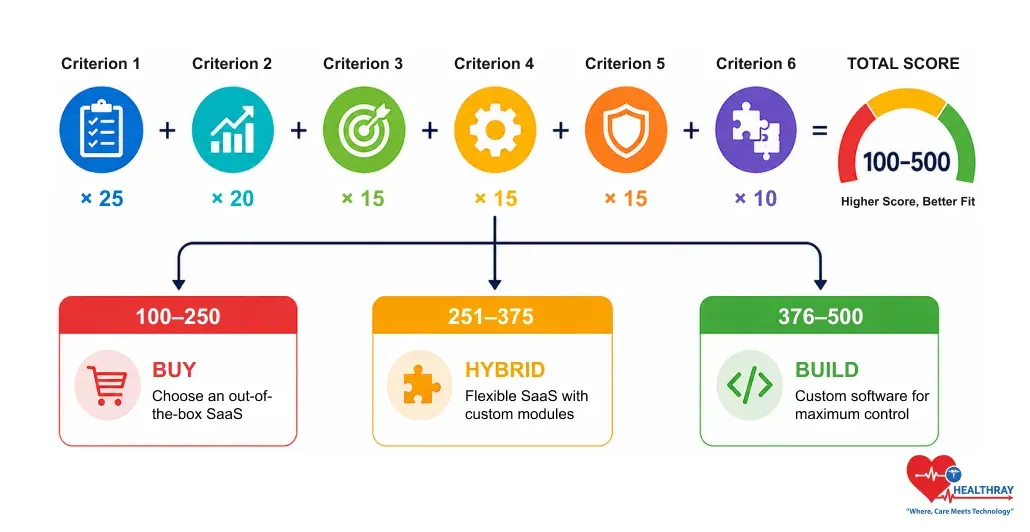
Total Score = (Criterion 1 × 25) + (Criterion 2 × 20) + (Criterion 3 × 15) + (Criterion 4 × 15) + (Criterion 5 × 15) + (Criterion 6 × 10)
The evaluation is done on a scale of 1 to 5, where, after multiplying it by its own weightage, the result obtained will be between 100 and 500. This result aids you in knowing which system will fit the requirements of your clinic – Build, Buy, or Hybrid.
Final Operational Verdicts:
- Score 100–250 → BUY: It’s time to buy an out-of-the-box, already built SaaS product. You don’t need any complex integrations or workflow automation that goes beyond the current capabilities of SaaS platforms. Save yourself the trouble and pick a vendor instead.
- Score 251–375 → HYBRID: You’ve progressed past the point of being satisfied with pure SaaS but haven’t reached the level where you require something entirely from scratch. You can achieve this by combining a proven SaaS core with modules tailored to your unique needs.
- Score 376–500 → BUILD: Invest in custom clinic software development for your clinics. Your business processes, regulations, integrations, and goals need a solution beyond what SaaS configuration alone can offer. With building, you gain independence and control that SaaS cannot offer you.
Learn more: How Clinics Improve Patient Experience at Every Digital Touchpoint, exploring how clinics leverage technology at every stage of the patient journey to deliver faster, more personalized, and seamless care experiences
To Sum Up: Choosing The Right Foundation For Growth
Choosing to build vs. buy is not about whether you like a platform; it is about determining which one works best for your clinic based on its processes, needs, regulations, and future goals. This model allows you to move away from vendor presentations and look at what makes sense for your operation.
Clinics with standardized processes and urgent change needs benefit most from tried-and-tested SaaS products. Clinics with custom workflows, integration needs, or high compliance standards gain from hybrid solutions without full software reconstruction. Score your results to gain a scientific insight into whether SaaS, Hybrid, or Custom software best supports your sustainable growth.