



Summary
Revenue generation alone does not improve financial performance. Hospital revenue is a continuous flow where every stage directly impacts the cash flow. Registration problems, improper coding, delayed claim submission, and payment posting challenges seem small, but they create significant financial loss when they occur at scale. This blog will cover how revenue cycle management software in healthcare can improve financial performance and simplify the cash flow in practices.
Introduction
Hospitals often believe that a cash flow problem is solely a financial issue. However, in most cases, problems arise in the billing and collection process. Payment that seems delayed is the result of a breakdown of the actual revenue cycle in multiple stages. Many hospitals think of billing as the last step. They think if billing is accurate, then revenue is stable. However, real financial risks start after the billing process. Claims get delayed, denial increases and collection becomes unpredictable.
The reality is a hospital revenue cycle is not just limited to bill generation. It begins from the patient’s first touchpoint–from booking the appointment to receiving final payment. It includes multiple steps in between, such as registration, eligibility check, coding, claim submission, adjudication and payment posting. If errors occur at any stage, then the entire process becomes slow. If this error occurs at a large scale, it will directly impact cash flow. Here, revenue cycle management software in healthcare plays a critical role. Advanced medical billing software captures accurate data through real-time verifications and automated procedures. This helps hospitals to efficiently control their billing operations and improve their financial performance.
How Does Revenue Cycle Management Software in Healthcare Strengthen Hospital Financial Performance
Hospitals create significant revenue but actual cash inflow does not occur regularly in time. Furthermore, this mismatch clearly demonstrates that the problem is not with pricing or demand, but rather with the process. Let’s check how the RCM application improves cash flow:
1. Billing Inefficiencies: Small Errors, Big Financial Loss
Hospitals usually consider small billing mistakes such as incorrect codes, missed charges, and incomplete documentation insignificant at the initial stage. However, when these errors are created at high volume, then it leads to serious revenue leakage. Traditional systems and outdated systems are incapable of detecting such inefficiencies at the beginning stage. Modern revenue cycle management software can proactively detect these errors and prevent revenue loss at the initial point.
2. Claim Denials: Direct Hit on Hospital Profitability
Claim denial is not just an operational issue; it’s a direct revenue loss. Every denied claim signifies delayed and lost revenue. Further, if denial management is not strong, then recovery becomes difficult. Healthcare billing dashboard software accurately identifies these denial patterns and enables hospitals to take corrective action immediately. Thus, it helps hospitals naturally improve overall profitability in the system.
3. Cash Flow Delays: Revenue Locked Inside the System
Hospital has delivered the services and completed the billing but has not received the payment yet. This situation creates a revenue lock. Cash got stuck inside the system. Furthermore, inefficient workflows and slow follow-ups further raise the delays. To combat such situations, hospitals should use efficient medical billing software. It expedites the payment cycle through automation and tracking features.
4. Lack of Visibility: Financial Decisions Without Data
When hospitals lack clear visibility on their revenue stage, then decision-making becomes weak. Further, medical billing staff become incapable of tracking pending medical claims, denial patterns and collection deadlines. They completely make the financial planning on speculative ground. Revenue cycle management software in healthcare boasts intuitive dashboards that help hospitals make timely and concrete decisions.
 NOTE
NOTE
What Is the Financial Cost of a Broken Revenue Cycle
Hospitals consider revenue loss an occasional issue. However, in reality, a broken revenue cycle is an ongoing financial drain. Further, it is not an isolated problem; it is the consequence of a typical breakdown arising in multiple stages. If a hospital lacks revenue cycle management software in healthcare, the losses become undetectable but accumulate consistently.
1. A Complex Chain: 15–20 Steps Where Revenue Can Break
Revenue cycle is not a simple flow. Further, it has 15–20 interrelated steps that begin with registration and end in final payment delivery. Every stage has some risk points. If hospitals rely on a traditional or fragmented approach, then these risk points can break the entire cash flow.
2. Billing Errors: Loss of Clinically Earned Revenue
Hospitals mostly lose 3%–5% of revenue loss just because of billing mistakes. Further, a hospital can conveniently prevent these errors, such as inaccurate coding, missing expenses, and insufficient documentation. Traditional systems are incapable of detecting such errors in the practices. By using a medical revenue management application, hospitals can prevent such leakage to a significant level.
3. Claim Denials: Revenue That Never Comes Back
Claim denials are not just delays; they are a permanent loss in the system. 5% to 10% of claims are rejected by hospitals, with 60% of those claims not being reworkable. However, it exists in the revenue system. Ineffective medical application and weak follow-up are the core reasons behind these shortcomings.
4. AR Delays: Revenue Exists, But Cash Is Missing
Accounts Receivable (AR ) may go up to 40–55 days if hospital practices rely on traditional software. Smart RCM software can make it 20–30 days. This 15-20 day delay can block millions in cash. Moreover, a smart revenue management application can expedite the cash collection process. Also, read our blog on outpatient billing software to know more deeply about it.
5. Invisible Losses
The most detrimental part of traditional systems is that financial losses are completely invisible. Revenue system displays “pending,” but actually, it is under high risks. With revenue management solutions, hospitals can identify such complex areas.
 PRO TIP
How Does Revenue Cycle Management Software in Healthcare Impact Cash Flow
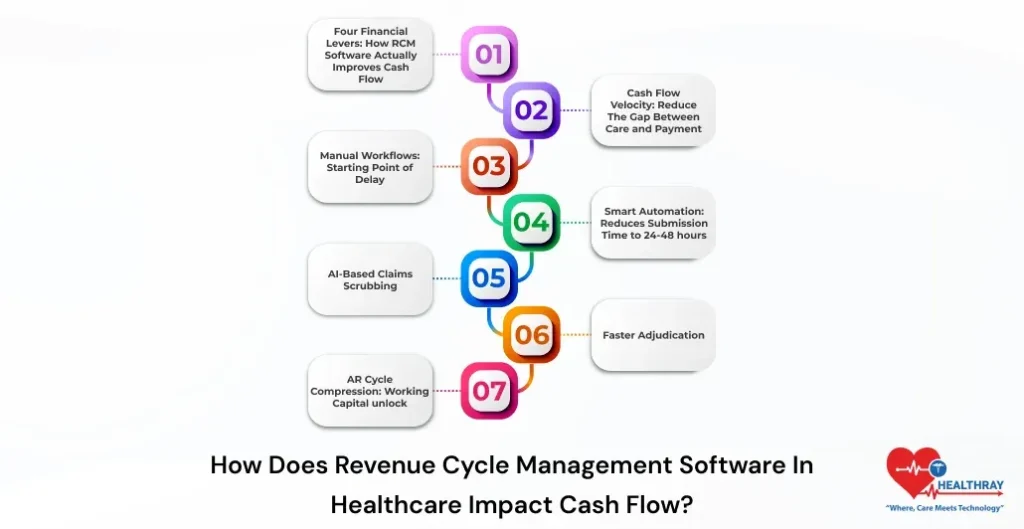
1. Four Financial Levers: How RCM Software Actually Improves Cash Flow
RCM software impacts are not vague. Further, it simplifies the hectic billing operation by utilizing clear financial levers. RCM software optimizes the direct financial performance.
- Faster cash collection.
- Reduce revenue loss from denials.
- Recover unbilled revenue.
- Reduce collection cost.
2. Cash Flow Velocity: Reduce The Gap Between Care and Payment
The most significant impact is on cash flow velocity–how quickly a hospital can convert earned revenue into cash. Traditional systems can help hospitals to earn money but are incapable of converting it in a particular time frame. Medical billing software helps hospitals to narrow down these gaps.
3. Manual Workflows: Starting Point of Delay
In the manual billing workflow, hospitals submit claims in 5-7 days. Further, if a hospital makes an error, then the rejection and resubmission cycle takes place. It takes several weeks to successfully complete the process. Healthcare billing system helps hospitals minimize claim denial.
4. Smart Automation: Reduces Submission Time to 24-48 hours
Advanced Healthcare automation billing applications are endowed with automated charge capture and claim generation features that help hospitals submit claims in 24-48 hours. This early submission expedites the payment cycle, which naturally strengthens cash flow in the practices.
5. AI-Based Claims Scrubbing
Traditional software detects errors after the claim rejection. However, modern RCM medical software uses AI-based scrubbing. This helps hospitals fix the errors beforehand. This accelerates the clean claim approvals and avoids delay in the medical billing procedure.
6. Faster Adjudication
Clean and accurate claims are rapidly processed in the payer’s system. In a traditional system, adjudication takes 14-30 days. Medical RCM software improves payer-side speed indirectly.
7. AR Cycle Compression: Working Capital unlock
Millions of dollars of working capital are released when hospitals shorten their collection cycle to five days. However, this is not new revenue; this is already earned money that hospitals now are getting fast. Revenue cycle management software in healthcare expedites the cash flow in the medical billing procedure.
Charge Capture Optimisation: Billing for What Was Actually Delivered
1. Charge Capture Failures: The Most Invisible Revenue Leakage
The charge capture failure is an invisible problem in hospitals. Sometimes the service is delivered, but no bill is generated. This is a significant loss, as hospitals earn the revenue but are unable to collect it. With Revenue cycle management software, hospitals can conveniently detect the leakage.
2. No Error, No Alert: Revenue Directly Get Miss
Staff will receive rejection alerts in denial cases; however, there will be no signal if charge capture fails. Team perfectly performs the procedure, but documentation remains incomplete, and charges never add up in the claim. A hospital RCM application can easily identify these gaps.
3. Root Cause: Clinical Work vs Billing Accuracy
Doctors’ and clinical staff’s main focus is on patients, not on documentation compliance. That’s the reason documentation gaps are natural. In a manual system, these gaps remain unnoticed. By implementing revenue cycle management software in healthcare, hospitals can easily bridge this disconnection.
4. Automated Reconciliation: What Was Done vs What Is Billed
Advanced healthcare billing software efficiently matches the procedure logs and billing data. If there is any mismatch, the system automatically detects it and notifies the team to fix the errors at an early stage.
Conclusion
The biggest problem in healthcare finance is not about generating revenue; it’s about collecting it. Hospitals systematically lose their money that they have already earned. Revenue cycle management software in healthcare closes this gap. RCM software is a financial infrastructure that unlocks the existing revenue. Platforms like Healthray provide end-to-end visibility, control and accuracy and ensure that every earned rupee is properly tracked, processed and collected.