

Summary
Claim Management Software Healthcare supports the entire claim process from patient registration to final payment, not just claim submission. In India, the process is complex due to TPAs, insurers, and strict regulations, so even small errors in data entry, documents, or coding can delay reimbursement by 15%-25% and lead to significant revenue loss. By using claims management software along with medical billing software and automated patient billing, hospitals can reduce manual work and incorrect claims, improve accuracy and tracking, and receive reimbursements faster.
Introduction
A large number of hospitals treat the process of submitting claims to payors (insurers) as the last phase of billing. However, the submission of the claim is “technically” only a single piece of the overall billing journey.
A claim is composed of many components including all details about the patient’s registration, diagnosis, and treatment during his/her stay at the hospital. Any detail that is not documented correctly or at all will probably cause a delay in the claim being approved by the payor.
Therefore, hospitals need to maintain a connected and integrated system for managing their claims instead of utilizing many separate and isolated processes. This is especially important to keep a smooth medical billing workflow between all departments.
The process of claims management becomes extremely complicated in India, due to the presence of TPAs, insurance providers, and ever-changing regulations. Different stakeholders have their own separate ways of checking and approving claims, and these methods do not work well with each other. Therefore, even small differences or mismatches between the stakeholders can slow down or delay the reimbursement process. Utilizing Claim Management Software Healthcare allows for a structured process and consistency across all departments. In practice, it helps hospitals maintain consistency across complex workflows
A Comprehensive Guide To The Complete Claim Lifecycle
In order to get reimbursement for services quickly, you need to know where claims flow through the value chain. A structured approach using claim management software healthcare ensures that each step in this lifecycle remains connected.
1. Patient Registration and Data Entry
The patient registration process begins when the patient arrives at the facility. During this time, relevant patient information, insurance information, and patient eligibility information will be captured. Any data errors that occur will cause issues down the line in getting reimbursement.
2. Clinical Documentation
The physician documents the patient’s diagnosis, services, and other relevant details.This is the basis for the eventual claim to the payer and should be as accurate as possible.
3. Medical Coding
The clinical data will be translated into standardized coding, such as ICD codes. The insurers utilize these codes as validations of the claim. Due to the number of claims that are submitted incorrectly, approximately 20% of claims will require re-work due to coding errors.
4. Claim Preparation
A claim file is prepared with all of the necessary documentation needed to submit a claim to the insurer. This will include the claim form and all supporting documentation (e.g., copies of the clinical notes).
5. Claim Submission
The hospital submits the claim to the insurer or third-party administrator (TPA) for approval. The accuracy of the documentation will have a direct effect on how long it will take to have the claim processed and approved.
6. Claim Review and Validation
Both the insurance company and TPA will review the claim form for accuracy as well as potential errors based on the coding, documentation and coverage of the policy.If they find discrepancies, the insurer or TPA sends a request for information to the hospital.
7. Approval or Rejection
The claim will be either approved in full, partially approved or denied. Many hospitals will see 10% to 20% of their claims returned for re-work.
8. Payment and Settlement
Once the claim has been approved, it is sent for payment processing and then closed-included in this entire process is a clearly defined and structured system that is initiated at the point of claim creation through a software application that provides claim management software for the healthcare industry to ensure that every step connects with an accurate and appropriate process.
This entire flow forms a structured system, and claim management software healthcare ensures that each step connects properly.
Where Claim Management Typically Fails
Even with a defined process much of today’s hospitals repeatedly experience challenges with:
Incomplete Documentation
Missing or vague documentation creates questions which results in increased turnaround for receiving payment & expense when reimbursement has occurred.
Coding Errors
If you code incorrectly or use a general code that does not match the diagnosis and/or procedure, your claim may be denied or delayed.
Lack of Visibility
After submission, it is not uncommon for hospitals to lose track of their submissions so follow up and management of progress become reactive as opposed to proactive.
Manual Workflows
When claims are processed manually, it increases hospital’s dependency on staff and introduces the likelihood of inaccuracies or other errors within a high volume environment.
Delayed Communication
Intermittent and back and forth communication with Third Party Administrators (TPA) increases processing of claims and makes the overall process longer.
In many instances the above can occur simultaneously which is one of the reasons why claim management software is so necessary in the healthcare industry for efficient claims management.
How Claim Management Software Healthcare Improves Efficiency
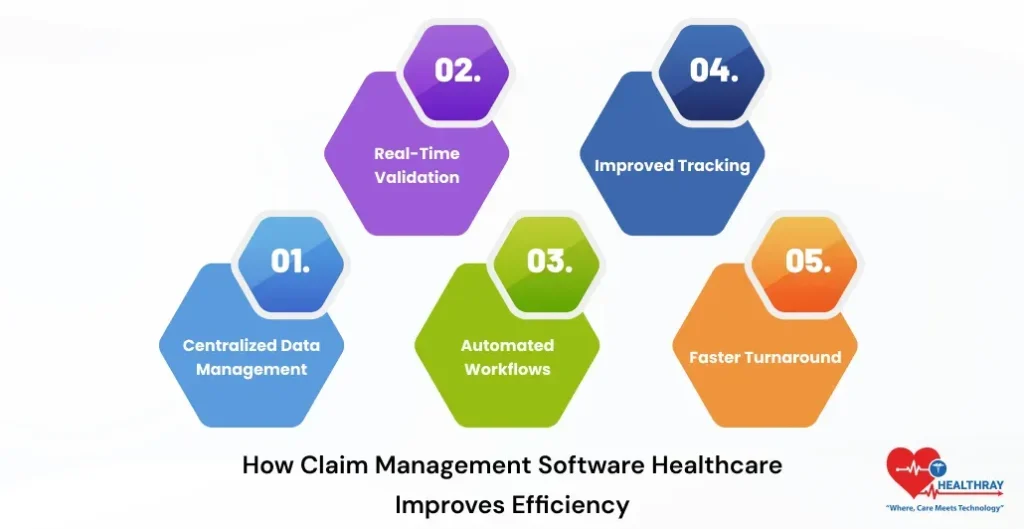
Claim Management Software Healthcare Improves Efficiency By establishing a structured method in which hospitals will have the ability to process all claim(s) from beginning to end.In addition, billing and coding software healthcare supports accurate data flow between coding and claim processing.
Centralized Data Management
All patient, billing, and treatment details are kept together in one system. This avoids repeating the same data and helps keep information correct.
Real-Time Validation
The system checks for mistakes as you enter the data, so you can fix errors immediately.
Automated Workflows
Automatic routines speed up your workflow by allowing routine activities such as creation of claims/documents, attaching different types of documents/attachments to a given claim to be completed at the click of a mouse button rather than having to manually complete them.
Improved Tracking
You can monitor the status of your claims through each stage of processing using a Healthcare Billing Dashboard, which allows you to identify potential delays before they become a problem.
Faster Turnaround
Hospital that use structured claim management software see up to a 20% increase in the number of claims that are processed and approved by their first attempt.
You can predictably and reliably manage how you submit, track, and manage your claims through the use of claim management software healthcare.
The Role of Medical Billing Software in Claim Accuracy
Accurate charges are the foundation for the successful submission of claims. A minor billing error can impact the entire claim submission process. This is where billing and coding software healthcare complements billing systems by ensuring coding accuracy before claim submission.
Medical Billing Software helps ensure:
- Correct charge capture
- Consistent formats through multiple types of billing
- Accurate records of financial transactions
Integrating Medical Billing Software to your Claim Management system will result in an increase in the overall quality of the claims processed by your claim management department and will help reduce the number of submissions that are denied due to errors.
Patient Billing Automation: Reducing Errors at the Source
A significant number of claim submission issues begin at the point of patient billing. This is where the patient billing automation functions as a key component to reduce claim submission errors.
By automating billing processes:
- Manual errors are reduced
- Data consistency improves
- Charges are captured accurately
Healthcare facilities have shown through numerous studies that Hospitals implementing patient billing automation can see a 10-15% increase in their patient billing accuracy, improving the success rates for claims submitted to payors.
What Drives Faster Reimbursement
Faster reimbursement for medical claims is based on accuracy and collaboration among various parties at all levels of the claim process.
- Clear Documentation: Detailed clinical notes reduce queries and speed up approvals.
- Accurate Coding: Specific ICD codes ensure proper alignment between diagnosis and treatment.
- Timely Submission: Submitting claims on time prevents delays.
- Quick Query Resolution: Responding quickly to insurer queries improves turnaround time.
- Connected Systems: Integrated workflows reduce data gaps and improve efficiency.
By focusing on the above-mentioned components of the claims process, many hospitals are able to shorten their overall claim payment cycles by 5 to 10 days on average.
 NOTE
NOTE
Reasons for Claim Rejection
Identifying the patterns of claim rejections can help prevent similar issues from recurring in the future.
Common reasons that claims are denied include:
- Medical records do not match the ICD code
- Missing documentation
- Diagnosis and treatment do not match
- Policy coverage issues
As the statistics indicate, over 60% of claims can be denied due to preventable reasons; therefore, if various systems and workflows that process claims are designed correctly, there will be a reduction in the number of denials.
Importance of Claim Visibility
When hospitals lack visibility on claims, they can only make educated guesses. When you have proper tracking, you can:
- Track the claim status in real time.
- Identify delays early
- See patterns of rejections
This allows you to make better decisions and allow your processes to run more efficiently.
Automation VS Human Input
Automating your process will help you finish the work faster. However, human judgment is required.
Systems can:
- Identify errors,
- Monitor work flow, and
- Track claims.
However, there are times that you need the input of a person such as when dealing with difficult cases, appeals, and negotiations.Having the right balance of automation and human expertise will give you the best results.
Importance of Clinical Documentation
Coders cannot code correctly unless there is good clinical documentation. Coders must also use the information written in the patient’s medical record.
For instance:
- “Infection” is not very specific
- “Bacterial respiratory infection” gives a code!
This will directly impact approval rates, reimbursement amounts, and the success of audits.
Hospitals that improve their documentation will often see a 10% to 15% increase in the accuracy of coding.
 PRO TIP
The Importance of Standardization Across Departments
Each department has its own method of recording things; there can sometimes be gaps in between what they record due to different coding methods.
Standardization ensures that there is:
- Standardized coding practices
- Consistent documentation
- Increased coordination
Fewer errors as processes become more standardized.
Training and Skill Enhancement
Technology alone can address issues regarding coding errors; however, skilled labor still is required to resolve these issues.
Frequent training provides staff the opportunity to:
- Stay updated on the newest programming techniques.
- Understand payer requirements
- Improve accuracy and speed
Investing in employee training within a hospital can lead to improved operations within 3-6 months of initiating employee training.
Minor Enhancements Can Have Major Impacts
Hospitals tend to focus their energy on large-scale improvements or modernizations; however, small improvements can provide tremendous benefits.
Examples of this include:
- Better documentation
- More specific coding
- Validation of work before submission
If hospitals could improve their coding accuracy 5% higher, it would enable them to receive payments faster, while also lower the number of disputed claims submitted.
Impact on Patient Experience
Not only will hospitals have challenges when submitting claims for reimbursement, but patients will have challenges too.
Delays or errors can:
- Create confusion
- Delay discharge
- Reduce trust
An accurate claim management system makes billing smoother and keeps patients more satisfied.
Why Compliance Is Becoming More Important
Healthcare regulations in India are becoming stricter.
Insurers and regulators focus on:
- Standardized billing
- Accurate coding
- Complete documentation
Hospitals must meet these requirements to avoid penalties and delays.
Conclusion
Claim management is not a one-time affair, but a process that involves several stages from the time a patient submits the claim to final settlement. This is a process that must be managed efficiently in India where different stakeholders are involved.
With the right claim management software healthcare, hospitals can achieve greater accuracy, better visibility, and fewer delays. When combined with Medical Billing Software and Patient Billing Automation, the entire process is now faster and more reliable
Even small improvements in workflow and accuracy can lead to better financial results and a longer revenue cycle.