

Summary
Billing and coding software healthcare is not only used for producing bills, it aids in creating accurate records, checking that your organization complies with federal guidelines, and facilitating the transactions between healthcare providers and third-party payers through quick processing. In India, due to the number of insurance claims that have been delayed or denied as a result of poor coding or a lack of documentation, using quality software and accurate ICD codes, hospitals can minimize errors, maintain compliance, and get paid in a timely manner. This document provides a simple, step-by-step procedure for utilizing this software and maintaining quality practices in your own hospital. Please continue reading for information on how these practices may be implemented at your organization.
Introduction
People often think of billing and coding as administrative tasks that happen after treatment is over. In real life, they have an effect on almost every step of the healthcare revenue cycle.
When a doctor writes a diagnosis, they need to convert it into standard medical codes, check against insurance rules, and then submitted correctly for payment. These are part of a medical billing workflow. This workflow links clinical notes, coding, and claim submission. Each step must be done carefully, and for that, every department must follow the same method. All teams need to work together so the process stays consistent.. And here, billing and coding software healthcare helps ensure the consistency.
However, things are more complicated in India because of the involvement of TPAs, insurance companies, and rules that change often. Every department has its own rules for checking and keeping records, so a claim can be denied or delayed if there is even a small difference between the diagnosis and the procedure.
Billing and coding software healthcare helps fill this gap by making the process more accurate, clear, and consistent.
Understanding What Coding Means for Healthcare Billing
To support this process, many providers rely on billing and coding software healthcare to improve coding accuracy; it’s the way hospitals and clinics communicate with insurance companies.
When a doctor makes a diagnosis or does a procedure, they have to turn that information into standard codes like ICD. Insurance companies and third-party administrators (TPAs) use these codes to check if a claim is valid and how much should be paid. To manage this effectively, hospitals rely on billing and coding software healthcare.
In most cases, ICD-10 is a common way to code diagnoses in India. But the insurance company may want different amounts of detail.
Correct coding makes sure that:
- Claims are handled without any extra questions.
- Payments show the real care that was given
- Audits make sure that compliance requirements are met.
Coding mistakes, on the other hand, can mess up the whole process. Research shows that coding mistakes are responsible for almost 25% of cases where claims have to be redone. This makes the work of the administration more difficult and makes it take longer to get paid.
Why ICD Accuracy Is Important in Indian Healthcare
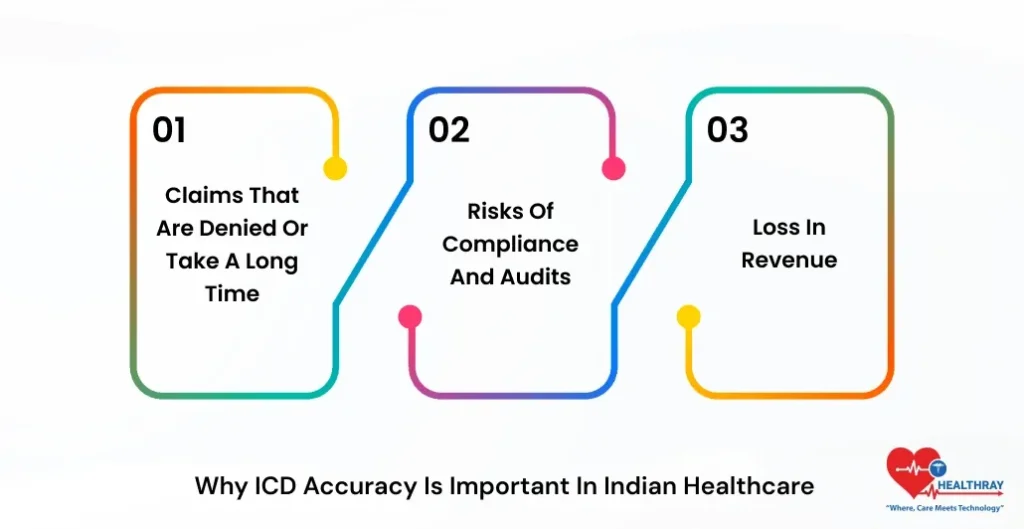
ICD accuracy has a direct effect on financial results, compliance status, and operational efficiency. Maintaining this accuracy often depends on billing and coding software healthcare.
Claims that are denied or take a long time
ICD codes are very important for insurance companies and TPAs when they look at claims. If the diagnosis code doesn’t match the treatment or policy coverage, then the claim might be denied or sent back for more information.
As a result, this can cause payment delays of 7 to 15 days or more in many hospitals, depending on how hard it is to fix the problem.
Risks of Compliance and Audits
Regulatory audits check healthcare billing. If you notice patterns of inconsistency, then incorrect coding can make compliance more difficult.
Global healthcare data shows that problems with coding audits make up almost 10% of compliance problems in billing systems.
Loss in Revenue
If any hospital or clinic uses too few codes or very general ones, then the insurance company may pay less than what the hospital actually deserves. But if the hospital uses too many codes or adds extra details, then unnecessary details, it can attract audits, extra checks, or even penalties. In both cases, the hospital’s income and financial health put themselves at risk.
A coding error rate of 2% to 3% can cost medium to large hospitals a lot of money each year.
 NOTE
NOTE
Where Most Hospitals Make Mistakes with Coding
Many hospitals, whether it is large or small, struggle with similar coding challenges. This is where billing and coding software healthcare helps reduce common coding and documentation errors.
Over-dependency on Manual Processes
For instance, manual coding increases the chances of error, especially in high-volume cases. which is why hospital billing automation is becoming essential for reducing dependency on manual processes.
Incomplete Clinical Documentation
Similarly, when clinical notes lack detail coders are forced to interpret information. This increases inconsistency and risk.
Discrepancy Between Diagnosis And Treatment
One of the common reasons for claim rejection is when the diagnosis code does not justify the procedure performed.
Lack Of System Integration
When coding, billing and clinical systems are not connected, this means data gaps become common. This causes mistakes and copies.
How Billing And Coding Software Healthcare Improves Accuracy
Today, modern systems, especially an automated medical billing system, speed up work and also make it more reliable. They cut down on manual work. They help workers do the same things every time. This is why automating hospital billing is important.
Validation in Real Time
Finding mistakes happens when you enter data, not after you send in a claim. This cuts down on the amount of work that needs to be done again by a lot.
Procedures that are the same
A clear, consistent process helps every department follow the same coding rules.
Code Suggestions That Are Automatic
Systems help users by suggesting ICD codes based on clinical information.
Better visibility
Hospitals can track claim status in a timely manner and identify where delays occur
Organizations that adopt billing systems have reported up to 20% improvement in first-pass claim acceptance rates.
The Compliance Layer In Indian Healthcare
Importantly, compliance is not limited to coding accuracy but It includes alignment with payer requirements.Using billing and coding software healthcare helps hospitals meet these requirements more consistently
TPA Requirements:
TPAs verify documentation, coding accuracy, and treatment justification. Any mismatch in it can lead to claim rejection. This is why billing and coding software healthcare is important for maintaining compliance.
IRDAI Guidelines:
The Insurance Regulatory and Development Authority of India (IRDAI) prioritizes and accepts transparent, standardized billing, and hospitals are expected to implement these norms to lower the chances of non-compliance.
Documentation Standards:
Good coding depends on clear, complete medical notes. If the paperwork is missing details, then even the right codes can get questioned or rejected during checks.
ICD Coding Pitfalls That Lead To Revenue Loss
Mistakes appear small but have a significant impact.
Using Non-Specific Codes
General codes may result in lower reimbursement or additional queries.
Ignoring Code Updates
ICD codes are updated periodically. Using codes can lead to automatic rejection.
Incorrect Code Mapping
Mismatch between diagnosis and procedure codes is one of the common issues.
Audit Readiness In Healthcare Billing
Hospitals or clinics should always be ready for audits, not just when an audit is announced.
A way to stay audit-ready is to:
- Always maintain complete and accurate records
- Use consistent medical coding practices
- Keep clear audits for every claim
Hospitals with structured systems usually handle audits faster and have fewer compliance issues.
Steps to Accurate Medical Coding
To improve coding accuracy, hospitals and clinics need strong systems and clear processes.
Step 1: Standardized Documentation
Everyone should use the same forms and clear wording.
Step 2: Coding Software
Use computer tools to suggest and check codes.
Step 3: Ongoing Training
Train your staff regularly on rules and updates.
Step 4: Quality Review
Review coding work to find and correct errors from time to time.
Step 5: Compliance Check
Ensure all codes follow all the laws and payer rules.
Key Metrics Hospitals Should Track
Measuring performance is essential for continuous improvement.
- Claim rejection rate
- First-pass acceptance rate
- Average payment cycle time
- Coding accuracy rate
Hospitals that actively monitor these metrics see improvements within 3 to 6 months. Many of these improvements are supported by billing and coding software healthcare.
Why Integrated Systems Matter
On the other hand, using separate systems for billing, coding, and clinical data creates inefficiencies, which is why Medical Billing Software is important for integrating these processes into a single system.
An integrated system ensures:
- Consistent data across departments
- Reduced duplication
- Faster processing
Hospitals that adopt systems often report 15% to 25% reduction in billing errors.
The Future Of Billing And Coding In India
Healthcare billing in India is slowly moving toward more standard and technology-based systems.
- Automation will handle routine validation
- Compliance requirements will become stricter
- Data analytics will play a larger role
However human expertise will remain essential especially in complex scenarios.
Denial Management Starts With Coding Accuracy
In reality, many hospitals treat denial management as a function. In reality most denials originate earlier during coding.
Studies show that over 60% of claim denials are linked to front-end errors, including coding and documentation.
Some common reasons people deny things are:
- Wrong ICD codes
- Not having the right documents
- Diagnosis and treatment don’t match up
- Policy coverage that doesn’t match
If the coding is correct, then the step denial rates can go down a lot.
This is why improving coding accuracy is more than just a technical change. It is a smart move to lower the number of denials.
 PRO TIP
The Importance of Clinical Documentation for Accurate Coding
How clearly doctors and other health care professionals write their notes is what makes coding accurate. The coding staff can’t guess or add their own information. They can use only what is clearly recorded in the patient’s medical file.
For example:
- If a doctor simply writes “infection,” the coder has very little to work with.
- If the note says “bacterial lower respiratory infection,” the coder can choose a precise ICD code.
This difference directly impacts:
- How quickly claims are approved
- The reimbursement amount
- How the hospital performs in audits
Hospitals that improve documentation quality often see 10% to 15% improvement in coding accuracy.
This highlights a point. Coding accuracy is not just a coder’s responsibility. Both clinicians and billing staff share responsibility for this
The Importance Of Standardization Across Departments
Hospitals have different ways of coding for different departments. This makes things not consistent.
For example:
- One department might use very specific ICD codes.
- Another department may employ general codes.
This lack of consistency affects the quality of claims and the results of audits.
Standardization ensures that:
- Writing code in the same way every time
- Keeping records in a way that is always the same
- Better teamwork
When processes are the same, mistakes happen less often, and you don’t have to do any extra work.
Small Improvements That Create Big Impact
Hospitals often look for large, expensive system upgrades to improve billing. However even small improvements can create results.
For example:
- Improving clarity and completeness of clinical documentation
- Choosing more specific ICD codes instead of generic ones
- Validating claims before final submission
Even a 5% improvement in coding accuracy can lead to:
- Faster payments
- Lower denial rates
- Reduced workload for billing teams
Over time, these small gains add up to major operational and financial benefits.
The Relationship Between Coding Accuracy And Patient Experience
Billing errors do not just affect hospitals. They impact patients, too.
Impacts of delayed or rejected claims on patients:
- Patients can experience confusion regarding their bills
- Discharge times can increase
- Trust in the hospital decreases
Accurate coding of claims enables a more seamless and clear billing process, which results in greater patient satisfaction. Coding may seem like an administrative task; however, coding is an integral part of the patient experience.
Why Compliance Is Becoming Stricter in Indian Healthcare
Regulations are becoming more structured and transparent in India’s healthcare system.
The IRDAI and insurers are looking for:
- Standardized billing formats
- Clear documentation
- Accurate coding processes
Hospitals will therefore not have the ability to utilize vague or inconsistent processes any longer.
Compliance is mandatory in order for hospitals to run functionally.
Conclusion
There are now many electronic billing and coding software solutions, including high-quality Medical Billing Software, to assist healthcare providers with their operations. Among these, billing and coding software healthcare play a key role in improving accuracy and compliance. In India, where ICD accuracy, TPA rules, and IRDAI compliance all matter, old manual workflows are not enough. Hospitals or clinics must keep clear records, use accurate codes, and check their work regularly. They can cut errors, with the right mix of technology and simple processes and get more claims approved, and stay compliant. Even small improvements in coding accuracy can slowly add up to big gains in both revenue and efficiency.