

Summary
Traditional billing systems are not only slow; they are highly expensive as well. Errors, delays and denied claims all together cost millions in revenue loss. Legacy billing becomes a hidden cost center that downplays the overall performance of the enterprise hospitals. Solution is not simple, but it’s clear–the right balance. Modern hospital billing automation software uses AI, RPA and FHIR technology that are game-changers for enterprise hospitals to improve their revenue cycles. This guide will cover how enterprise hospitals can use automation to optimize their revenue cycles while also strengthening their core mission of patient care. Keep reading!!
Introduction
Billing processes of enterprise hospitals are still entangled in a traditional paradigm. Faxed superbills, excel sheets and outdated workflows slow the pace of the hospital’s advancement.
This mismatch is an “enterprise paradox,” where clinical innovation is fast but the revenue cycle is still weak. Hospital margins are already tight. Labor expenses, inflation and payer scrutiny have raised the pressure on the system. If billing is inefficient, it creates a direct impact on revenue. A strong revenue cycle can push the margins up by 7%+.
Top-performing hospitals give priority to billings. They highly focus on reducing AR days, denials and faster collections. Hospital billing automation is a strategic move that defines the hospital’s financial stability. When hospitals adopt smart medical billing software, they are capable of making their revenue cycle flexible, scalable, and agile in the future.
The Scale Problem: Why Manual Billing Breaks at Enterprise Volume
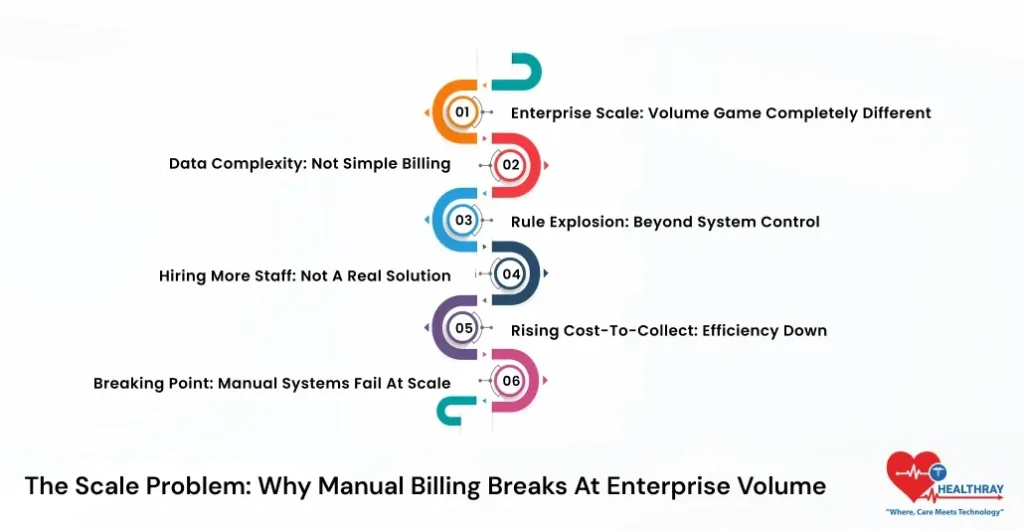
1. Enterprise Scale: Volume Game Completely Different
Small hospitals can handle limited claims manually. However, at enterprise levels, pictures transform totally. Further, enterprise hospitals process more than 5 lakh claims yearly. This high volume becomes unmanageable with standard manual procedures.
2. Data Complexity: Not Simple Billing
Every claim in an enterprise hospital doesn’t just include simple information. It also includes a combination of standardized diagnosis codes, procedure codes, modifiers, and patient demographics. And this information should be checked in accordance with multiple payers’ guidelines. Further, this entire process becomes a complex puzzle where a small discrepancy can invalidate the claim.
3. Rule Explosion: Beyond System Control
Enterprise billing includes hundreds of payer contracts and each holds its own rules and guidelines. Further, when these rules combine with data, they create billions of checks. Handling such a large-scale validation is practically impossible with manual systems.
4. Hiring More Staff: Not a Real Solution
Usually, hospitals think hiring more staff will resolve their problems. However, labor grows linearly, whereas billing complexity grows exponentially. In simple words, whether hospitals increase their staff or not, the system is not always capable of maintaining pace.
5. Rising Cost-to-Collect: Efficiency Down
When billing is inefficient, it raises the cost of accomplishing every claim process. Further, this unnecessary overhead directly hits the margin and reduces the profitability in the system.
6. Breaking Point: Manual Systems Fail at Scale
At the enterprise level, manual billing breaks at some certain points. Further, it raises errors, delays and inefficiencies and makes the traditional system unsustainable.
 NOTE
NOTE
The Full RCM Continuum: Where Hospital Billing Automation Applies
Revenue Cycle Management (RCM) is not the last step of billing. It is a full journey from patient enrollment to final transaction. Moreover, in enterprise hospitals, automation is successful only when it is applicable in front-end, mid-cycle and back-end levels. Let’s elaborate more about it:
1. Front-End Automation
- Smart Patient Access
Automation begins at patient registration and scheduling time. Hospital billing automation software instantly performs eligibility verification in real time to determine whether a patient is covered by insurance or not. Further, doctor billing software automatically flags if any coverage issue is detected. This minimizes the risks of claim rejection in the future.
- Prior Authorization: High-Impact Automation
In the front end, the most powerful automation occurs in the prior authorization phase. Through an API, a payer can directly request approval from the system. Further, this reduces the workloads of manual follow-up and expedites the approval process. Hospital billing automation application can reduce front-end denials by 15–20%.
2. Mid-Cycle
- Documentation and Coding Accuracy
The biggest challenges in mid-cycle are correct documentation and coding. Digital medical billing scans EHR notes and determines accurate ICD standards and CPT codes. Moreover, this minimizes coding errors and optimizes the claims acceptance rate.
- CDI Automation: Improve Revenue Capture
Clinical Documentation Improvement (CDI) automation sends smart queries to doctors, such as infection and sepsis clarification. This creates detailed documentation and hospitals get proper reimbursement. Additionally, hospitals can improve the case mix index by up to 5–10%.
3. Back-End Automation
- Fast Claims Processing
Hospital billing automation accelerates the claims submission process and makes the tracking easier. Billing invoice application automatically validates the claims and determines errors at the initial stage.
- Denial Management: Smart Recovery System
Machine learning tools can easily categorize the denials. It can determine which claims can easily be fixed and which are complex. Further, medical billing software solutions generate automated appeal letters. This expedites the revenue process and reduces leakage to a significant extent.
- AR Optimization: Accelerate Cash Flow
Hospital billing automation creates intelligent queues that prioritize high-value claims. Further, this reduces the AR days from 60 days to 40 days. This makes the cash flow dependable and predictable as well.
The Integration Imperative: Hospital Billing Automation Within the Enterprise Technology Stack
1. Integration Imperative: Only Billing is Not Sufficient
In enterprise hospitals, billing automation is not an isolated system. Further, this works effectively only when it seamlessly connects with EHR, practice management systems, patient payment platforms and data warehouses. Connected systems always provide better results.
2. Data Flow = Real Value Creation
Enterprise hospitals can detect real impacts of automation only when data move smoothly from one system to another. Further, if systems are disconnected from others, the real impact of automation will diminish gradually. A smooth data flow will further augment the productivity and accuracy in the practices.
3. EHR Dependency: Garbage In, Garbage Out
EHR is the main source of clinical data. If documentation is incomplete or accurate, eventually, billing automation will provide wrong output. Billing will be accurate only when hospitals provide strong input data.
4. Unified Strategy: Separate Workstreams Mostly Fail
Many hospitals view EHR optimization and billing automation as separate projects. Further, this approach mostly fails in the long term. Best-performing enterprises manage both in the form of a single data pipeline.
5. API-First Architecture: Backbone of Integration
The core part of modern billing automation is the API-first approach. Further, APIs connect EHR, payer systems, clearinghouses and payment gateways in real time. This minimizes the manual intervention and greatly increases the speed of operation.
Measuring What Matters: KPIs for Automated Revenue Cycle Operations
1. KPIs’ Role: Measuring Automation Is Crucial
Implementing automation for enterprise hospitals is not sufficient. Moreover, it is highly crucial for enterprise hospitals to measure the performance as well. Right KPI will help enterprise hospitals determine whether revenue is improving or not.
2. Traditional Metrics: Still Important But Limited
Metrics such as gross collection rate, days in AR and denial rate are highly crucial. However, these metrics don’t display the full picture in automated RCM. It just displays outcomes, not any useful insights on process efficiency.
3. Touchless Rate: Most Significant Metric
In automated billing, the most important KPI is the touchless rate. This determines the number of claims that are accomplished without the need for manual intervention. Further, this is a powerful indicator of the system’s overall performance.
4. Benchmarking: Good vs Best Performance
High-performing hospitals’ touch rate is around 75%+. This benchmark provides clear direction to enterprise leaders for improvement.
 PRO TIP
The Strategic Path Forward: Building for Scale and Resilience
1. Future Mindset: “Should We Automate?” or “How to Scale?”
Enterprise hospitals are now moving beyond basic automation questions. They are focusing on designing systems that are agile for the future. Furthermore, they are building a system that can easily scale and absorb new payer rules without any manual efforts.
2. Scalable Architecture
Enterprise hospitals are designing automation in such a way that it can handle multiple hospitals, locations and workflows. At present, enterprise hospitals are adopting scalable architecture, as it is a foundation for future progress.
3. Resilience
Resilience is a critical factor at the enterprise level. In simple words, if any component of the system fails, the billing process should not get paused in between. Hospital billing system comes with smart automation backup workflows and dependable fail-safe mechanisms.
4. Intelligence Layer
Automation’s real power does not lie in operational efficiency; it lies in the intelligence layer. Further, this layer provides predictable insight and helps hospitals to identify the issue beforehand.
5. From Cost Center to Strategy Engine
Traditional billing is considered a cost center; however, with automated and data-driven systems, it becomes a strategic function. It plays an important role in financial analysis and making good decisions.
Conclusion
At an enterprise level, automation is not just an option. It’s a direct competitive edge. Top-performing hospitals define automation as a “strategic capability” at an initial stage. Hospitals that are adopting automation achieve faster collection rates, lower denials and better margins. Platforms like Healthray help enterprise hospitals to build strong billing systems that foster growth and sustainability.