


Summary
In 2026, the manual approach to running medical practices will not be effective. It is highly imperative for smart hospitals using HMS to manage day-to-day hospital activities. The hospital management system software connects all the departments’ functions of the hospital in a single dashboard. In simple words, it makes it easier for clinics to handle all of the patient data from several departments in one location. Through AI and automation, doctors can quickly make treatment decisions and improve the quality of medical services. AI can deeply recognize the patient’s medical symptoms and suggest proper care to them. In this blog, I will discuss the role of smart hospitals using HMS and how it simplifies mundane tasks of teams that take tremendous time with manual approaches. Keep reading!!
Introduction
The smart hospitals 2026 concept is transforming the healthcare industry. In the current medical ecosystem, providing only treatment is not sufficient for clinics. The patient needs fast, accuarate and personalized care.
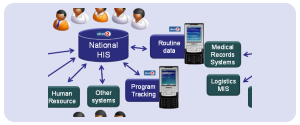
To overcome such challenges, intelligent hospital management systems are gaining traction as game-changing platforms. Traditional HMS are just limited to basic functions such as patient registration, billing or appointment scheduling. However, in 2026, HMS’s role has become highly advanced in hospitals. HMS leverages AI, IoT and cloud technology, allowing hospitals to manage all the data on a single dashboard. Intelligent HMS improves patient experience to a significant extent.
Online appointment booking, digital payments, telemedicine integration, and real-time updates provide extraordinary convenience to patients. Through a remote monitoring device, doctors can track patient data even while sitting anywhere across the globe. In 2026, smart hospital management software will work as a central nervous system in hospitals. Intelligent systems are the foundation of future healthcare that converts the hospital from just treatment centers to a fully digital, patient-centric ecosystem.
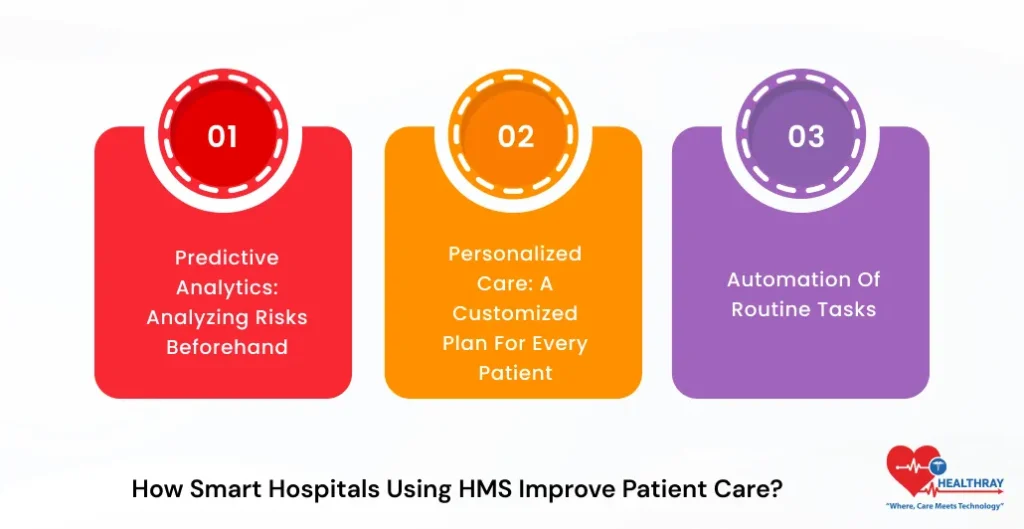
How Smart Hospitals Using HMS Improve Patient Care?
1. Predictive Analytics: Analyzing Risks Beforehand
AI can easily analyze patients’ past data, lab reports and health patterns and help doctors to determine the high-risk diseases. Further, this helps doctors to take necessary steps to successfully treat the disease at an initial stage. Timely treatment can prevent future risks of serious ailments, and patients can combat the ailment at an early stage by following a proper healthcare regimen.
2. Personalized care: A Customized Plan for Every Patient
AI can interpret every patient’s data and suggest a customized plan according to specific patient symptoms. In a traditional system, doctors use a standardized approach to treat every health symptom. However, AI patient-centric algorithms read every individual symptom and prescribe courses as per that. Further, doctors can design treatment plans more accurately with AI. Patients can recover faster as compared to the standardized medical approach.
3. Automation of Routine Tasks
AI hms simplifies all the routine tasks of the department. In traditional software, doctors execute operations manually. They rely on manual notes to write every detail of patient health symptoms and send the same information to other departments. This manual approach was tiresome and the chances of error were higher. Further, intelligent HMS automates all the basic functions of appointment scheduling, billing, report generation and data entry. Thus, helping staff to concentrate primarily on patient care rather than partaking in paperwork.
How Does Smart Hospitals Using HMS Reduce Hospital Readmissions?
1. Risk Stratification
The AI system divides the patient into groups (high risk or low risk) as per their severity level. Further, high-risk patients get extra attention, frequent follow-ups, special care plans and monitoring. This targeted approach reduces the unnecessary hospital returns by 20–45%.
2. Real-Time Risk Scores
AI models such as LACE and HOSPITAL score generate real-time risk scores within the HMS. Further, these scores help doctors determine the patient risk level. AI-powered HMS allows doctors to make fast and concrete decisions. This effectively reduces the probability of readmissions. Overall, it raises hospital operations efficiency.
3. Personalized Discharge Planning
AI creates a personalized discharge plan for every patient. It clearly defines medicines, diet, follow-up visits and care instructions. Further, this allows patients to follow a healthcare regimen post-discharge. Better transition planning maintains treatment continuity and reduces the risks of readmissions.
4. Automation of Processes
AI HMS automates the entire process of admission, discharge, billing and care coordination. Further, this reduces manual workload and errors in the system. Smooth workflows provide timely care to patients. Thus, hospitals can avoid transition gaps, which are the major reason behind readmissions.
Step towards digital era with our healthcare solution
Revamp your hospital facilities and embrace change for better healthcare management. Ease in managing and organizing large medical datasets leads to effective analysis. Seize the opportunity now!
How to Integrate AI Predictive Analytics in HMS?
1. Define Objectives
Firstly, clinics should determine what they want to achieve with AI. For instance, clinics aim to guarantee appropriate care quality or lower readmission rates. Further, clear goals help teams to work in the same direction and conveniently gauge their effectiveness.
2. Data Collection & Preparation
Accurate and clean data is paramount for AI. Further, clinics should collect data from HMS, EHR, lab reports and billing systems and convert it into a clean, structured and secure format. Proper data quality helps AI models deliver accurate and consistent results.
3. Build AI Models
Machine learning models such as random forests and neural networks are deeply trained on historical data. Further, these models understand the patterns and generate risk scores. Testing and validation ensure models are trustworthy and credible.
4. System Integration
Healthcare practitioners must use APIs to integrate AI models with HMS. Further, clinics can access alerts and reports through real-time alerts via dashboards. Doctors can evaluate risk scores and take suggestions directly from the system.
5. Testing & Pilot Run
AI systems are tested in departments or small groups prior to full deployment. Additionally, this aids the clinic’s system in determining its functionality and areas that still require improvement. Pilot runs reduce the risks and help clinics make the system performance better.
Learn more: AI in Healthcare Software – How Healthray Leads
Training Staff for AI-HMS: Best Practices
1. Role-Based Training
Every staff member has different work. Therefore, medical sectors should provide customized training to every individual. Furthermore, doctors should be trained on clinical alerts, nurses should be trained on workflow or monitoring and the admin department should be well trained on data entry and reports. Through this approach, every professional will deeply understand their work and effectively use AI to engage in their mundane job responsibilities.
2. Hands-On Learning
Just relying on a theoretical concept for learning HMS is not sufficient. Further, hospitals should provide a demo of real HMS tasks and allow staff to practice on their own. Staff should properly understand the reason behind using AI. This reduces readmissions, boosts the confidence level of hospital specialists, and accelerates the learning process.
3. Continuous Training
Providing only one session for training is not sufficient. Regular workshops, videos, refresher sessions aur updates are highly imperative for staff to deeply absorb the concepts. As technology evolves extremely fast, therefore, staff should update themselves with the latest ideas and concepts to leverage the full power of technologies. Also, read our blog on the healthcare workflow automation guide for deep understanding.
 NOTE
NOTE
How does HMS AI Handle Data Privacy in Predictive Models (DPDP Act)?
1. Consent Management
AI-HMS takes consent from hospital management before using patient data. Furthermore, it communicates clearly with patients about the reasons for using their privacy information. Also, patients can withdraw their consent upon request. This helps hospitals build trust and transparency in the practices.
2. Data Minimization
The HMS system can use patient data that are only required for predictable modeling. Further, AI models don’t have access to patients’ sensitive information such as bank details, insurance, passwords and more. This minimizes privacy risks and healthcare practitioners can comfortably follow DPDP Act rules and standards. In simple words, HMS has minimal visibility to data whose values are critical for their treatments and care.
3. Anonymization & Tokenization
To hide patient identity from AI models, the HMS system uses anonymization and tokenization. In simple words, the system removes and replaces patient names and personal details. Further, this keeps the data useful, but AI algorithms can’t identify any specific patient-sensitive details.
4. Security Safeguards
AI smart hospitals using HMS use high-level security protocols such as encryption, role-based access control (RBAC), and secure login systems. Further, only authorized staff can access the data. System notify alerts if any uncertainty is detected. This is the important part of DPDP compliance.
5. Privacy-by-Design Approach
Privacy is included while designing the system. Further, the system uses Secure APIs, consent platforms and data protection tools. This proactive approach reduces the risks and the system automatically follows compliance.
6. Bias & Fairness Checks
AI models are regularly audited to avoid any bias and unfair decisions. Further, this ensures predictions should be reasonable and equitable for every patient. Using Ethical AI is an important part of DPDP compliance.
7. Patient Rights
AI-HMS provides full control power to patients to handle their data. Further, patients can access, correct, or delete the data (DSAR requests). System provides an “Erase-on-request” feature that deletes patient data from the model. This strengthens the privacy of the system.
 PRO TIP
Conclusion
In 2026, hospitals are no longer just treatment centers. It has become a smart digital ecosystem. AI-powered smart hospitals using HMS connect all the departments and make the processing fast, accurate and efficient. Modern HMS platforms such as Healthray provide an integrated solution to hospitals where clinics can manage their data, analytics, and workflows in the same dashboards.
Contact our support team for any assistance.