

In This Blog, You’ll See:
- Healthcare appointment software is now assessed on compliance, not convenience.
- Scheduling systems belong to the regulated healthcare infrastructure if they store patient information.
- DPDPA and ABDM/NDHM in India set the key rules for data privacy and interoperability.
- A compliant system would have to deal with consent, data security, integrations & audit logs.
- AI scheduling, patient self-booking and real-time data flow are becoming fundamental expectations.
- Clinics must conduct frequent audits of their existing system and change if it does not satisfy these standards.
Why Healthcare Appointment Software Now Has Compliance Expectations
Only five years ago, clinics were mainly concerned about whether scheduling software worked or not. Today, the main concern is whether it is compliant. A doctor appointment system which is linked to patient identity, medical history, and communication records and supported by medical call center software for handling inbound patient calls and routing is now an element of regulated infrastructure rather than a mere booking tool.
1. The Shift From Convenience Tool to Regulated Infrastructure
Initially, scheduling software was just a layer of convenience. Though as these systems began to store patient contact details, health indicators, and insurance data, they wandered into areas that regulators treat differently. As soon as a system holds personally identifiable health information, it is accountable for data protection duties, regardless of its original purpose.
2. What Happens When Scheduling Software Doesn’t Meet Standards
The fallout is quite targeted. A healthcare appointment software that lacks proper consent features, has unsecured data flow, or no audit trail is not just non-compliant but also a risk. In case of a dispute or breach, not being able to prove compliance is what takes a mere work-related issue to a legal one.
3. Who Sets the Standards, And Which Ones Apply in India
The primary legislative system in India is the Digital Personal Data Protection Act 2023 (DPDPA). But ABDM interoperability guidelines lay down the standard for how scheduling systems should interact and exchange data. Globally, HIPAA, GDPR, and ISO 27001 have also been increasingly cited as points of reference by Indian medical facilities that are treating foreign patients or have international collaborations.
The Compliance Checklist Every Appointment Management System Must Meet
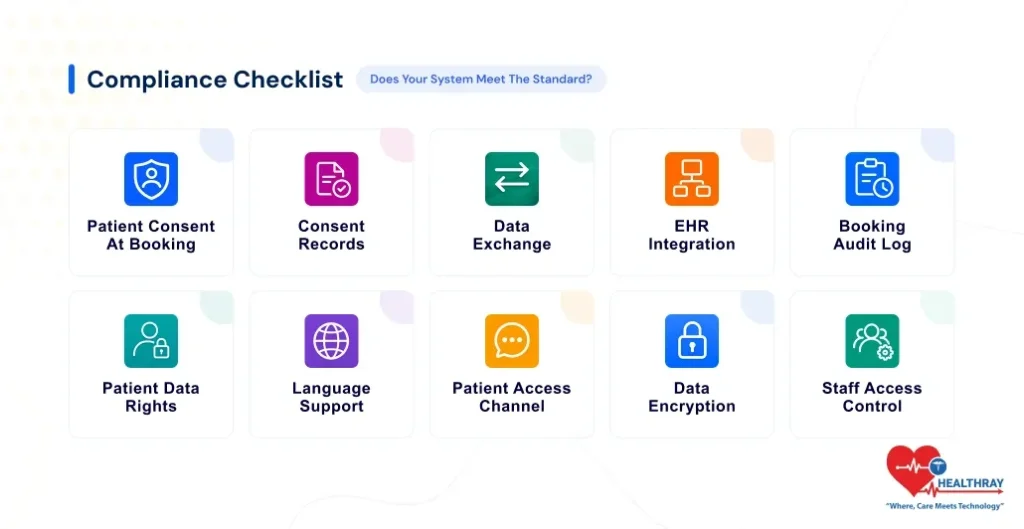
This is more of a minimum requirement, the least one can expect. List the things on this checklist to either help you decide on a new system or audit a current one.
1. Data Privacy and Patient Consent
First of all, the clinic appointment system should be capable of obtaining clear and unquestionable patient consent at the time of booking, which is essential to make visible and confirmable, not hidden by a long list of terms. Consent documents should be stored, the time consent should be marked, and documents should be easily accessible.
Apart from that, patients should be given a choice to look at their data, make changes to it or request its deletion. With or without integrated consent management, the DPDPA will not be respected by the practice, no matter how well the system is scheduled.
2. Interoperability With Existing Clinical Systems
Locking the patient information in a proprietary format via software has been identified as a major compliance risk. ABDM requires that any healthcare software should be able to support HL7 FHIR for data exchange.
That’s why a healthcare appointment software that does not communicate with an EHR system and needs the user to enter data manually will be regarded as non-compliant with the standard.
3. Audit Trail and Record-Keeping
One of the most crucial features is that the system should log every single booking activity – whether it is a new booking, modification, cancellation, or just a simple viewing – with a timestamp and the identity of the user who performed the action.
Having this audit log is very important. Besides being a protective measure for the clinic if there are any disputes, it also aids in accreditation processes and is one of the most fundamental components of the NDHM guidelines.
4. Accessibility for Diverse Patient Demographics
In India, reaching out to as many people as possible means providing multi-language support in the major regional languages, allowing SMS-based interactions for those without a smartphone, and designing booking flows that do not require users to be literate or comfortable with technology.
A system that is only functional for English-speaking smartphone users is leaving out a large number of potential patients.
Learn more: Compliance standards reduce operational risk, but clinics also need systems that lower the daily burden on staff. Automation handles repetitive scheduling tasks, reminders, and queue coordination without increasing manual effort. How to Reduce Staff Workload by 50% with Doctor Appointment Automation explains this in detail.
Global Scheduling Trends That Are Becoming Baseline Expectations
Standards for healthcare appointment software keep evolving. Concepts that three years ago we considered quite advanced have now become commonplace.
A doctor consultation booking system that was one of the leaders in 2021 could be considered below standard in 2025.
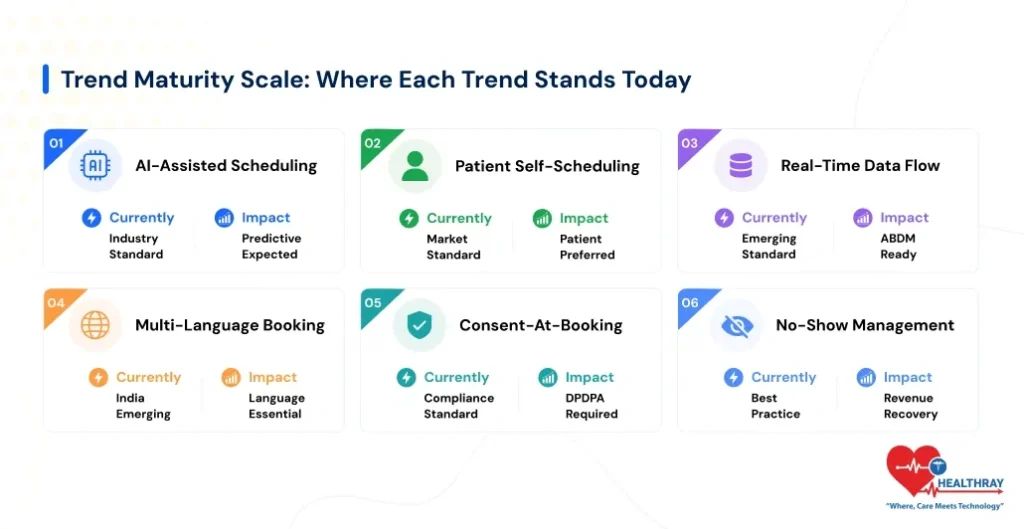
1. AI-Assisted Scheduling More Than Just Being Reactive
Employing AI for scheduling has transcended the stage of a mere trend. Sending out automatic reminders is just the lowest common denominator now; the real expectation is that the AI helps in workload management by forecasting. Mid-sized hospital chains, for instance, are currently procuring scheduling systems with top features like analyzing past appointment data to detect the highest no-show probabilities and suggesting the optimal scheduling pattern.
2. Patient-Controlled Booking as the New Default
Giving patients the power to organize their appointments should not be taken as a feature that only a minority have. Simply put, it is the norm today. Those clinics which do not provide self-scheduling are already losing patients who are opting for those that do. India is still somewhat lagging behind this trend; Still, the chart is set, and even the clinic officials are amazed at how rapidly it is progressing.
3. Cross-System Real-Time Data Flow
Standalone scheduling software use will be a thing of the past. A scheduling platform which can interact with systems like EHR, financial, and laboratory in real-time will become a standard – a scheduled appointment would mean automatically preparing the patient’s file and assigning resources. ABDM’s push for interoperability is going to aid the rise of this trend in India.
 NOTE
NOTE
How to Audit Your Patient Appointment Booking App Against These Standards
Most probably, many clinics have not thought about doing a formal compliance audit of their patient appointment booking app or software at all, and providers usually won’t open up about non-compliance issues. Here’s one way to uncover these issues yourself.
1. Questions to Ask Your Current Vendor Right Now
These are not questions vendors typically prepare for, which makes them the most useful:
- These are questions vendors do not expect, making them the most effective ones:
- Where are our patient records physically held, and is the data encrypted both when at rest and in transit?
- How do you handle and document patient consents during the appointment booking process?
Deal with a vendor who is not able to respond to these questions clearly and without delay, as one whose compliance status is not yet verified; do the same with your dealings.
2. What Your Own Team Should Be Able to Answer
Without your team being able to answer such questions, expect that gaping holes could be not merely in the software but beyond it as well
- Is it within our capability to generate a report containing details of every patient booking within the last 30 days, including identifying the personnel who created or changed each booking?
- If a patient contacted us today requesting information on what data we have on them, are we equipped to not only access but also provide them with a copy of that data within a timeframe of 72 hours?
3. Signs It’s Time to Switch, Not Just Upgrade
If your current system exhibits any of these problems, upgrading it won’t help; you will have to get a new one:
- No native consent management, consent is handled via a separate paper form or not at all.
- Lack of audit log, there’s no way to see who accessed or changed a booking record.
- No interoperability, patient data can’t be exported in a standard format or integrated with your EHR.
 PRO TIP
Conclusion
Healthcare appointment software has become so much more than just a booking tool since it began to involve patient identity, consent, and clinical communication. The compliance obligations that these systems are now required to meet are not hypothetical; they are based on DPDPA, ABDM guidelines and the trend of healthcare regulation worldwide. Hospitals and clinics that consider compliance in scheduling just an IT checkbox rather than a business priority are exposing themselves to risks that they may only become aware of when something happens.
Fortunately, the criteria for the standards are available, the checklist can be evaluated, and the audit questions are simple. An efficient OPD appointment management system not only helps with scheduling but also makes it justifiable. That is the essence of the new standard.