


Quick Summary
The All-in-One Guide to Hospital Management System Benefits showcases how HMS streamlines patient data operation practice management. It facilitates telemedicine and enhances functional effectiveness through data analytics. Additionally, it automates executive tasks for better patient care and provider workflows.
Introduction
The advantages of a hospital management system (HMS) in the rapidly evolving healthcare industry in 2024 cannot be emphasized. Implementing an HMS offers several advantages. These include enhancing patient care. Moreover it also streamlines administrative duties and optimizes resource utilization. HMS promotes smooth communication between healthcare providers. It enhances decision-making procedures. This guarantees regulatory adherence, all of which enhance medical facilities and overall operational effectiveness and care quality.
Convenient electronic medical record services have become increasingly in demand in the past few years. The healthcare sector is rapidly digitizing. As a result, more software tools and systems are being introduced into medical facilities.
The hospital management software system is one of the most comprehensive all-in-one healthcare systems. This post will examine SaaS-based HMS and its main features and advantages.
What is a hospital management system?
A hospital’s executive, clinical, and financial management processes can be streamlined and automated using a Hospital Management System( HMS), a complete software package. Hence this advanced system unifies several operations into a single platform, similar to electronic medical records( EMR), billing, appointment scheduling, force operation, and patient enrollment.
Unnaturally, an HMS supports effective resource operation, improves patient care and boosts organizational performance. It’s the foundation of sanitarium operations. It facilitates quick and accurate access to current case data for healthcare professionals, enabling them to make informed opinions and produce personalized treatment programs.
An HMS’s ability to digitize and centralize patient records is one of its main features; this makes it possible for different departments and healthcare professionals to easily retrieve, share, and update medical information. It improves coordination and communication across care teams and lowers paperwork and administrative responsibilities for medical professionals.
By enabling online appointment booking, cutting down on delay times, and maximizing resource operation, appointment scheduling capabilities in an HMS ameliorate clinic workflows. Likewise, features related to billing and invoicing grease fiscal operations enhance profit cycle operations and guarantee prompt remittances.
Moreover with the modules, hospitals may effectively track and manage medicines, medical outfits, and inventories, reducing waste and stockouts and guaranteeing sufficient vacuity for patient care.
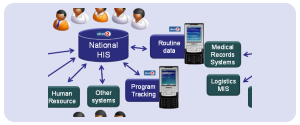
The healthcare information has been transferred from one segment to another division without any obstacle. It integrates modules such as patient management system, stock optimization, billing management, and interoperability. Furthermore, it improves workflows efficiency, precise inventory analysis, data-driven decision, and reduces delays. Detects mistakes, minimizes manual efforts, enhances efficiency.
All effects considered a hospital management system software, which offers a smooth and intertwined approach to managing hospital tasks, is essential to contemporizing healthcare delivery, adding functional effectiveness health care, and eventually perfecting patient issues.
Seven benefits of using the hospital management system
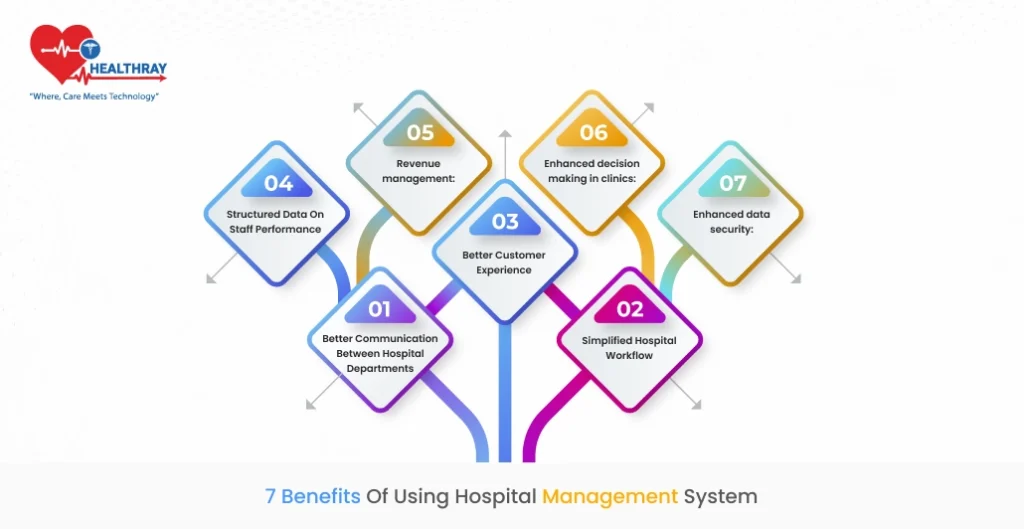
Better Communication Between Hospital Departments
One of the numerous benefits of using a Hospital Management System( HMS) is that it facilitates communication across departments. Hence departments may snappily and partake in real-time test findings, treatment plans, and patient data with a centralized platform. Healthcare workers are more suitable for coordinating their sweat, expediting decision-making and enhancing patient care.
HMS also makes recording consultations, operations, and movables easier, cutting down on delay times and maximizing the use of available coffers. Moreover using integrated communication technologies, staff can work together efficiently and provide accurate and timely case status updates. All effects considered, increased interdepartmental communication promotes a unified healthcare delivery system, lowers crimes, and improves functional effectiveness.
Simplified Hospital Workflow
Enforcing the sanitarium operation system( HMS) optimizes healthcare delivery in several ways by streamlining processes. First, digitizing patient information, scheduling, and billing procedures improves administrative effectiveness by cutting down on paperwork and misapprehensions.
Streamlined processes allow workers to concentrate more on patient care, raising the service standard. Consolidated clinical data also facilitates better departmental communication, which speeds up decision- timber and promotes coordinated treatment. Reduced detention times, precise information recovery, easier discharge processes, and contribute to increased case satisfaction.
Once healthcare workflow runs smoothly, it increases client safety, improves clinical results, and optimizes clinical resources automatically. Administrative activities have been executed in the proper manner and reduce aggregate time. Furthermore, the hospital management system increases practice efficiency and each step towards goal reaching.
Hospital management systems in healthcare also make it easier to misbehave with legal conditions, guarding patient insulation and data security. Eventually, it fosters a more effective, structured, and case- centered healthcare terrain.
Better Customer Experience
In the healthcare sector, putting in place a Hospital Management System( HMS) greatly raises patient satisfaction. In certain circumstances, streamlined processes reduce superintendent stress and save time.
The vacuity of online appointment scheduling and electronic medical records increases penetration into the healthcare system. By icing delicacy in insurance claims and billing, HMS lessens misconstructions and agitation. Integrated communication systems grease easier commerce between cases and healthcare providers, leading to advanced situations of satisfaction and engagement.
With immediate access to information about their medical history, cases are better equipped to make informed opinions about their health. Overall, the effectiveness and availability handed by HMS enhance the client experience and contribute to an indeed more perfect and tailored medical trip.
Structured Data On Staff Performance
There are numerous preferences to executing a CHospital management software (HMS) with organized information on staff execution. To begin with, it makes it conceivable to track worker viability and efficiency proficiently, ensuring the best conceivable utilization of assets.
Utilizing information to illuminate choices almost workforce levels, preparing necessities, and execution surveys progresses decision-making. Moreover organized information too makes it simpler to spot patterns and designs in representative execution, which makes a difference apply centered enhancement strategies.
It too advances responsibility and openness among workers, boosting assurance and cooperation. Eventually, improved patient care results, cost-effectiveness, and operational fabulousness are all encouraged by utilizing organized information on staff execution inside an HMS.
Administer several teams from an unified hospital management system platform. Captures exhaustive details such as personnel confidential information, advanced payment details, salary receipt, income statement, and records performance metrics.
Revenue management
The utilization of a Hospital management software(HMS) for income administration has a few benefits. It begins by streamlining the charging handle, lessening blunders and guaranteeing precise invoicing.
Hospitals can increment cash streams by utilizing effective income cycle administration to speed up repayment. Hence assignment mechanization diminishes staff individuals of authoritative obligations and gives them more time to center on understanding care. By encouraging adherence to directions, the strategy decreases the probability of fines.
Real-time analytics from HMS make it less demanding to recognize income patterns and make well-informed choices with respect to money related administration. Upgraded straightforwardness in monetary exchanges cultivates belief and certainty between patient and providers. Utilizing an HMS for income administration frequently progresses the money related execution and operational adequacy of healthcare organizations.
Enhanced decision-making in clinics
There are colorful ways in which enforcing a Hospital Management System( HMS) improves decision- making in conventions. First, it gives healthcare providers instant access to patient data, enabling them to act snappily and decisively.
Second, it simplifies procedures, relieving workers of some executive duties and freeing them up to concentrate more on patient care. Thirdly, covering force, hand schedules, and case inflow makes effective resource allocation easier while streamlining processes and cutting down on waste.
Hence HMS also provides data analytics results, which help conventions with strategic planning and quality enhancement conditioning by allowing them to study trends, results, and performance measures. HMS generally promotes substantiation- grounded decision- making in healthcare settings, increases clinic effectiveness, and improves patient issues.
Enhanced data security
Putting in place a Hospital Management System( HMS) ensures patient sequestration and confidentiality while perfecting data security. Sensitive medical data is shielded from breaches and unwanted access by stoner authentication procedures and encryption styles.
Having consolidated storehouses and backups helps to give durability of treatment by precluding data loss from tackle malfunctions or natural catastrophes. Access controls uphold patient confidentiality and legal compliance by precluding unauthorized individualities from penetrating private information.
Also, HMS makes auditing functionalities easier, allowing directors to cover system exertion and spot possible security pitfalls snappily. Overall, the better data security offered by HMS protects patient information and promotes a safe and secure healthcare terrain.
How does the Hospital management system from Healthray help?
With a feature-rich set specifically designed to meet the demands of contemporary healthcare institutions, Healthray’s Hospital Management System transforms healthcare administration. Aspects of ]hospital operations similar to patient administration, appointment scheduling, invoicing, and clinical attestation are all streamlined by Healthray’s HMS.
Healthcare interpreters may effectively manage patient data with Healthray’s HMS, guaranteeing quick access to vital information and promoting smooth care platoon collaboration. The system’s stoner-friendly module for the patient history and scheduling movables streamlines clinic operations, cutting down on delay times and raising patient satisfaction.
Robust billing and invoicing are other features of Healthray’s HMS that help hospitals ameliorate profit cycle operation, expedite fiscal deals, and guarantee billing compliance. Also, Healthray’s HMS offers sophisticated analytics and reporting features that enable sanitarium directors to maximize functional performance and make data- driven choices.
Healthray’s Hospital Management System is a noteworthy development in healthcare sanitarium operation software, furnishing a complete answer to optimize workflows, boost productivity, and ameliorate patient care.
Encompassing several modules that includes electronic health records, financial integration, inventory management, IPD management, pharmacy management system, ward management, and more. If you are eager to know more, check the hospital management system website page of Healthray.
Conclusion
All aspects of the ultramodern world must be digitized. Creating software for operating sanitariums is one of the many innovations that are taking place in the field of healthcare. HMS is a tool for gathering all data related to sanitization, which eliminates paper from the process as much as possible. You can mix and match different sorts of sanitarium operation systems in your HMS. Select the features that each user component needs in order to meet their needs. Additionally, there is the problem of data sequestration. To properly protect users’ data, it would be beneficial if you focused more on enforcing secure services in your HMS.