



Brief Summary
Innovation in the medical landscape continuously increases but the adoption challenges remain constant and hard to adapt with new healthcare technologies. Moreover, major bottlenecks do not come from the new trends but the organization itself is the core barrier like difficulty in RIS training and user adoption. Let’s discuss in-depth.
Introduction
In the healthcare infrastructure, the radiology centre is the crucial and more connected one. As the complexity of radiology tasks increases, IT healthcare built an exceptional radiology information system, streamlining in coordination and efficient services. However, each coin has two sides.
Here we talk about the other side, what challenges do employees encounter and also find the exact solution. A standardized approach needed to overcome clinical barriers and render an efficient solution, which reduces frustration, increases patient satisfaction score, and optimizes results.
Might you have been surprised to hear that, even big companies fail to execute RIS properly, making it harder for organizations to adapt. Moreover, You have to conduct proper training sessions simplifying the adoption lifecycle. Adopting the clinical system maximizes income, decreases frustration among employees, and easily adjusts with changes.
Radiology Information Systems : A Modern Approach To Deal With Medical Images
A backbone of advanced diagnosis and makes it smoother to administer varied medical images. Incorporated with the medical devices, it directly stores radiology images in the RIS platform that make it simpler to examine and trace them more efficiently.
From radiology order, patient registration and scheduling system to claim management, each of the activities done by the radiology information system platform. Moreover, it provides coherent patient care and advances radiology services to the next level.
Called Integrated hub, it connects multiple stakeholders and smoothens the coordination among them. Supervising entire radiology duties with no more stress, you should familiarize with the radiology kinds.
Types of RIS systems
There are various kinds of radiology information systems, here we discuss the core one :
Integrated :
Smoothly connected with other healthcare systems like EHR, PACS, and LIMS for better coordination with departments and administer data at centre.
Standalone :
Proper handling of appointments and support in efficient tracing of radiology information, it supports independent medical practice.
How Does RIS System Automate Workflows?
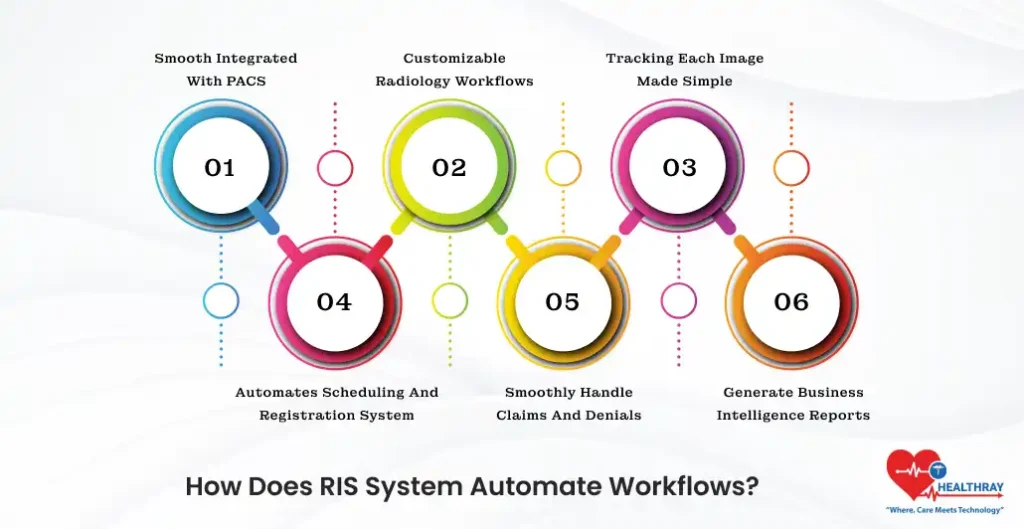
Incorporating radiology information system (RIS) for smooth execution of workflows and delivers excellent patient care quality. Moreover, it creates a smart radiology system, which optimizes procedure and enhances workflow efficiency. Happens due to automating radiology workflows, let’s see in detail :
Smooth Integrated With PACS
If you need an automated workflow system in radiology, it must be incorporated with PACS for enhancing processing speed of radiology images and minimizing diagnostic times, which is beneficial for emergency cases. Let’s comprehend why it’s best.
- Decreases the manual transfer, mitigates the potential risks
- Creates the comprehensive integrated system
- Automatically generates the accumulated reports
- Increases the speed of accessing radiology images
Additionally, it creates extreme security, increases turnaround times, reduces delays, and enhances data accuracy.
 PRO TIP
Customizable Radiology Workflows
The major reason for customizable workflows, incorporating electronic medical records. It provides flexible templates, which smoothens the data entry procedure along with security regulations. But, what it does. Take a look below :
- Enhances more than 50% turnaround time
- Preserves over 1 hour per shift
- Improves operational efficiency
- Minimizes appointment cancellation by 70%
Executed radiology workflows in less time, increases consistency in work and increases personalized configurations.
Tracking Each Image Made Simple
The radiology information system delivers seamless monitoring from order, patient information, medical equipment to insurance claims. Moreover, it accumulates all images and radiology reports for effective medical practice. It helps us to :
- The current status of radiology images
- Securely collected and provide data accessibility
- To know whether the equipment is available or not
- Improves operational performance and satisfaction score
In PACS and RIS both play a significant role in meticulously tracking healthcare images. EHR is like a plus for exhaustive records and exchanging information with one click.
Automates Scheduling And Registration System
Streamlines to book and consolidate patient appointments, provide reminders at a periodic interval, and easily administer hospital resources. Furthermore, it heightens the quality of patient journey, enabling the comprehensive view of all images and information that makes it smoother accessible.
After reserving appointments for imaging scan, it seamlessly transmits with the team member and provides timely reminders. Supereasy to transmit reports from one hospital unit to another one.
Smoothly Handle Claims And Denials
Radiology management system, potential to embed with third-party systems like insurance claim processing. Moreover, it enhances data precision, increases the reimbursement process, and easily supervises invoicing systems.
- Generates medical invoices with the ICD-10 codes
- Seamlessly tracing the insurance procedure
- Accessing documents for checking eligibility
- Simplifying procedure for speedy adjudication
While managing insurance documents and bills, it complies with the necessary requirements, reduces the risks and increases efficiency level. The amazing aspect, it can be done with mobile RIS applications.
Generate Business Intelligence Reports
Accumulation of radiology reports and progressive images as the treatment goes ahead, generates the comprehensive visual reports for making effective and fast decisions. Moreover, it helps to monitor key performance indicators, easily examine what could be the supply in the future, and assists to take immediate actions.
Therefore, it enhances operational productivity, improves revenue cycle by taking necessary actions, and improves patient flow process.
Several Roadblocks You May Encounter In RIS Training And User Adoption
The radiology information system (RIS) effectively supervises medical images and patient information, arranges it too well and monitors precisely. Furthermore, here are the several roadblocks for RIS training and user adoption :
Resistance To Adopt Digitalized System
- Several factors influence employees for adopting the new radiology technology, which smoothens the curve of radiology workflows. Still, employees refuse to use it.
- Operational and psychological factors are more influential ones, which will affect the company costs and patient care standards.
- They are more reluctant because it is time consuming, initially creates errors, and minimizes efficiency.
 NOTE
NOTE
Inadequate Training That Enhances Frustration
- Employees do not get sufficient training, reduces their motivation and morale
- One-time training session often frustrated employees and create errors
- Non-intuitive interface creates difficulty for simple healthcare tasks
- They don’t rely on the new software too early and have fear of mistakes.
Securing Information From Breaches
Using the radiology information system for a longer time, poses a threat for data loss and penalties. When you don’t manage radiology data properly, there is a high risk of data breaches. Moreover, let’s learn what could be the negative consequences :
- Impose hefty fines
- Delete significant records
- Affected reputation
- Reduces productivity
Lack of Vendor Support
- Vital and foremost hurdle for successful installation
- Creates the negative outcomes rather than positive
- Might be missing to learn critical functionalities
- Difficult to accomplish the expected return on investment
Incompetency With Legacy Systems
- Migrating information from one to another system can be difficult
- Experienced professional deny to work in the modern system
- Legacy systems create improper documentation, hard to train new comers
- Employees can’t leave their old habits that had been done manually
Limited Flexibility In RIS platforms
- Usually, the comprehensive platforms are not that successful, often creating errors and disrupting the entire workflows.
- Increases the workload, enhances errors, and decreases productivity rate. Also, it creates more rigidness in radiology workflows.
- Difficulty in creating flexible training programs, imbalance in operational performance. Therefore, employees tend to believe less.
How To Resolve RIS Training And User Adoption Challenges?
Do we address RIS training and user adoption obstacles? Yes, definitely you can do it. But, you must follow the right and structured format. Let’s discuss in detail how to resolve challenges :
Select The Right Vendor
When do you select the vendor for adopting RIS? Then, you should the consider the following factors :
- Checking the user experience and testimonials
- Before finalizing, conduct the demo
- Inspecting the software interface and critical functions
- Ask more questions, check their behaviour with you
Reinforcing Open Communication
- Create a friendly culture in your work environment, give chances to employees to actively participate in the cloud radiology information system training sessions.
- Decreases fear, reduces their resistance to adopt the new modern systems. Also, it reduces practical risks.
Monitoring The Training Progress
Conducting training is not enough, should be periodic and monitoring entire sessions. Moreover, it is suggested that training sessions are recorded in the video format, employees are able to revise whenever they want. Besides encouraging customers, the other benefits encompasses :
- Improves employee performance
- Achieving business goals on time
- Reduce workspace chaos
- Increases productivity rate
What are Future Trends of Radiology Information Systems?
The radiology information system evolves continuously, demands are equal to heighten upgradation of technology. Have you thought about the RIS future trends? Let’s learn with us :
AI-based Technologies
Undoubtedly, the upcoming radiology information system (RIS) endowed with the progressive technologies (machine learning and natural language processing), which speeds up your diagnosis procedure, and mitigates expenses. Also, it increases efficiency level, and enhances quality care. AI chatbots for radiology usually help in :
- Analyze reports and images
- Help in decision making
- Enhancing the clarity of images
- Suggesting and predicting outcomes
Cloud-based Architecture
In this platform, patient medical images and sensitive radiology information is stored in the remote server. Moreover, it streamlines data accessibility and is not required to be online for accessing documents, you can use the offline mode.
Enhancing the security of radiology and patient information, easily tracks the information and provides high-end security. Therefore, the cloud-based solutions secures from data loss, increases efficiency, and reduces manual entry.
Conclusion
Are you tired of RIS training and user adoption challenges? I think this article is perfect for guiding you. It integrates with PACS, simplifies tracing, improves scheduling system quality, manages insurance claims, and drafts business intelligence reports for effective decision-making . No doubt, the radiology information system is a progressive approach but still there are some pitfalls in RIS adoption. Moreover, common hurdles encompass insufficient vendor support, create resistance to employ a digital system, secure data, incompetency with legacy systems, and limited flexibility. When you select the right vendor, employ open communication, and seamlessly monitor the training progress.