

Summary
LIMS vs LIS are both laboratory systems, but their focus is entirely different. LIS is mainly constructed for hospitals and diagnosis centers to simplify complex operations from collecting samples and generating reports to delivering the reports. In simple words, LIS automates all the workflows that were being done manually in hospitals. On the other side, LIMS is a broad term and focuses on sample lifecycle tracking, research data, compliance, quality control, and inventory management. In this blog, I will discuss the difference between LIS and LIMS more deeply to help you understand both teams clearly. And I will cover how to select the platform as per your business needs.
Introduction
Have you ever noticed the same-sounding term in healthcare technology systems creates confusion? LIMS or LIS is one of them. Both terms have to do with the laboratory; they both deal with test data and produce reports. But they are still not similar. What’s the actual difference? And, most importantly, which laboratory software should clinics use?
Laboratory information systems are mainly designed for hospitals or diagnostic labs and their main focus is on patient-centric testing. To put it simply, once the doctor places the order, the sample is collected, the test is generated, and the report is automatically updated on the patient portal. Now, let’s talk about LIMS, Laboratory Information Management System. It is a slightly broader and advanced term. LIMS is not just limited to patient reports.
LIMS can efficiently handle sample lifecycle tracking, research data management, quality control, inventory tracking, compliance documentation, and complex workflows. Furthermore, LIMS are not just intended only for hospitals; they are also meant for pharma companies, research labs, biotech firms, and manufacturing labs that are adopting them. Now you might be thinking, if both are managing labs, then what’s the difference? LIS is more optimized for clinical environments, and LIMS are adaptable for process-oriented or multi-industry applications. Keep reading this blog to know the difference between LIMS vs LIS and how to choose the software as per industry workflow.
LIMS vs LIS: Core Features Comparison
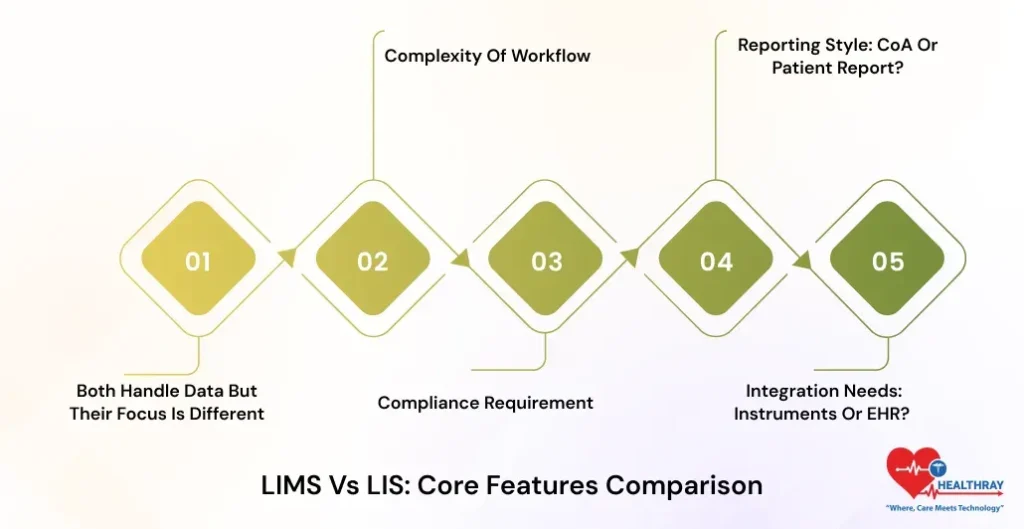
1. Both handle Data But their focus is different
At surface level, both LIMS and LIS handle the lab data and simplify their complex operations. But if we look deeply, LIMS handles more than just clinical data. Further, LIMS tracks the sample data and provides details thoroughly, such as sample stage, batch processing status and approval details. On the other hand, LIS is completely patient-centric. Further, it provides you accurate details about patient tests, result updates and what type of reports doctors need.
Sample vs Patient: What’s your primary focus?
If you need batch testing and inventory management software, then LIMS is a strong choice, and if you just focus on patient reports or doctor coordination, then LIS is a better fit.
2. Complexity of Workflow
First, clinics should understand their workflows. Furthermore, they should check whether their workflow is detailed or just based on fulfilling the fundamental need of lab operation. If clinics need to track all the steps of operations, such as sample tracking, storage, batch testing, instrument integration, or final analysis. Then, LIMS is a useful choice. It can manage the entire sample lifecycle. Further, if a clinic’s focus is on doctors’ test orders, result verification, and patient report delivery, then an LIS is the best fit for your clinic’s needs. LIS simplifies all the complex operations and expedites the clinic’s practices that took hours to accomplish with the traditional system.
3. Compliance Requirement
Every lab compliance requirement is different. And this impacts the clinical decision. If you are working in a research and manufacturing environment where following GMP and ISO standards is highly paramount. Clinics have to maintain documentation, audit trails, and quality control. Here LIMS plays a dominant role. Further, if clinics are running diagnostic centers or labs that emphasize patient data security and HIPAA/CLIA compliance. Then, LIS is the best option for clinics. Clinics first need to check their compliance requirements before making the decisions.
4. Reporting Style: CoA or Patient Report?
Clinics should first clarify the types of reports they want. If your needs are based on manufacturing and research labs, then detailed Certificates of Analysis (CoA), batch summaries, or analytical reports are the fundamental requirement. In this case, LIMS is the appropriate option, as it is proficient in generating standardized, audit-fit documentation. But if you are running a diagnostic lab where you need to prepare clear and easy-to-read reports for your patients, then LIS is an apt solution. Additionally, LIS delivers doctor-friendly and patient-friendly reports that are suitable for your lab workflows with all details along with EHR integration.
5. Integration Needs: Instruments or EHR?
Before making the decision, first think: How do you want to connect the system? If your lab system connects with multiple analyzers, testing instruments, and ERP systems, then LIMS provides you strong integration. It directly fetches the data from instruments and then synchronizes all the data in the system. Also, it can efficiently handle inventory. But where your focus is on patient care and where your system requires connection with EHR/EMR, billing software, and POC devices, then LIS is a suitable option. Before making a long-term choice, check the direction for your ecosystem. Also read our blog LIMS integration with HIS to understand it more deeply.
 PRO TIP
Pros of LIMS
1. Multi-Industry Flexibility
If your lab is not just limited to patient testing, then LIMS is the best fit. Further, LIMS simplifies the complex operation of Research labs, pharma companies, and manufacturing units. Lims can conveniently handle sample monitoring, batch preparation, quality control, and compliance documentation. That’s why it is easily adaptable in a multi-industry environment.
2. Smartly automate complex workflows
If your labs process multiple samples at a time, then manual tracking becomes a complex practice. Further, LIMS eases the complex operation, such as simplifying the batch processing and tracking the sample lifecycle at every stage. It makes the entire process hassle-free, systematic and expedient.
3. Provide strong analytics for business insights
Just collecting data is not sufficient; clinics should take out some insights from that to improve their business. Further, Lims provide strong analytics where management can easily check:
- Which sample tests are in higher demand?
- Which areas require performance improvement?
- How is the productivity of labs?
Additionally, LIMS provides clear visibility on operational trends and reports. This helps management in making better planning and improves decision-making.
Learn more: Exploring the Latest Trends in Lab Solutions Software Development
Cons of LIMS
1. Difficulty in Understanding Advanced Features
LIMS boasts a highly powerful tool and advanced features. Initially, staff feel uncomfortable with understanding the interface and workflows. Staff needs proper training to leverage its full benefit.
2. Training or Change Management Important
Team requires rigorous and structured training to utilize the full features of LIMS. Clinics discover real efficiency and productivity benefits only when staff members become proficient at utilizing the system.
Pros of LIS
1. Perfect for clinical environments
If your lab workflows operate in hospitals or diagnostic centers, then LIS is actually a perfect choice. Further, it boasts features that ease the complexity of clinic operations. It ensures:
- Seamless EHR integration
- Synchronise patient records, test orders, and reports
- Provide fast diagnostic workflows.
2. Billing and Compliance Already Built-In
LIS includes billing and reporting features that automatically calculate the test charges. Additionally, Laboratory Billing Service software smoothly maintains regulatory requirements and documentation standards.
Cons of LIS
1. Provide Limited Option for Advanced Research Workflows
Lis features are limited only to patient diagnosis. It does not support complex R&D processes, batch experiments, or multi-stage testing.
2. No Customization and Scalability features
In research labs, workflow changes constantly. LIS is not suitable if clinics require scalability features. It is not an appropriate option for non-clinical and experimental setups.
Step towards digital era with our healthcare solution
Revamp your hospital facilities and embrace change for better healthcare management. Ease in managing and organizing large medical datasets leads to effective analysis. Seize the opportunity now!
LIMS vs LIS: Choosing the Right System
Let’s check out:
1. Define your Lab Type
Before making the long-term decision, first clinics should know their lab type. If you’re running a hospital or diagnostic center where the primary focus is on patient testing, then LIS is a better option. But if you are running lab operations in a research, pharma, or manufacturing environment, then LIMS is the best option to simplify day-to-day mundane operations.
2. Check Testing Volume
If your operation deals with High-throughput batch testing, then an AI-driven LIMS System is an appropriate option. On the other hand, if you are dealing with a patient’s diagnostic test, then LIS is the perfect choice.
3. Don’t Ignore Integration Needs
If EHR/EMR integration is your priority, then choose LIS. On the other hand, if your lab instruments connect with HPLC, then LIMS is a perfect choice.
 NOTE
NOTE
Conclusion
I hope you grasp the precise definitions of LIMS vs LIS after reading the blog mentioned above. If your priority is on patient reporting or EHR integration, then choose LIS. On the other hand, LIMS is a strong option for versatile sample management. Modern hybrid platforms such as Healthray combine the benefits of both systems. In 2026, the system that supports your long-term goals is an ideal option.