




Summary
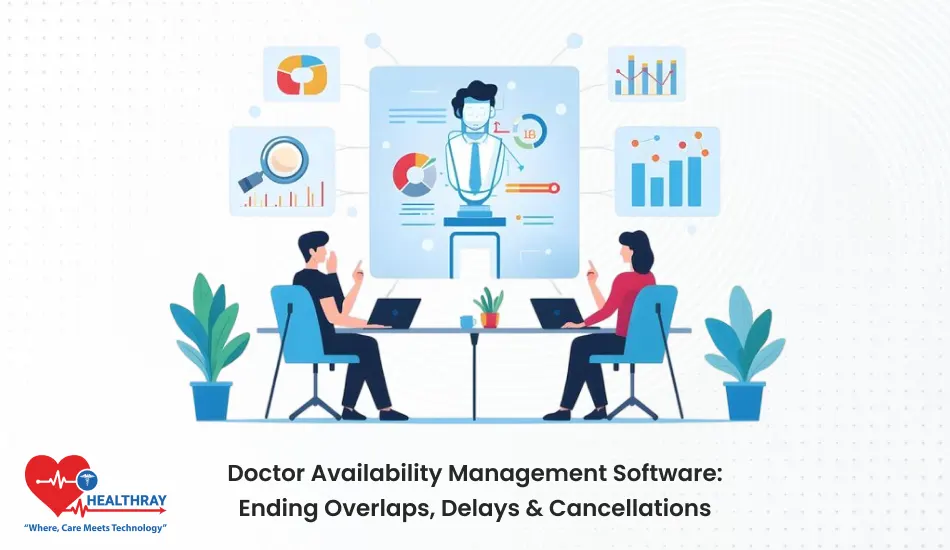
Conventional doctor scheduling method creates upheaval in opd workflow from overlapping appointments to last-minute delays and unnecessary cancellations. In peak hours, situations become more challenging and it becomes difficult for doctors to handle multiple patients at the same time. Manual systems are unsuitable for handling emergency situations, which leads to patient dissatisfaction and doctor workload. In this blog, I will discuss how doctor availability management software functions like clockwork and is adept at tracking doctor timing, shift changes, breaks, and sudden unavailability and makes the opd workflow, fast, smooth and highly efficient.
Introduction
In today’s fast-moving healthcare world, no clinic wants to utilize outdated scheduling methods that result in double bookings, unnecessary delays and appointment cancellations. These days hospitals are looking for modern, reliable solutions that smartly manage the doctor availability and facilitate smooth patient flow. Doctor availability management software transforms the entire scheduling process from tracking doctors’ timing to handling sudden changes and managing all the operations in real time.
You might be thinking doctor appointment systems are highly expensive? But the truth is entirely different. When you combine manual errors, missed appointments, staff confusion and patient dissatisfaction; it costs clinics more than traditional approaches. However, when clinics embrace the right doctor availability management software, it saves significant expenses of clinics and also it simplifies the most stressful part of opd operations doctor time coordination.
Integrated features provide transparent and convenient care to patients. Patients can easily determine doctors’ availability times, and also they can receive updates in their preferred language. They no longer need to stand in long queues and wait for rescheduling. Moreover, the doctor gets the benefits of accurate slot management, automatic updates and zero-overlap appointments. Overall, this system brings clarity, minimises burden and allows all staff members to focus on the same goal, that is, providing timely and quality care.
The Growing Scheduling Challenge in Healthcare
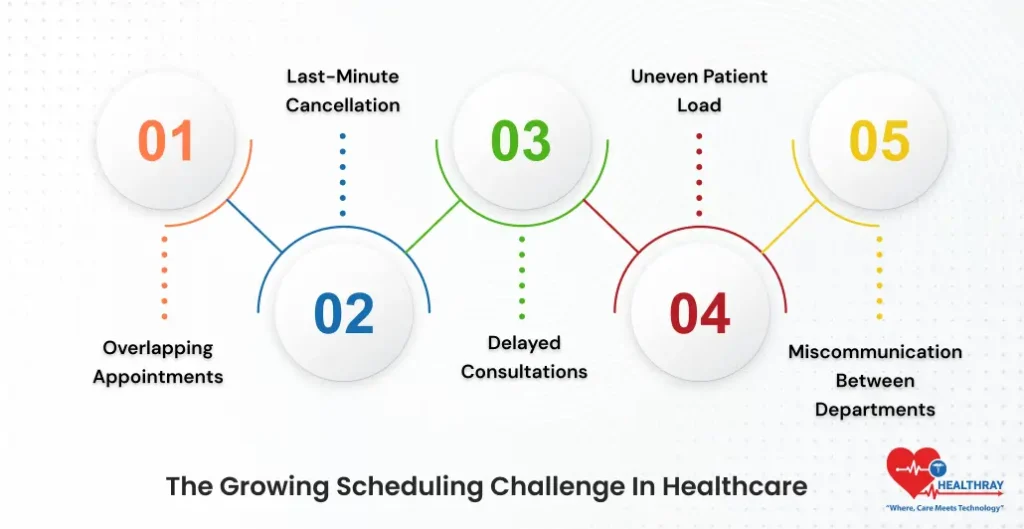
Nowadays in healthcare setups, coordination among multiple doctors, visiting consultants, part-time specialists and telemedicine services is extremely challenging. Furthermore, it’s clear that manually scheduling will inevitably result in errors when dealing with these moving components. Few challenges clinics encounter:
Overlapping Appointments
In healthcare facilities, overlapping appointments has become a common and frustrating issue. Further, when calendars are obsolete and multiple staff members rely on different tools, there are high chances of double bookings. Also, in peak hours, this problem gets more serious.
Huge numbers of patients arrive at hospitals for consultations during the same time slots. This disturbs the entire overflow of OPD. Moreover, doctors need to handle the extra rush; patients get upset and the entire staff gets into confusion. This type of scheduling chaos directly hits the clinic’s efficiency and degrades the patient experiences.
Last-Minute Cancellation
In healthcare scheduling, last-minute cancellation creates a major disruption. Furthermore, when patients without any prior information cancel the appointment at the last moment, then doctors’ valuable time becomes wasteful. In a manual system, this problem becomes more critical, as slots do not receive quick refills. Also, staff members do not have real-time visibility.
This results in wastage of resources and dysfunction of opd workflow. Beyond that, it becomes unsustainable for staff to efficiently manage patient waiting lists. Overall, this sudden cancellation causes operation loss and negatively impacts overall productivity and revenue.
Delayed Consultations
In healthcare settings, delayed consultations are a regular and exhausting challenge. Furthermore, when doctors fail to receive a previous patient’s exact duration or receive emergency add-ons at the last moment, it disrupts the entire schedule. Manual scheduling system lacks real-time visibility. Because of this, staff members are not aware of the amount of time that doctors are falling behind.
Additionally, patients have to waste time waiting for doctors to become available. Also, it creates unnecessary pressure on doctors and slows down the opd practices. Overall, these prolonged delays not only waste time but also impact patient satisfaction, staff coordination and clinic productivity.
Uneven Patient Load
In hospitals, uneven patient load is a silent troublemaker. Furthermore, when the medical system lacks a centralized system, doctors get stuck with a long waiting line of patients while other slots remain half empty. This imbalance mostly occurs because every department manages their appointment process independently, without having real-time visibility of the entire work procedure.
Result? One doctor is swamped with work and handles the rush, while another doctor sits completely idle. Both situations hit the clinic’s productiveness. Overall, this uneven distribution slows down the opd workflows, increases waiting times in redundant ways. Even worse, patients feel the entire hospital system is unclear and chaotic.
Miscommunication Between Departments
Miscommunication among departments is the most prevalent and expensive aspect of medical centers. Furthermore, when staff depend on manual coordination, phone calls, WhatsApp groups, or informal communication tools, then eventually information gets easily misplaced, delayed, or misinterpreted.
The availability of doctors is updated by one department, but it is delayed in reaching another department. As a result, patients arrive at wrong times, doctors are not available and appointments are unnecessarily pushed back. Overall, this type of communication gap creates confusion and makes the entire operation workflow slow, unorganize and unpredictable.
Overall, the abovementioned inefficiencies not only disturb schedules but also impact patient satisfaction, staff morale and overall organizational efficiency. According to a 2023 Healthcare IT News article, hospitals are losing 18% of their appointment revenue due to poor scheduling practices.
How Software Ends Overlaps, Delays, and Cancellations
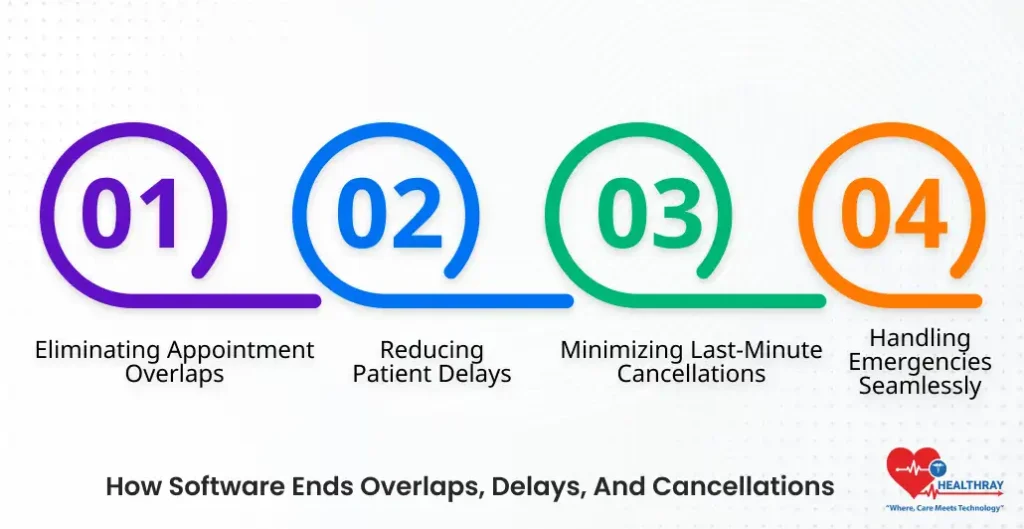
Let’s check out:
Eliminating Appointment Overlaps
Just imagine you are heading to clinics, and someone else has also been called at your time slots. It sounds awkward indeed. Agree? This problem usually occurs because clinics are managing the appointments manually. Spreadsheets may not always be updated, staff may verbally give patients appointments, and calendars may not always be correctly integrated. However, with doctor queue management software, clinics can easily minimize their appointment overlaps. The system centralizes all the appointment work.
Patients and staff get real-time updates of booking, cancellation, and availability changes. It reduces the possibility that someone else will inadvertently be assigned duplicate slots. A doctor’s appointment system guarantees that each patient has a fair turn without any delays or overlaps. Also, it becomes easy for doctors to plan their day, as they have clear timetables of patient visits.
Reducing Patient Delays
Patients frequently complain about having to wait a long time for their appointments when they visit a doctor. A few patients’ cases take longer than anticipated, and certain times the doctor gets busy, causing the appointment to be rescheduled. In every clinic routine, this is the real scene that takes place.
However, doctor appointment software completely changes the entire medical process. System evaluates the real-time data, such as the doctor’s average consultation timing, patient history, and peak hours, and assigns accurate slots to patients. This naturally makes the queue management flawless and minimizes unnecessary delays in the system. Doctor availability management software also creates a buffer that ensures smooth workflows of regular patients even in emergency situations. This helps clinics provide predictable times to patients, and also doctors can lay out their daily schedule systematically.
Minimizing Last-Minute Cancellations
At some point, every clinic experiences the same pattern. The entire day is planned well, but one patient not showing up perturbs the entire rhythm. This disturbance seems small, but eventually it breaks the clinic’s daily flow. At last, clinics realize that they need a more dependable system. Doctor consultation booking system keeps the communication active among other departments and reminds patients of their upcoming visits, sends messages to patients at the right time and keeps the patients connected, no matter how busy their schedule appears to be.
Doctor availability management software effortlessly manages the doctor’s session cancellation process. Without creating noise, this system automatically notifies patients, reassign slots and sets up the entire day. Workflows that were perceived as chaotic previously now seem manageable. Now, last-minute cancellations no longer influence the clinic pace. Gradually, clinics start getting a new and stable rhythm that supports both patients and staff.
Handling Emergencies Seamlessly
No matter how well clinics are set up, emergency situations always arrive unexpectedly. A sudden case, an unexpected complication, or immediate patient care all these situations disturb the entire routine of medical practices. However, when clinics start searching for a stable rhythm, this situation no longer creates panic; instead, it redirects the flow. As the emergency situation arises, online slot booking for doctors immediately starts working silently in the background.
This software identifies doctor availability and which rooms are easily accessible and how to adjust existing schedules without breaking the normal routine. Now, staff no longer scramble; instead, they provide calm, confident responses to patients as they are clear about next steps. In these moments, clinics understand their real strengths. This stability creates strong trust among patients and clinics are capable of maintaining a stable rhythm even during uncertainty.
 PRO TIP
AI: The Silent Mind Behind a Clinic’s Schedule
Let’s check out:
Predicting Patient Rush Before It Arrives
Firstly, AI predicts peak hours. The AI platform can easily determine the time at which patient volume naturally increases and suggest which doctors to deploy at that particular slot. This foresight helps clinics to prepare for any emergency situations.
Fine-Tuning Slot Timings Through Real Experience
Next, AI analyzes past appointments and then fine-tunes the future timings. If a doctor consistently takes more time during consultation, the system automatically adjusts the next slot as per that rhythm. Gradually, the system minimizes delays or overlaps and makes the entire medical flow transparent and predictable.
Understanding Urgency and Prioritizing with Sensitivity
AI can quickly recognize the clinical urgency. It automatically prioritizes cases from mild to routine flow and brings urgent cases to frontline attention without any manual scramble. This provides immense clarity to staff for upcoming events and ensures patients get timely care.
 NOTE
NOTE
Conclusion
Doctor availability management software is not just a luxury but an essential foundation for modern healthcare. When scheduling gets automated, it minimizes overlap and last-minute cancellations, and consequently, clinics get new clarity and patients get a smoother, stress-free experience.