


Summary
Healthcare institutions are unwittingly experiencing a yearly loss of revenue ranging between 1% and 5% as a result of payment leakage through unattended co-payments, claim denials, and billing errors. This blog will examine how a contemporary healthcare payment system that utilizes UPI, real-time insurance validation, and sophisticated POS systems assists in plugging those leaks.
Introduction
Every rupee made by your hospital has to go back into your hospital. But in practice, most Indian hospitals do not enjoy such a luxury. Inefficiencies in billing and payment processes cause an organization to lose revenue, a situation known as revenue leakage. Implementing modern medical billing software can help hospitals track every transaction accurately and prevent revenue from slipping through the cracks. Hospitals can lose crores each year due to revenue leakage.
If your health billing infrastructure is fragmented – where the billing system cannot communicate with insurance, pharmacy counters operate independently, and front desk personnel enter patient information manually – errors will compound rather than remain isolated.
That is precisely why forward-thinking healthcare providers are moving beyond traditional billing toward an integrated healthcare payment system – where UPI, insurance, and POS operate seamlessly under one unified payment layer. The system now captures, verifies, and settles revenue that would have slipped through the cracks in real time every single time. In this blog post, we will take you through all aspects of a payment solution in detail and explain why the time for upgrade has finally come.
UPI & Wallets: Stop The Wait-And-Collect Cycle
Patients who say “We’ll bill you later” rarely pay, so you will not receive the money. As soon as the patient leaves your hospital without settling their debt, there will be a significant reduction in the possibility of collecting this sum. According to research, post-discharge recovery percentages are down to 20-30% – even without including additional expenses associated with contacting the patient and reminding them to pay their debt.
UPI Eliminates This Problem At The Source
The number of P2M (Person-To-Merchant) transactions via UPI exceeded 67 billion by June 2025, a 37% rise from last year, making Indians prefer UPI for merchant transactions. In fact, pharmacies, laboratories, and outpatient counters constitute high volume UPI merchant categories. Now, it’s a matter of whether your clinic can enable them to do that. Here is what a UPI-integrated healthcare payment system does differently:
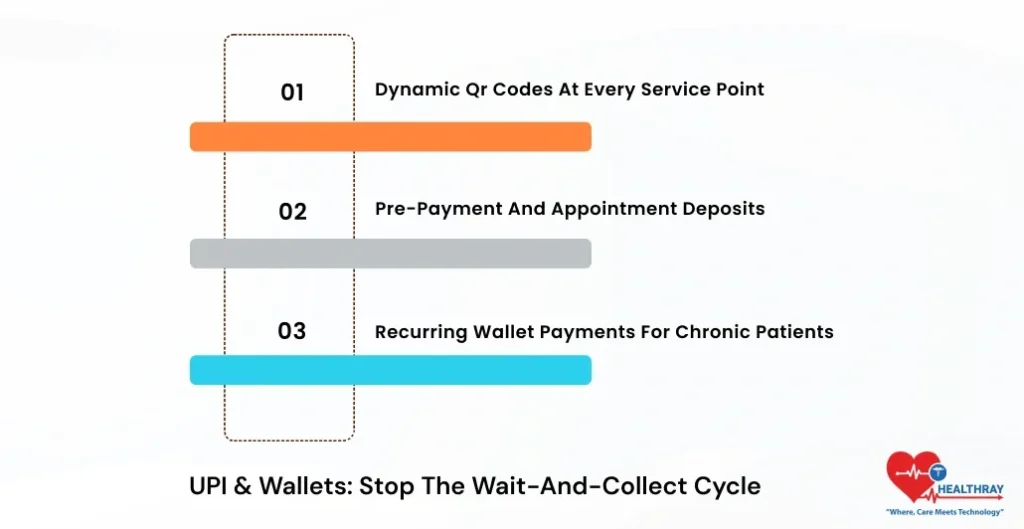
- Dynamic Qr Codes At Every Service Point: It’s not only the receptionist that uses the QR code, but also the lab, the pharmacy, and the radiology desk. By integrating doctor billing software, each payment is tracked automatically, ensuring no revenue is lost the moment the service is delivered. The system immediately records your payment in your account the moment you make it.
- Pre-Payment And Appointment Deposits: patients who schedule an appointment make an advance payment using UPI, which results in low no-shows and effective use of slots. The clinic collects money even before the patient visits.
- Recurring Wallet Payments For Chronic Patients: For patients requiring continuous treatment, recurring payments are possible and will ensure money is collected from patients every time they visit, making billing automation in healthcare a reality at your clinic.
The math is basic: Same day collections are three to four times higher than post discharge billing. With UPI, same day collection becomes the norm rather than the exception.
 PRO TIP
Insurance Integration: Stop Claim Denials Early
While UPI solves the cash flow issue, insurance integration addresses an even bigger problem: claim denials. More than 50% of all claims denied have their root cause in front-end errors, such as erroneous eligibility information, lack of pre-authorizations, and incorrect billings for services not covered under the policy plan. This is not due to billing inefficiency but stems from issues in the revenue cycle management system. It leads to losses running into crores for Indian hospitals.
Real-Time Eligibility Verification
It begins the instant that a patient registers. This means that, before providing any service, the system will check the policy of the patient to see which services are covered by the policy. The system tells you immediately which services insurance will cover and which it will not.
Automated Prior Authorization
Eliminates the manual process with TPAs that is slowing down treatment due to approval delays and billing holes. With seamless integration of TPAs into your program, approval requests and confirmations can take place through digital means, resulting in an electronic trail of transactions since day one.
Automated Split-Billing
That is the true game changer. The minute any service is delivered, the system automatically computes the accurate Insurance Share versus Patient Share and captures the patient share instantaneously using UPI and/or POS. Prompt payment begins from there; it isn’t done when the patient leaves the facility or even weeks after that, but right then and there as the service is rendered. Based on apeer-reviewed study on Revenue Cycle Management published on PubMed, delayed billing is one of the major causes of poor collection performance with providers losing 2%–5% of net patient revenue due to inefficient RCM.
A real-time healthcare payment system with insurance integration not only reduces claim denials but also improves revenue collection, as shown below:
| BILLING APPROACH | WHEN PATIENT IS BILLED | AVG. COLLECTION RATE |
| Conventional Billing | Days to weeks after discharge | Approximately 20-30% |
| Partial Split-Billing | At time of discharge | Approximately 55-65% |
| Real-Time Split-Billing (UPI and Insurance) | At the time of service | Approximately 85-95% |
 NOTE
NOTE
POS Systems: Capture Every Charge, Every Time
Most healthcare organizations cannot determine whether they charge for all services provided. And if you’re an honest administrator, you know the truthful answer is no. Imagine a situation where your laboratory, radiology, and pharmacy are operating in their respective databases. Or even worse, the billing process happens manually. You prescribe a blood test but forget to document it. Your pharmacy provides an item, but you forget to associate it with the patient’s profile. You provide an emergency service, but you don’t have time to record it. All these are relatively minor problems. But they add up, causing significant losses in your financial management performance. This is exactly where integrated POS (Point-of-Sale) systems become essential, as they ensure every service is captured and recorded in real time, eliminating manual errors and preventing missed charges.
Integrated POS Systems Seal All Gaps
Each of the service counters in your facility – whether in pharmacy, laboratory, radiology, or outpatient consultation will have their own terminals that communicate directly to patient billing system ensuring every charge is automatically recorded and reconciled. The system records each charge and attaches it to the patient’s profile as soon as a service is requested or rendered. There will be no need for manual input, delays, or missed charges.
- Auto-Reconciliation: This means that your financial department is no longer spending countless hours each evening reconciling your cash, credit card, and insurance payments to the HMS system. The system processes transactions in real time and flags any discrepancies immediately, rather than waiting for quarterly audits.
- POS Flexibility With Payments: Convert processes where customers may be inclined to defer treatment. With EMI and BNPL options, patients can afford a ₹40,000 operation without paying upfront. They make payments in stages. The medical center receives its dues. Everyone benefits from this arrangement.
This is what an integrated payment system for healthcare looks like on a tangible front – from the tip of the iceberg to its base.
How a Healthcare Payment System Protects Revenue
All three elements above – UPI, insurance integration, and POS – address one particular revenue leakage issue individually. When integrated, a healthcare payment system provides a greater benefit: total financial transparency. With every digital transaction, there will be a corresponding data trail. The digital healthcare billing system organizes data so that it is well-defined, easy to search, and useful. Eventually, the data trail provides insights impossible to derive manually:
- Charges are consistently under-captured in certain departments.
- Some insurance payers tend to delay claim settlements beyond 30 days.
- Certain billing processes generate the highest number of exceptions.
- Specific patient populations carry the largest outstanding balances.
Financial professionals with insight into this kind of information aren’t waiting until an issue emerges during their annual audit. Instead, they’re catching issues as they happen and taking preemptive action. Dashboards help finance leaders track collections, claims, and balances by department. Predictive analytics flag problem cases before patients are discharged.
Many organizations often underestimate employee responsibility. A cashless system reconciles all transactions digitally, preventing mistakes from internal cash handling. This effectively eliminates the potential for losses through such means.
Finally, audit-proof transactional trails will reduce costs and speed up regulatory compliance significantly. It doesn’t matter if it is an internal audit, a TPA audit, or an IRDAI examination of your practice. The system records each payment transaction, dates it, and links it to the correct patient account. This is what distinguishes a practice that reacts to loss of revenue from the one that anticipates it.
Conclusion
A broken infrastructure causes revenue leaks; billing issues are only a symptom. In cases where there is separation between UPI, insurance management, and POS systems, there will always be revenue leak issues. This will not result from the absence of effort but will come as a direct consequence of an inadequate infrastructure that cannot capture every single rupee in real-time at the right place. A healthcare payment system addresses these issues by capturing payments in real time, verifying insurance before services, streamlining claim settlements, and enabling reconciliation and financial analysis.