

Summary
Hospitals should not just depend solely on price alone; they should also evaluate long-term outcomes and savings potential. Calculating the ROI of a hospital management system allows medical sectors to determine how much value the HMS system delivers in terms of effectiveness, revenue development, and patient fulfillment. In this blog, I will explore how to calculate ROI from HMS implementation and how to generate maximum investment from it.
Introduction
In today’s competitive healthcare market, ROI-driven decision-making is highly imperative for hospitals. Hospitals that perceive HMS as an overhead burden lose out on the long-term advantages that it brings. However, medical facilities that measure the ROI of hospital management software correctly will successfully achieve optimized operations and sustainable revenue growth in the long run. That’s the reason the ROI calculation of hospital management system is not just a financial metric but also a performance benchmark.
While calculating ROI, hospitals should consider multiple factors such as initial capital investment, operational cost savings, and revenue upgrades. Another important aspect is scalability. In traditional systems, as hospitals expand, costs also get increased. However, modern HMS are scalable; they can conveniently add innovative modules, standardized divisions and integrated features without triggering any serious glitches in the prevailing procedures. This makes the long-term financial return (ROI) more compelling.
Which Areas Should Hospitals Include When Calculating The ROI Of Hospital Management System
1. Reduced Headcount & Overtime Costs
HMS reduces the complex tasks of registration, billing, discharge and inventory. Further, this alleviates manual workload. Reduces staff requirements and significantly mitigates the overtime costs.
2. Paperless Operations & Storage Savings
HMS reduces the expenses of paper files, printing and physical storage. Further, by reducing digital records (EMR), hospitals get long-term savings, and also they can expedite document retrieval operations.
3. Inventory & Supply Chain Optimization
HMS offers a standard live, real-time inventory management and auto-notification system. This helps mitigate the impact of excessive stocking, inventory shortages, and discarded medicines. Moreover, it reduces the additional overhead of the emergency procurement cycle.
4. Reduced Revenue Leakage
Accurate billing, proper coding and tariff mapping avoid inflated invoices and unpaid billed fees. Moreover, a hospital CRM system ensures services are properly captured and documented. This approach provides a complete picture of hospitals’ actual revenue.
5. Faster Claims & Better Cash Flow
HMS is endowed with auto-validation and tracking system features that quickly process the insurance claims. Moreover, this reduces Denial rates and A/R days and also it improves the hospital’s cash flow.
How To Quantify Efficiency Gains From HMS In Hospitals
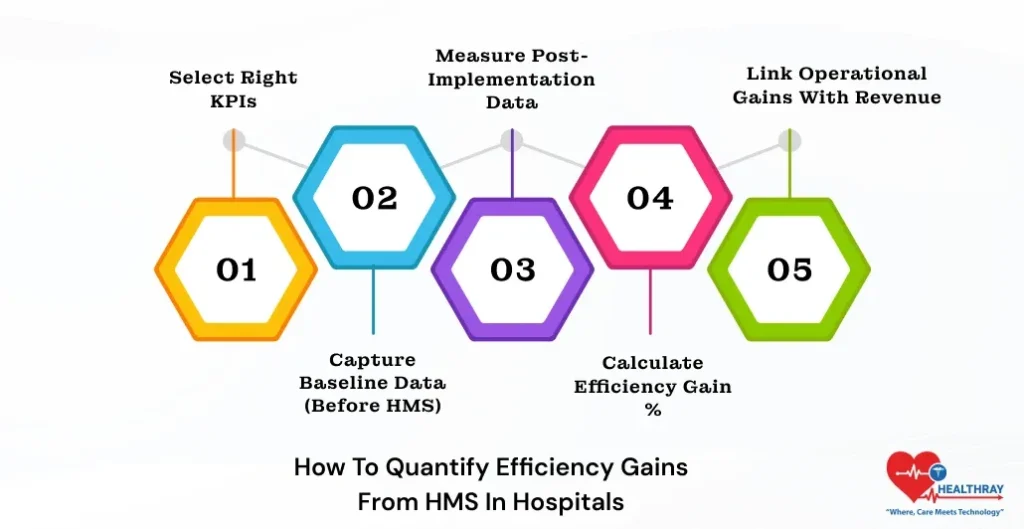
1. Select Right KPIs
Firstly, hospitals should select relevant KPIs such as patient waiting time, ALOS, A/R days, staff time per patient, and OT utilization that are directly compatible with the HMS workflow. Further, these metrics showcase real-life performance progress.
2. Capture Baseline Data (Before HMS)
Before establishing an HMS , Hospitals should assemble 2–3 months of data such as current waiting time, billing errors, A/R days, and staff processing time. Further, these benchmarks are a basis of reference for future comparative analysis.
3. Measure Post-Implementation Data
After making the HMS live, hospitals should measure the same KPIs again after 3-6 months. Moreover, this provides a clear picture to hospitals to determine the area that is showing significant improvement post-HMS implementation.
4. Calculate Efficiency Gain %
Hospitals should convert the improvement in terms of percentage with the help of a simple formula:
Efficiency Gain = (Old Value – New Value) ÷ Old Value × 100.
Additionally, this helps management understand the ROI impacts clearly.
5. Link Operational Gains with Revenue.
Lower ALOS and faster billing correlate with a high volume of patient management and receiving faster payments. Moreover, this improves the bed utilization and significantly enhances the revenue per bed/day. Also, read our blog, HMS vendor comparison, to find the best platform in 2026.
Strategies To Achieve Net Collection Rate Over 95% With HMS
1. Use Strong Front-End Controls
Verify insurance eligibility at the time of registration. Moreover, a hospital should estimate patient liability. Use HMS rules to block or notify unpaid balances. This approach helps hospitals control revenue leakage from the beginning.
2. Follow Clean Claims Process
Ensure proper tariff mapping and accurate coding in HMS. Moreover, hospitals should implement auto-validation rules that are adept at recognizing common errors at the time of claim submission. This reduces the denials and improves the clean-claim reimbursement standard rate.
3. Real-Time NCR Tracking
Use HMS dashboards to track NCR on the level of payer, department and doctor. Moreover, real-time visibility spots the recurring problem points and how to repair them promptly.
4. Create Smart A/R Follow-Up system
Divide the AR into aging buckets (0–30, 31–60, 61–90, 90+ days). Next, set priority-based follow-ups through HMS automation. This approach helps hospitals recover the old dues immediately and strengthens the cash flow.
5. Keep Strict Write-Off Control
Keep the write-offs minimal and track all the adjustments. Further, hospitals should monthly review the HMS reports and link billing/front-office KPIs with NCR. This approach helps hospitals sustain a 95%+ collection uniformly.
Learn more: The Role of Diagnostics Management Systems in Modern Healthcare
Typical ROI Timeline For A Hospital Management System Implementation
Generally, the HMS ROI timeline is about 12–24 months for the break-even point. Moreover, with proper implementation and usage, hospitals can discover a strong positive ROI of a hospital management system in 2-5 years. Let’s understand more about it:
1. First 0–6 Months: Adjustment Phase
Hospitals may face disruption in the initial months of the go-live phase. Further, hospital may experience high costs because of staff training courses, workflow adjustments, and system adherence. Hospitals may stumble upon a temporarily low and negative ROI .
2. 6–12 Months: Stability begins
In this phase, the process becomes more stable. Further, billing speed gets more effective, errors are less and staff efficiency is higher. Hospitals can conveniently determine the savings in the standardized system.
3. 12–24 Months: Break-Even Gets Achieved.
Many medical sectors during this period have reached the break-even stage. Further, hospitals discover a reduction in revenue leakage, collection becomes more faster and operational efficiency increases. This balances the ROI of hospital management system.
4. 2–5 Years: Strong Positive ROI
In 2-5 years, hospitals experience the real benefits of HMS. Moreover, optimized staffing, optimal bed utilization and decreased errors augment the hospital profit margin impressively.
 NOTE
NOTE
How Does Hospital Size Affect the HMS Payback Period?
Hospital size directly impacts the ROI of hospital management system. Moreover, small clinics achieve faster ROI as compared to large hospitals that discover low payback periods due to heavy investment.
1. Small Hospitals (0–100 Beds)
Small hospitals’ or clinics’ setups are simple and require less cost for HMS configuration. Further, small efficiency gains quickly recoup the initial cost, allowing small clinics to make a profit in less than three to six months.
2. Medium Hospitals (100–300 Beds)
Mid-size hospitals come in a balanced category of hospitals. Moreover, their payback period is usually 12-18 months, as it can easily expand and its implementation scope is also manageable.
3. Large Hospitals (300+ Beds)
In large hospitals, HMS costs may go excessively high. As large hospitals require extensive customization, standard integration and robust infrastructure. That’s the reason the payback period can extend up to 12-36 months. Moreover, long-time savings are remarkably higher for large hospitals.
 PRO TIP
Strategies To Shorten Payback For Large Hospitals
1. Implement High-Impact Modules
Firstly, large hospitals should implement revenue-critical components like registration, billing, EMR and inventory. Further, this helps large hospitals to improve billing accuracy at the initial level. Moreover, this approach also speeds up the cash flow in the standard system.
2. Control Revenue Leakage
Implement tariff mapping and auto-validation rules in HMS. Further, this assists in preventing underbilling, missed expenses, and claim lapses. Further, this directly raises the net collection rates and the standard revenue.
3. Faster Claims & A/R Reduction
Use HMS automation to rapidly deal with the insurance claims. Further, this reduces denials and A/R days. This approach accelerates the payment procedures and improves working capital.
Phased Implementation Plans to Accelerate HMS ROI
Instead of implementing the HMS all at once, clinics should roll it out in phases. Further, this reduces disruption and generates ROI of the hospital management system in the early phase.
1. Phase 1 – Core Admin & Revenue Modules
Firstly, hospitals should emphasize launching registration, billing, receipts and basic reports. Moreover, these modules directly improve cash flow and minimize billing errors and hospitals can discover ROI in 3–6 months.
2. Phase 2 – Clinical & IPD Workflows
In this phase, hospitals should add EMR, nursing notes, OT/OR and IPD management. Further, standardized workflows reduce the rework, optimize patient stay and also make the inventory management more efficient.
3. Phase 3 – Analytics & Integration
In this stage, hospitals should implement advanced dashboards, analytics and integrations (lab, insurance, and ERP). Moreover, this improves decision-making and makes the ROI highly compelling.
Conclusion
Calculating the ROI of hospital management system is not just a game of numbers. It is a strategic approach. It provides a clear idea to hospitals of whether the investment is justified or not. Additionally, it sets direction for future planning. HMS ROI is not just limited to financial return. Platforms like Healthray help hospitals to align with their clinical, operational and financial goals to successfully achieve long-term profitability, excellent patient quality of care and stable revenue.