



Summary
This blog explains what custom HMS software development is, why off-the-shelf hospital management systems often don’t meet the needs of modern hospitals, and five strong reasons to choose a custom solution. It also goes over the key features your system should have and gives a realistic idea of what it might cost, helping hospital administrators make better decisions
Introduction
Now imagine you have an out-of-the-box software solution designed to be perfect for all hospitals. The problem is, it ends up not being truly perfect for any of them. Your employees use multiple platforms and manually transfer data across them using copy-paste technique. There are numerous errors in bills. Patients are waiting longer than expected. Whenever the IT team submits a change request, the answer tends to be the same either it’s already on the roadmap or it requires an expensive custom build.
Such a scenario reflects the day-to-day reality of hundreds of hospitals stuck with generic management solutions. Fortunately, this is exactly what custom hospital management software and modern custom software development services are designed to solve.
In 2026, hospitals are no longer choosing between “technology” and “no technology.” The real choice is between a Hospital Management System (HMS) that adapts to your hospital and one that makes your hospital adapt to it. Our blog post explains some problems that inflexible HMS can have. We also present top five arguments that prove flexibility is the best approach here.
What Is Custom HMS Software Development?
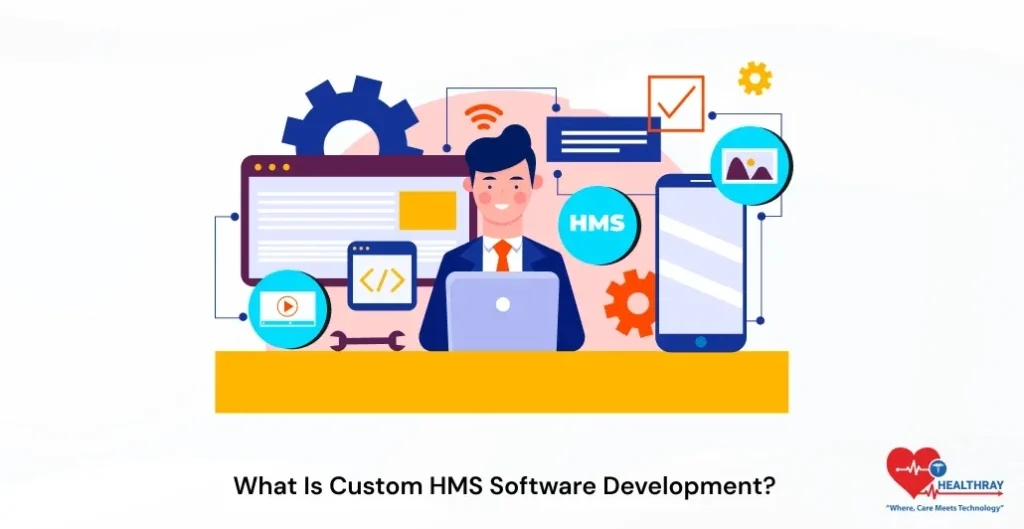
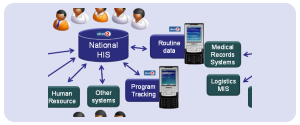
Hospital Management System (HMS) refers to a centralized software solution that brings together all departments of a hospital for better efficiency and coordination. This includes registration, outpatient and inpatient services, pharmacy, laboratory, billing, human resources, and many other functions into one comprehensive system. In other words, this system acts like the brain of the health center.
Whereas the general HMS offers numerous features, a customized HMS will go a little bit beyond that. This means that instead of relying on ready-made software that may not fully meet your needs, you can create a system tailored specifically for your organization. The result is software that perfectly fits the requirements of your health center.
To illustrate, a ready-made HMS is like a ready-made suit that fits only somewhat, whereas a custom-made HMS fits perfectly, like a tailor-made suit designed to meet all your specifications. Clearly, the difference in effectiveness between a ready-made system and a tailor-made one is significant.
 NOTE
NOTE
The Market Is Speaking Loud and Clear
Before diving into the five reasons, it helps to look at where the industry is heading:
- The global HMS market will grow significantly in the coming years
- Healthcare IT is expanding rapidly, with steady double-digit growth
- Globally, AI applications in healthcare are becoming a strong focus for investors.
- Hospital information systems continue to see strong, consistent growth
These numbers point to one clear trend healthcare providers are investing heavily in digital systems. More importantly, many hospitals are leaving rigid, one-size-fits-all systems for solutions that match how they actually operate. Those who make this shift early are likely to gain a clear edge in efficiency, patient care, and overall performance.
Reason 1 – A Perfect Fit for Your Workflows, Not Someone Else’s
Pre-existing HMS systems serve everyone, but truly fit no one. A behavioral health clinic has different software needs than a multispecialty group. A small-town general hospital and a specialized orthopedic center also require very different features. Yet, a one-size-fits-all HMS tries to meet the demands of all four.
The end result? No matter the type of hospital, it must adapt its processes to fit the system, rather than the system adapting to it. Workarounds emerge. The departments create a separate tracking system in Excel. The management creates multiple reports, none of which match. Staff spend valuable time dealing with software shortcomings instead of managing patients.
Tailoring the solution takes the entire equation in a new direction. The process starts with an extensive discovery phase. During this phase, we examine your workflows, talk to department heads, and document your unique needs something no ready-made software can do.
By designing the workflow process into the software, Custom HMS software development helps hospitals to reduce manual data entry, billing errors, and patient waiting times within months. This is exactly why modern hospital patient software must be tailored to real workflows instead of forcing hospitals to adapt to rigid systems.
Reason 2 – Seamless Integration Without the Middleware Tax
Current healthcare organizations don’t operate using one software alone. Hospitals need to integrate a variety of systems. These include EHR platforms like Epic or Cerner, laboratory information systems, and radiology equipment. This complexity is why many hospitals adopt custom software development solutions to unify different systems into a single seamless workflow. They also rely on pharmaceutical management tools, insurance verification systems, and increasingly, AI engines.
Commercial HMS products cannot handle this level of integration. Typically, their connections work only through specific partnerships or approved APIs. As a result, trying to link other systems outside these partnerships often leads to extra costs, potential points of failure, and slower data transfers.
Custom HMS software development ensures the solution tailors integrations to the hospital’s requirements from the start. This includes standards such as HL7/FHIR, which are becoming a necessary component for any system due to regulations.
Reason 3 – Scalability Built Around Your Growth
Healthcare organizations are never static. For example, a hospital at a single campus may expand into a chain of locations, a general medical institution might add new oncological or cardiological departments, or a regional clinic could implement telemedicine technologies. In all these cases, hospitals need additional resources and features, and if the HMS can’t support them, it slows down operations.
Generic systems rely on tiered pricing and extra paid modules, even if you don’t need them. Many organizations never buy expensive enterprise licensing packages, where most advanced options are available.
If you have a custom-designed HMS, the developers planned for scaling right from the start. Being cloud-based, designed using microservices, it is quite easy to expand. When you add a new location or service, your HMS can scale without costly migrations or upgrades.
Reason 4 – Compliance and Security as a Foundation, Not an Afterthought
The information in the healthcare sector is probably the most sensitive in the world, and compliance rules in the domain are becoming increasingly stricter each year.In the US, HIPAA Security Rule demands stringent data access policies, encryption of all the data, and audit tracking. The 21st Century Cures Act requires systems to support FHIR R4 APIs and give patients access to their health data. In the EU, GDPR applies its own set of rules to all facilities storing EU patients’ data.
Most off-the-shelf products were developed years – even decades – prior to the latest compliance rules being put into practice. Compliance with the rules, therefore, requires installing new modules for data protection which were never envisioned when designing the product. In the world of healthcare, however, even one gap in data security might result in catastrophic breaches, causing heavy penalties and loss of reputation.
When you build a system around your needs, compliance is considered right from the start. Things like access control, data encryption, audit logs, and reporting are included as part of the core setup not added later as extra features.
Reason 5 – Total Ownership Means Zero Vendor Lock-In
This is something many healthcare leaders don’t think about until it suddenly becomes a serious problem.
When your HMS depends on a third-party platform, you’re relying heavily on that vendor. If they increase pricing, change their plans, or stop supporting a key feature, the vendor leaves you with limited options. Even major changes like company acquisitions can impact your system without your say, creating uncertainty and disruption.
With a system built around your hospital, that control stays with you. You control how the system is hosted, when it gets updates, and which features or integrations come next. There’s no reliance on a single vendor and no unexpected changes forced on you. Over time, this control not only reduces risk but can also lead to better cost efficiency and long-term stability.
Quick Comparison: Custom vs Off-the-Shelf HMS
It’s worth noting that all hospitals have their own peculiarities, so an off-the-shelf HMS may be easy to install, but will fail to adapt to the hospital’s needs, integrate into other software or adjust to changes in your organization. The table below highlights the key differences between HMS options.
| Factor | Off-the-Shelf HMS | Custom HMS | Benefit |
| Workflow Alignment | General purpose but hospital adjusts | Specifically built for hospital | As a result, workflows improve and there are no extra middleware charges |
| Integration | Limited APIs, additional expenses | In-built EHR/Laboratory/Radiology integration | Therefore, the system can be scaled easily and effectively |
| Scalability | Additional components required | Designed for future growth | Can be scaled easily and effectively |
| Compliance & Security | Add-on modules | Built-in HIPAA/GDPR | This ensures reduced risk and safer patient data |
| Ownership | Vendor-controlled | Hospital-owned | Consequently, you have full control with no surprises |
| Cost | Lower upfront, recurring fees | Higher initial, saves long-term | Over time, hospitals avoid license and upgrade costs |
Must-Have Features in a Custom HMS
Regardless of whether you need to brief your partner on your progress or peruse the proposal, a good custom HMS solution should provide you with the following capabilities:
Patient Registration and ADT Management: This is the registration of patients, insurance validation and the development of automatic HL7 ADT messages to all the systems linked to it.
Outpatient (OPD) and Inpatient (IPD) Modules: This consists of booking of appointments, queuing, allotment of beds, rounding and full management of discharges.
Electronic Medical Records (EMR): This would involve the safe storing of patient history, prescription, diagnoses, and clinical information in a single site.
Pharmacy and Inventory Management: This will involve real time drug inventory and expiry management, automated order and supply chain process alerts.
Billing and Revenue Cycle Management: Automated invoicing and insurance claims management, payment matching and financial dashboards to track financials in detail. The module is essential in hospital revenue optimization by enhancing accuracy of claims and minimizing financial leakage.
Laboratory and Radiology Information Systems: Laboratory findings, compatibility with DICOM images and direct connection to the patient record without the need to manually enter at any point.
HR and Payroll: Monitoring of attendance of employees, management of shifts, performance analysis, and payroll processing are all in one integrated ecosystem.
AI-Powered Analytics: Bed management predictions, patient flow forecasting, revenue analytics, and clinical outcome analysis to make evidence-based decisions.
Telemedicine Integration: Video consultation services, e-prescription and scheduling of appointments of such patients who prefer to receive treatment at their homes. Moreover, AI chatbots in hospital systems are also becoming popular to automate the processes of booking appointments, responding to patient requests, and enhancing the overall communication efficiency.
Cost and Development Timeline: What to Realistically Expect
The initial cost is one of the largest concerns of hospitals, and it is quite reasonable. But it’s important to look at the bigger picture.
The overall cost varies based on the number of modules required, the complexity of integrations, and whether you are constructing a facility or a facility with many locations. The initial cost may seem large, but with Custom HMS software development, hospitals can save in the long run by avoiding license fees, unnecessary integration costs, and the operational gaps of generic software
As to the time frame, a simple version with fundamental functions may take approximately 6 months, whereas a more comprehensive system that involves various departments might take 12-18 months. Your team will guide continuous enhancements to the system after launch based on their feedback.
This can be cleverly done in stages. Go live with the most crucial modules (such as patient registration, OPD, and billing) and then roll out slowly. This minimizes risk, provides value more quickly and makes sure the system expands according to real needs.
 PRO TIP
Conclusion
Ready-to-use systems are designed to suit the typical hospital. However, when you want high-quality patient care, smoother operations, and less strain on your staff, Custom HMS software development offers a solution that fits your hospital’s specific workflows. By choosing a system built around your real needs, you gain greater control and can adapt more easily as your requirements evolve.
The advantages, including improved workflow fit, simpler integration, scalability, inherent compliance, and complete control, result in actual improvements in day-to-day operations. The difference is already being felt in many hospitals since the abandonment of one-size-fits-all systems. Then when you consider your next move with HMS, you might want to ask yourself: how long can I continue to use a system that is no longer suitable?