

Summary
Role-based access makes the hospital function secure and organized. Here every user gets permission that is extremely important for their responsibilities. Role-based accessibility prevents the risks of unauthorized access and data misuse. In this blog, I will discuss how role-based access in HMS maintains hospital trust and smooth operation in the system. Keep Reading!!!
Introduction
Is it safe to provide information access to every staff member? Obviously not. The problem is not about technology; the problem is about control. In modern hospitals, data is the foundation of everything.
However, some clinics disclose this delicate content without any proper security measures, so it heightens the risk of data infringements. Unauthorized retrieval, unintentional data alterations, and privacy violations can all occur.
Patients have high trust in hospitals, but do you truly feel confident that their data is safe and reliable? Here, role-based access in HMS is the paradigm shift. It provides only limited access to the users that are crucial for them. Many hospitals nowadays use a “one login fits all” approach. Staff uses multiple systems and shares passwords, but the system lacks clear tracking. This approach is not only inefficient but also highly unwise. Modern hospital management software smartly manages the data through role-based access. HMS not only improves security but also strengthens a workflow. Role-Based Access is not just limited to a functional characteristic; it’s the central foundation of hospital data security.
Role-Based Access in HMS Systems Examples
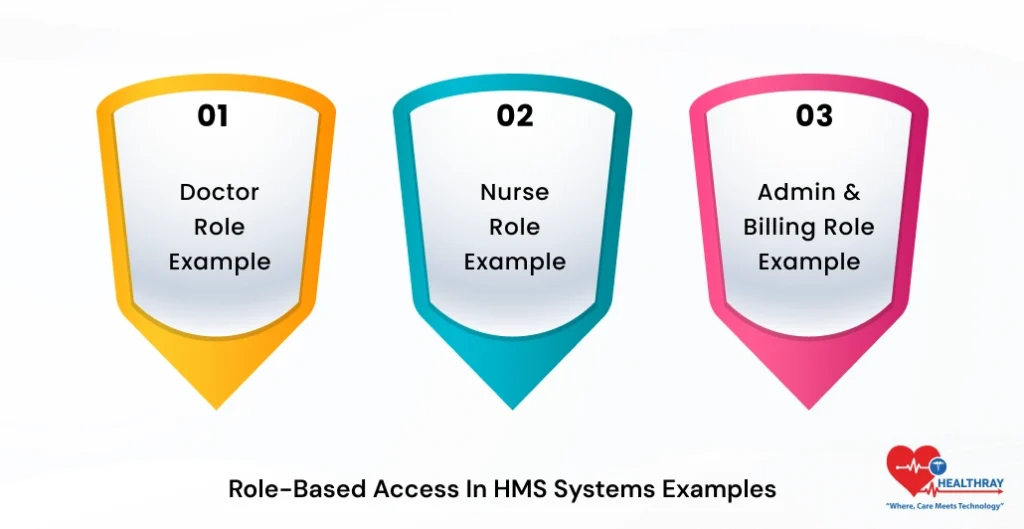
Role-based authorization in healthcare software controls data access in the HMS system. Further, every user gets permission as per their roles. This keeps the data secure and minimizes the risks of misuse. Let’s understand with the help of an example:
1. Doctor Role Example
Doctors are able to view complete medical histories, update diagnoses, prescribe medications, and obtain test orders. Access is also restricted to patients who are coping with it.
2. Nurse Role Example
Nurses update patient vitals, administer the treatment process, and record observations on the system. Moreover, they don’t have access to prescribing rights and billing data, so that system remains safe and reliable.
3. Admin & Billing Role Example
Admin staff schedule the appointments and manage the patient updates. Further, the billing team conducts regular checks on insurance and financial data; they don’t have access to clinical records. Role-based security in hospitals assists in making the revenue cycle trustworthy.
RBAC vs ABAC Differences in Healthcare
RBAC (Role-Based Access Control) is based on predetermined roles; however, ABAC (Attribute-Based Access Control) is based on dynamic conditions. In addition, both RBAC’s and ABAC’s main objective is data security but both use different methodologies to interact with it. Let’s understand more about it:
1. Role of RBAC
Role-based access in HMS is optimal for a stable hospital structure. Further, Role-based authorization in healthcare software provides full patient data access to doctors and limited access to nurses. It is simple and convenient to maintain.
2. Use of ABAC
ABACs are highly advanced. Further, it checks the condition. For example, nurses can access data only on hospital wifi and are granted permission to browse patient data within the ward.
3. Healthcare Example
In EHR/HMS systems, RBAC provides only basic control access; on the other hand, ABAC further strengthens the security, such as blocking off-site and after-hours privileges.
4. Pros & Cons of RBAC
RBAC is flexible and convenient for large hospitals. But sometimes it establishes more standardized roles in the HMS.
5. Pros & Cons of ABAC
ABAC is flexible and highly secure, especially for dynamic environments such as telehealth. Moreover, its implementation process is highly intricate and demands a high level of competence.
 PRO TIP
Common RBAC Pitfalls in HMS Security
1. Role Explosion Problem
Hospitals mostly create different roles for every small task. This makes the HMS system unnecessarily complex. Gradually, roles augment to more than a hundred; this becomes difficult for the team to manage properly. Further, it slowed down the audit process and raised the potential risks of unpredictability and complication.
2. Privilege Creep Issue
When staff roles get modified, their old permissions are retained in HMS. In simple words, they are not removed by admin teams. For example, Nurses are still getting old access even after their promotions. This extra access creates unnecessary risks and raises the risks of insider threats, especially when clinics are dealing with sensitive data.
3. Workflow Misalignment
Role-based access in HMS is sometimes not designed as per the real hospital workflow. Shift rotations, emergency situations and temporary staff lack proper access control. Either they get less access or more than assigned. Further, this is detrimental to both security and efficacy in the system.
4. Weak User Management
If the onboarding and offboarding processes are not strong, then the account system still remains active for ex-employees. This is the major security risk, as an unauthorized user can access the user’s sensitive data. Further, it exacerbates the consequences of data piracy. Also read the blog on the HMS analytics dashboard to know more deeply about it.
How to Prevent Role Explosion in HMS RBAC?
1. Design Minimal Roles
First, hospitals should keep the roles simple and limited. Instead of creating roles for every small task, use generic roles. For example, “Ward Nurse” instead of “Night Shift Nurse, Ward 1.” Moreover, this keeps the system function clean and hinders the formation of extraneous roles.
2. Use Role Hierarchy
Creating hierarchy eliminates the chances of duplicate roles. For example, senior doctors should automatically inherit the permissions of doctors. Moreover, this approach eliminates the need for defining the same permission repeatedly and the overall HMS system becomes simple and manageable.
3. Clear Naming and Follow Standards
Roles name be simple and consistent. In addition, following standard naming conventions reduces confusion and helps teams easily understand their respective duties and goals.
4. Hybrid RBAC + ABAC Approach
Hospitals should use attributes for dynamic situations such as time, location and patient assignment instead of imposing new roles. Further, this approach minimizes the quantity parameter and makes the system more adaptable.
Learn more: HMS for Billing & Revenue Cycle Management
Best Practices to Mitigate Privilege Creep in Healthcare
1. Follow Least Privilege
The most important rules grant access to users that are crucial for current roles. Initiate with basic tasks for new staff members and gradually upgrade their level of access. Moreover, this approach removes unnecessary approvals.
2. Automate Access Lifecycle
Integrate the HMS system with IAM tools so that access automatically gets updates as roles change or employees exit. Further, for temporary needs, use JIT (just-in-time) credentials that expire automatically.
3. Review Regular Access
Hospitals should regularly audit the access every week. Further, managers and IT and compliance teams should thoroughly scrutinize which users have additional and inactive privileges. This helps hospital management discover potential risk areas ahead of time.
4. Zero Trust Approach
Hospitals should adhere to a “never trust but always verify” approach instead of “Trust but always confirm.” Further, MFA (multi-factor authentication) and regular surveillance ensure only permitted individuals should interact with the standardized information.
Role-Based Access in HMS: Implementation Checklist for Hospitals
1. Start Planning Properly
Before implementing a permission-based access system software, hospitals should deeply engage in proper planning. Next, hospitals should understand their current workflows and identify all the access assigned to users. Moreover, Hospital management software development helps practitioners follow a structured approach to avoid any ambiguity in the practices.
2. Audit Current Access
Hospitals should audit all the existing permissions and check access overrides. Further, hospitals should analyze logs and determine which user is engaging with the redundant data.
3. Define Core Roles
Create simple and limited roles such as doctor, nurse, and billing staff. Further, design every role as per the job functions. Further, create hierarchy to avoid overlapping.
4. Map Permission
Define concisely the access allowed for every responsibility. Let’s understand it with the help of examples: Nurses can only update vitals; they should not have valid authorization for prescriptions. Moreover, this diminishes the consequences of data infringement.
5. Phased Rollout & Training
Don’t deploy the entire user access management system at a single time. First, launch the deployment with high-risk areas such as billing/RCM. Next, provide proper training to staff to help them embrace the new HMS system successfully.
 NOTE
NOTE
How Layered Security Strategies Support RBAC in Hospital Management
1. Defense-in-Depth Approach
In HMS, RBAC is not sufficient. Furthermore, layered security is all about creating multiple protection layers. If one layer fails, then automatically the second layer will safeguard the system. This approach is highly critical for HIPAA compliance as well.
2. Network Layer Protection
It is highly indispensable for hospitals to use firewalls and intrusion detection systems to keep the network secure. Use network segmentation. Always keep EHR separate to avoid spreading breaches in the complete system.
3. Data Encryption Layer
It is indispensable for hospitals to encode highly delicate medical data. Further, hospitals should utilize a standard AES-256 encryption protocol for both data at-rest and in transit. This standard procedure makes the data opaque even if it accidentally gets disclosed.
Conclusion
Role-based medical practice management software is the fundamental pillar of data integrity in hospitals. Role-based Hospital IT security systems provide a proactive approach to healthcare organizations. By controlling the permission beforehand, hospitals can prevent cyber threats and unauthorized access. No doubt, role-based access in HMS is powerful, but it requires integration with MFA, encryption, network segmentation and regular audits to make it a multi-layered security system.