

Summary
In today’s competitive healthcare market, pharmacy software is not just a management tool, but it’s a powerful customer loyalty engine. It shifts the paradigm from a transaction approach to a relationship-based model. Crm system centralizes the patient data. It helps pharmacists track the patient data. In addition, crm software provides personalized recommendations to make their healthcare journey more impactful. Through automated reminders, it sends alert messages to both pharmacists and patients to refill the order. It naturally improves engagement and impresses customers to continue using services. In this blog, I will discuss how pharmacy crm system build sustainable growth, better ROI, and more trustworthy customer confidence. Keep reading!!!
Introduction
In today’s highly competitive healthcare market, selling only medicine is not sufficient. If a pharmacy needs sustainable growth or a strong ROI, then it’s highly important to strategically manage customer relationships. This is where the pharmacy CRM system’s true power lies. This is not just a software tool; it is a powerful relationship-building platform that strengthens customer loyalty systematically.
In the traditional pharmacy setup, customer interaction was mostly limited to billing. But now, customers expect personalized experiences. Pharmacy management systems fulfill the advanced engagement requirements along with essential needs. Moreover, CRM technology assists pharmacists in running smart customer segmentation and targeted campaigns. It increases the repeat purchases, activates the inactive customers and helps pharmacists build strong long-term retention.
Beyond that, the Pharmacy CRM System supports pharmacists in maintaining adherence with data security standards. Through this digital platform, the pharmacy creates a trust-based ecosystem that builds strong loyalty with the customers. In today’s evolving market, customer loyalty is a real competitive advantage and the Pharmacy CRM System provides this strategic foundation to move confidently in the direction of growth, engagement and sustainability.
Why Customer Loyalty Matters in Pharmacies
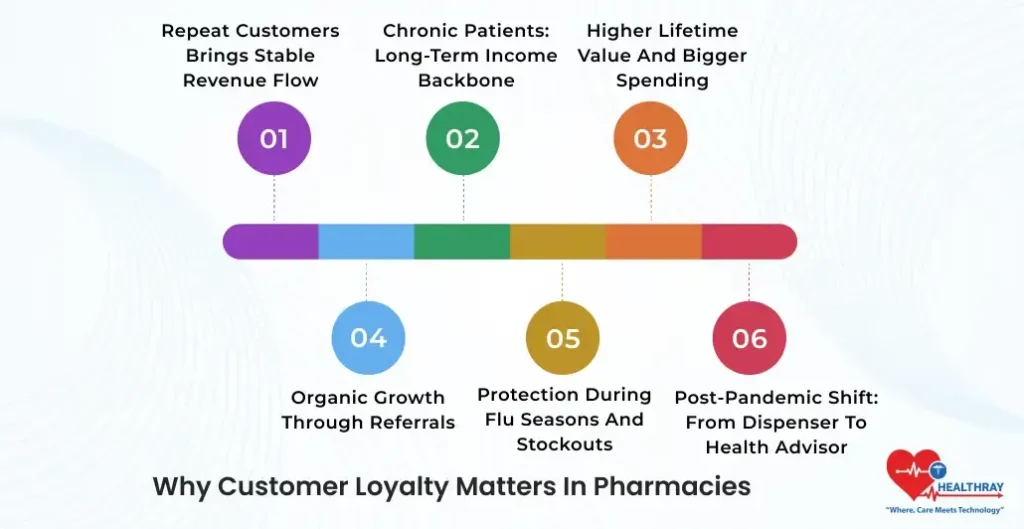
Repeat Customers brings Stable Revenue Flow
In the pharmacy business, loyalty is directly linked with revenue stability, and a Pharmacy CRM system plays a crucial role in managing customer relationships effectively. Approximately 70–80% of revenue is generated from customers. Furthermore, revenue becomes consistent with regular drug purchases and renewals. It is difficult to raise revenue with new customers. However, acquiring new customers is highly challenging for pharmacy centers in the initial days. Therefore, it is highly crucial for pharmacy centers to retain their existing customers. It is a financially more profitable strategy for pharmacists to cultivate recurring revenue streams. Strong loyalty model provides predictable cash flow and long-term sustainability to pharmacy sectors.
Chronic Patients: Long-Term Income Backbone
As we know, chronic patients, such as those with diabetes, BP, thyroid, or cardiac patients, depend on regular medication to cure their health symptoms. Further, their treatment is a consistent process that can be efficiently managed through a Pharmacy CRM system. They can serve as a long-term and predictable revenue source for pharmacy sectors. If these patients struggle with appropriate follow-up, refill reminders, and personalized communication, online pharmacists can easily draw them in with alluring discounts. Additionally, timely reminders for medication, dosage reminders, and healthy tips make the patient feel connected. This helps pharmacy centers build a strong base of confidence and a steady recurring revenue platform.
Higher Lifetime Value and Bigger Spending
Loyal customers are not just purchasing regular medicines; eventually, they fulfill their entire healthcare needs through a single trusted pharmacy. According to recent research, 67% of loyal customers spend more on services as compared to new customers. Further, when customer trust becomes strong, they prefer buying OTC products, wellness dietary supplements, personal hygiene items and preventive healthcare goods from the same platform. A Pharmacy CRM system naturally builds strong customer trust and helps pharmacy centers consistently grow lifetime customer value. Also read our blog, Retail vs hospital pharmacy software to learn the key difference between the two software.
Organic Growth Through Referrals
Trust is one of the biggest factors in healthcare sectors. When patients truly get delighted by your product, services, behaviour and time availability, they will recommend your platform to family members, friends and neighbors. Further, this word-of-mouth marketing is more successful than paid advertisement. With the support of a Pharmacy CRM system, a loyal customer not only gives repeat business but also helps attract new customers. Additionally, pharmacies can easily achieve organic and viable growth without incurring extra marketing expenditures.
Protection During Flu Seasons and Stockouts
Pharmacists are overworked when it comes to managing medications during flu season and periods of unexpected demand. Furthermore, if stock is unavailable at that critical time, the patient will prefer another option and try other alternatives. Here you will understand the importance of strong customer relationships. A Pharmacy CRM system enables personalized refill reminders, stock availability notifications and regular engagement messages that make the patient feel connected. They will wait rather than move on to the next treatment center if they believe your services are worth their time and are providing them with top-notch assistance. This effectively prevents unnecessary revenue leakage.
Post-Pandemic Shift: From Dispenser to Health Advisor
As we know, healthcare prescriptions have already changed since the pandemic ended. Nowadays, patients view pharmacies not just as drug distribution centers; they perceive them as trusted health advisors. centers. Further, patients are expecting guidance, preventive care plans and timely follow-ups. When loyalty programs are integrated with a Pharmacy CRM system, pharmacy centers can lure customers through personalized offers, health tips and reminders. This personalized care improves the customer retention. Nowadays, strong relationships are a real growth advantage.
 PRO TIP
Defining a Pharmacy CRM System: Beyond Generic Tools
A Pharmacy CRM system is not just normal sales software. Further, it is specially constructed for retail and hospital pharmacies. It is a complete, secure platform that follows HIPAA/GDPR compliance standards. Let’s check out some elegant features of pharmacy crm:
360-Degree Patient View: Complete Understanding
Generic CRMs are not just limited to name, number and basic contact details. However, pharmacy management services software captures the complete healthcare journey of patients. It displays prescription history, regular buying patterns, refill cycles, allergies and personal preferences on a single dashboard. Further, when pharmacists get a clear picture of complete patient data, they provide them practical tips on maintaining a healthy lifestyle along with dispensing services. This helps pharmacy centers understand the real need for patients and provide them personalized and caring service.
Unified Patient Ledger
The Unified Patient Ledger works as a powerful control center for the pharmacy. Furthermore, pharmacy software clearly displays patient prescriptions, OTC purchases, allergies, insurer information and payment history on a single dashboard. It minimizes the need for manual registers to maintain the patient information. Staff can independently work on the system. When staff easily get access to information, then pharmacy services become fast and error-free automatically. Plus, pharmacists know the patient’s past history and provide them more specific and thoughtful medical attention.
Behavioral Analytics Engine
The Behavioral analytics engine does not just provide data to pharmacists but also provides them with meaningful insights. Further, pharmacy software deeply analyzes the patient visit frequency, buying patterns and product preferences. For example, if a customer constantly purchases Naxdom tablets, then the system automatically suggests practical tips and shares offers on curing headaches. The marketing is therefore need-based rather than arbitrary. When a pharmacist converts the data into powerful suggestions, this improves customer engagement and boosts sales organically.
Omnichannel Hub
Nowadays, customers don’t just visit pharmacies to connect. Furthermore, they inquire through WhatsApp, mobile, or phone calls to check the medicine availability. In the traditional system, it is difficult for pharmacists to connect on different platforms. They get a high volume of calls per day to resolve customer issues. However, pharmacy software system resolved these challenges to a great extent. Omnichannel hub manages all these touchpoints in a single platform. Moreover, this helps pharmacists track every conversation and not leave out any appropriate information. Customers get the same response and smooth experience on multiple platforms; this naturally boosts trust.
Relationship-Driven Growth Model
Pharmacy CRM software encourages pharmacy centers to go beyond simply selling medications and handling invoicing and transactions. It shifts the focus from transaction to relationship. Pharmacy software properly manages the patient data, ensures timely communication and offers personalized offers through the patient treatment journey. Thus, it helps patients in receiving genuine medical treatment. Eventually, patients start building trust and recognize the pharmacy as their regular healthcare partner. Long-term dedication and sustainable growth are cultivated on this powerful relationship foundation.
 NOTE
NOTE
Seamless Integrations for Healthcare IT
Modern Pharmacy CRM are not different; they seamlessly integrate with existing healthcare IT ecosystems. Additionally, it works in unison with FHIR standards and RIS/EMR systems. As a result, the patient profile automatically updates with radiology reports and diagnosis information. Let’s check more features:
Healthray Pharamcy software Alerts: Smart Coordination
For healthray user, pharmacy software and CRM integration create real-time coordination. CRM software automatically integrates follow-up notifications and refill reminders and also activates awareness campaigns as new diagnoses enter the system. This makes the patient engagement more proactive.
EMR-Based Condition Nudges
Through EMR integration, the pharmacy can send condition-based personalized nudges. For example, a pharmacist can suggest nausea relief products or recovery supplements after chemotherapy. This care-based communication helps the patient to recover from the ailment more quickly.
Multi-System Synergy for Better Outcomes
When pharmacy software , EMR, Telehealth and CRM are connected deeply with each other, then healthcare operation becomes more connected and efficient. Further, this synergy helps pharmacists to make more informed decisions, have more effective patient involvement, and accomplish sustainable growth.
Conclusion
Pharmacy CRM enables both large chains and independent stores to move away from solely relying on transactional services. Pharmacy systems help centers genuinely build patient relationships and focus on long-term care and trust along with sales. It is clearly evident that crm ROI is relatively higher than its implementation cost, making it a profitable long-term investment.