


In This Blog,
You will get to know how to calculate your clinic’s software ROI in five steps, turn raw cost data into defensible numbers, and justify your practice management software investment to stakeholders with confidence. What questions will this answer?:
- How much money is your clinic actually wasting right now on manual processes?
- What’s the real payback period for clinic software, and how do you calculate it?
- How do you defend a clinic software ROI calculation to partners or internal decision-makers?
Clinic software ROI isn’t mysterious. It’s math. Your clinic is already losing money because of wasted time, lost income, and operational problems. In this walkthrough, you will learn exactly how to determine how much you will recover.
The Truth About Clinic Software ROI: Why Clinics Waste Money
The majority of clinic owners consider software to be an expense. That’s wrong.
Your clinic is already losing money. In fact, it costs clinics 8-12 hours per week on manual scheduling. Often, no-shows come at a cost of thousands per month. Invoices sit unfiled and unpaid, with claim denials building up. These are not theoretical but real costs that occur, with or without clinic software in place.
The question isn’t “Can we afford software? It’s the question of “How much are we losing if we don’t do it?”
As you consider the effects of clinic management software, you’re asking yourself one essential question about your business: How much waste are you going to be able to recover? When will software be cheaper than the money you lose?
That will be the next five steps, and that’s what you’ll discover. However, there needs to be baseline data first. Most clinics don’t run a cost analysis of their real costs, which is why they don’t estimate how much ROI they can get out of their clinic. What you can’t measure you can’t calculate. You can’t justify an investment without numbers. Nor can you make assumptions with stakeholders.
This walkthrough changes all that. It takes you from “I think we need software” to “Here’s what we will recover and when we will break even.
That’s where the research comes in. Research on the impact of health information technology on costs and benefits shows that clinics that calculate their operating costs find that 15-25% of their potential revenue is being lost as a result of errors and waste of labor. It’s a gap that can be made up. Clinic software doesn’t save money – it recovers money that is already saved.
 PRO TIP
What You Need Before Calculating Practice Management Software ROI
Without understanding your starting point, you can’t measure practice management software ROI. These four types of costs are measurable. Perfect data is not necessary; honest data is.
| COST CATEGORY | WHAT TO MEASURE | WHERE TO FIND THIS NUMBER |
| Administrative Labor | Hours spent on scheduling, insurance verification, and data entry per week | Employee timesheets, manager observation, and time-tracking software |
| No-Show Impact | Missed appointments per month × average revenue per visit | Practice management reports, billing system |
| Claim Denials | Rejected/delayed claims per month × average claim value | Insurance aging reports, billing software |
| Scheduling Gaps | Unused appointment slots per week × average revenue per visit | Scheduling system reports, revenue analysis |
These four categories cover 80% of the clinic’s operating costs and inefficiency. Don’t overthink it.
 NOTE
NOTE
Step 1 – Calculate Your Current Clinic Operating Costs & Labor Waste
This is your baseline. What’s your clinic losing right now to poor operating efficiency?
Workflow: Fill In Your Clinic Operating Costs Below:
1a) Administrative Labor Waste
- Hours lost to manual scheduling per week: ___
- × Your average admin staff hourly rate: $___
- × 52 weeks per year = $___________
1b) No-Show Revenue Loss
- No-shows per month (current): ___
- × Average revenue per appointment: $___
- × 12 months = $___________
1c) Claim Denial/Delay Costs
- Denied claims per month (current): ___
- × Average claim value: $___
- × 12 months = $___________
1d) Scheduling Inefficiency (Open Slots)
- Open appointment slots per week: ___
- × Average revenue per appointment: $___
- × 52 weeks = $___________
ADD THEM UP:
YOUR TOTAL ANNUAL CLINIC OPERATING WASTE = $__________
Real example: A 5-provider clinic calculated: $11,440 (admin labor) + $21,600 (no-shows) + $240,000 (claim denials) + $62,400 (open slots) = $335,440 annual waste.
Most clinic owners are taken aback by that number. But this is the clinic that you are losing right now, even without the use of clinic software. According to cost recovery from clinic software investment, clinics that measure baseline waste discover they’re much worse off than they thought.
The true question is: How much of the cost of running this clinic can be recovered through software? That’s answered by steps 2-5.
Step 2 – Determine Total Practice Management Software Implementation Cost
Now, total up how much you will really spend in Year 1. There’s more to the monthly cost of healthcare software implementation than meets the eye.
| COST COMPONENT | YOUR AMOUNT |
| Software subscription (Year 1) | $______ |
| Implementation/setup/training | $______ |
| Hardware/infrastructure upgrades | $______ |
| Integration with existing systems | $______ |
| Staff training hours (internal labor) | $______ |
| TOTAL FIRST-YEAR INVESTMENT | $______ |
Year 2+ Annual Cost (ongoing): $______
Write this number below. Be conservative. If a vendor offers $800/month, then use that. Do not use discounts for early bird reservations or discounts for multiple years. You don’t build an optimistic assumption; you build a defensible case.
Most clinics receive between $15,000-$35,000 for Year 1 based on size and complexity. When you calculate this practice management software cost against your annual waste (Step 1), however, the numbers typically add up.
Note: Most practice management software ROI is measured over 2-3 years, not Year 1. First-year costs include implementation; Year 2+ costs are subscription-only and much lower.
One Question Will Emerge: Should you build custom software instead of buying off-the-shelf? Here’s how to think about custom clinic software development.
Spoiler: Most clinics save money and time by buying rather than building.
Step 3 – Calculate Projected Annual Savings From Clinic Software ROI
Now the realistic part. You won’t recover 100% of your waste. However, even conservative savings estimates produce strong ROI.
Workflow: Use These Conservative Savings Reduction Targets
3a) Administrative Labor Recovery (40% of Baseline)
- (From Step 1a) $_______ × 0.40 = $_______
3b) No-Show Reduction (25% Via Automated Reminders)
- (From Step 1b) $_______ × 0.25 = $_______
3c) Claim Denial Improvement (30% Via Automation)
- (From Step 1c) $_______ × 0.30 = $_______
3d) Scheduling Efficiency (30% Of Open Slots Filled)
- (From Step 1d) $_______ × 0.30 = $_______
ADD THEM UP:
YOUR TOTAL ANNUAL SAVINGS = $__________
Real example: That same 5-provider clinic calculated:
- Admin labor: $11,440 × 0.40 = $4,576
- No-shows: $21,600 × 0.25 = $5,400
- Claim denials: $240,000 × 0.30 = $72,000
- Open slots: $62,400 × 0.30 = $18,720
Total projected annual savings: $100,696
These percentages are conservative. Many clinics see higher reductions within 6 months. However, we’re building a case that survives stakeholder scrutiny. Conservative numbers are defensible. Once software is live, you’ll likely exceed these projections, which becomes a win you celebrate.
Step 4 – Calculate Your Software ROI Percentage & Interpret Results
It’s now the real deal. ROI is the question you ask yourself: “How much money do I get back for every dollar that I invest?
A 100% ROI means that you see your return on investment in year 1. The 200% ROI translates to doubling your money. Here’s your software ROI calculation formula:
Software ROI Calculation Formula (Year 1):
(Total Annual Savings – Total Investment Cost) ÷ Total Investment Cost × 100 = YOUR ROI %
YOUR CALCULATION:
($__________ – $) ÷ $ × 100 = ____%
Real example: ($100,696 – $18,000) ÷ $18,000 × 100 = 459% ROI
With a 459% ROI in Year 1, you can expect to make a full return of your software investment in around 2 months, and then have $82k left to show for the rest of the year. The ROI of clinic software investments ranges between 150-400% in Year 1. Any savings rates below 100% are either very optimistic or may not be the best choice for the software.
Learn more: Dive deeper into Improving Clinic Profitability With Smart Software: What Actually Moves the Numbers to understand what profitability benchmarks mean and how to defend your numbers to skeptical partners.
Step 5 – Calculate Clinic Software Payback Period & Implementation Timeline
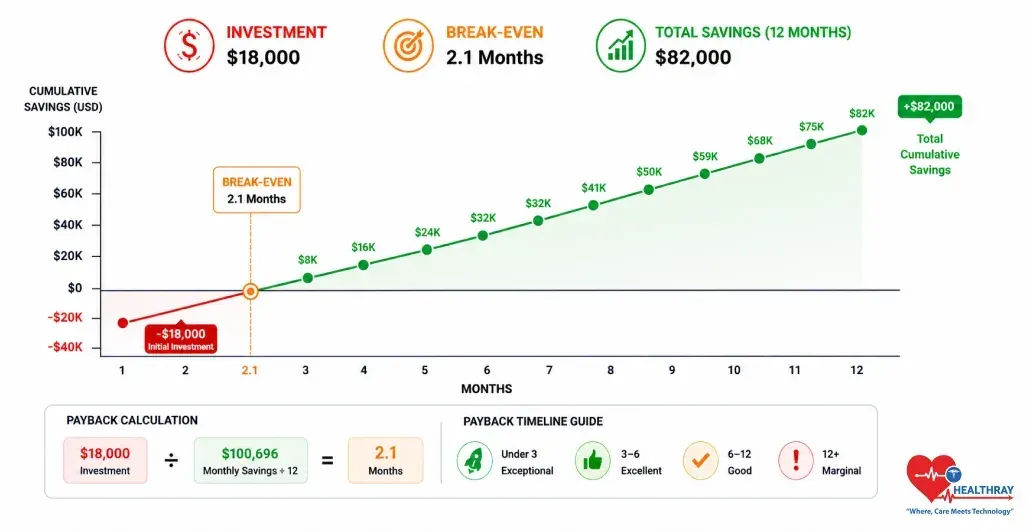
Payback period is just the number of months in which the total savings accumulated = the total investment. This is a favourite statistic for clinic owners as it is easy to understand: “When do we break even?”
Payback Period Calculation:
Total Investment Cost ÷ Monthly Savings = Payback in months
YOUR CALCULATION:
$__________ ÷ ($__________ ÷ 12) = _____ months
Real example: $18,000 ÷ ($100,696 ÷ 12) = 2.1 months
The 2.1-month payback period assumes that implementing in January will help your 5-provider clinic reach break-even status early in March. After the next 10 months, the software is virtually free, and you’re making a profit in your pocket.
Payback Timeline Interpretation:
- Under 6 months: Very good (occasional)
- 3-6 months: Good to great (most clinics fall in this range)
- 6-12 months: Good (still strong)
- 13+ months: Marginal (needs reassessment)
This is the number to start with when pitching to partners and/or stakeholders. It is tangible, specific, and eliminates risk perception. How clinic chains scale operations seamlessly shows why the payback period matters more at scale. Larger clinics see longer payback due to complexity, but results remain profitable.
Final Verdict: Turn Your ROI Calculation Into Reality
Your next step: Extract real numbers and determine your clinic software ROI using this walkthrough. If the payback can be achieved within 12 months and the ROI is over 100%, you have your business case. If it doesn’t, then the software is not for you, and that is very important information as well.
There’s nothing mysterious about clinic software ROI. It’s math. Your clinic is already losing money due to wasted time, lost revenue, and operational hassle. Software is not a factor in saving; it’s recovering what is already saved.
Once you’ve justified the investment internally, run a clinic software free trial before full implementation to validate your projections. Healthray clinic software is built to recover the labor hours, reduce claim denials, and eliminate no-shows your ROI calculation projected. That’s how you turn math into measurable results.