



Summary
Doctors in INDIA and the USA operate under a lot of pressure. They are exposed to an ever-increasing number of patients, paperwork, and clinical tasks than ever before. Though Electronic Medical Records came to the rescue in the beginning, it generated another issue in the form of typing soon. Physicians waste hours with clicks, scrolls, and typing in the notes in the inflexible templates. This takes away the focus of the patients and it de-energizes them even before the day is over. That is why a new pattern is occurring in clinics and hospitals: the emergence of the doctor voice EMR. It eliminates typing, reduces the amount of time spent on documentation, and brings back the comfort of face-to-face care. In this blog, we will examine why physicians will love voice, how voice will help enhance efficiency, and why AI-assisted documentation will become the new norm.
Introduction
Enter any OPD nowadays and you will witness the same scenario: the patients are waiting, the staff are scurrying files and the physicians are hopping between the screens and the individuals. Numerous doctors in INDIA and the USA report having more time in documentation than diagnosis. Although this might be the case of the old systems, current workflows are very different. Those clinics previously reliant on manual typing are moving over to conversation-based tools that interpret real-time speech.
The pace of this change accelerates due to the doctors who previously experimented with a doctor appointment system realizing that technology can enable them to cut down on workloads in other areas of their practice. At this stage, it is no longer a question of whether voice EMR is helpful in clinics but when they are supposed to switch.
Even better, technology is not the only motivating factor behind the move. It is motivated by the necessities of clarity, time, and human connection during any consultation. This has made doctor voice EMR systems to be the logical route towards clinics that wish to save time and do not affect the accuracy.
The Reason Why Doctors Are Outgrowing Typing
There is a stage in every industry when the old way of doing things ceases to be relevant in the present-day demand. As the labs have been replaced with the advanced systems in place of the Excel, so have the doctors replaced typing with talking. As much as typing was used in clinics over the years, documentation expectations continued to increase. Moreover, case histories and varied conditions, in addition to the digital patient records, made the load to be drastically high.
The Shift From Typing to Talking in Clinics
Physicians frequently refer to typing as a never ending interruption. They address a patient, wait, type, scroll, question, type, and attempt to reconstruct the story in their minds. This disrupts rapport. In the meantime, voice-based EMR releases the doctors off the keyboard. They talk the way they want and the system translates their words correctly. As a result, the focus remains on the patient and physicians fill out records without falling out of pace.
Why Doctors in INDIA and the USA Are Choosing Speed Over Screens
Clinics in Indian cities are experiencing an increase in the number of patients, whereas the USA specialists are dealing with the intricate insurance-related paperwork. Speed is important in both cases. Doctor voice EMR provides them with that speed and does not sacrifice details. Moreover, since modern speech recognition healthcare appointment software has become so accurate in recognizing medical words, the dialogue proceeds as it would otherwise.
The Hidden Costs of Traditional EMRs No One Talks About

Although many systems offer templates and shortcuts, doctors still feel the burden of constant clicking. Beyond time, emotional exhaustion also grows.
The Paperwork That Delays the Consultations
Typing slows clinical decision-making. Doctors must jump between windows, compare lists, and re-enter information that already exists in previous visits. Even if they type fast, the workflow still feels mechanical. With voice, the process changes instantly. Doctors describe symptoms, findings, and impressions in free flow. This freedom results in cleaner, richer notes without tension.
Why Workflow by Click Interrupts Clinical Thinking
Every click breaks focus. Doctors regularly pause to enter fields – chief complaint, history, observation, plan. Although this may be manageable in the morning, it becomes overwhelming by late afternoon. In contrast, speech to text for doctors eliminates constant field-switching and lets them concentrate on listening, observing, and diagnosing.
The Accuracy Gap That Grows With Manual Entry
Typing errors slip in easily like missed decimals, wrong values, or skipped lines. Because doctors rush, data sometimes gets summarized too quickly. Voice systems record fully, and AI medical transcription ensures details stay intact. Consequently, case histories become deeper, safer, and more reliable.
How Doctor Voice EMR Changes Everything
Convenience is not the greatest benefit of doctor voice EMR, but transformation. As soon as doctors dictate their notes rather than type them, the whole tone of practice is altered.
Real-Time Speech to Text for Doctors All Day Long
Voice comes naturally whether the doctor deals with dermatology, cardiology, pediatrics, or general practice. They are also able to narrate what they see during examinations. In the follow-ups, they dictate updates. They make notes of recommendations during counseling. Thus, all the components of the day are lightened.
Why Doctors are Switching to Voice Medical Records
AI for doctors listens, captures, formats, and organizes the notes. Doctors don’t slow down. The system operates in the background as a medical assistant that never gets exhausted. Besides, EMR for doctors automatically categorizes findings by the right headers maintaining the organization of digital medical records.
The Impact of EMR Automation on Clinical Efficiency
Automation in the clinic appointment system has been reported to reduce queuing time, ease the OPD process, and decrease the time of closing the case. Doctors complete documentation before the patient leaves instead of typing at night when they are tired. Then, the work-life balance will become better as well.
What Doctors Gain With AI-Powered Dictation
The benefits are experienced when doctors switch to voice-first documentation.
Natural Conversations Turning Into Digital Patient Records
Doctors maintain eye contact with patients and this makes them feel heard. Meanwhile, the system translates the conversation into significant notes. This smooth flow creates trust particularly in long term care.
Faster Case Documentation for Specialists and Surgeons
Experts handle a large volume of history, procedures, and follow-ups. Doctor voice EMR makes workload much lighter. They say something once, and the system captures all of it sequentially. Besides, the AI that supports doctors comprehends various accents; that is why doctors in INDIA and the USA do not hesitate to use it.
Hands-Free Workflow That Works Even During Busy OPD Hours
Overcrowded clinics do not allow time to type. Doctor voice EMR is able to solve this easily. Physicians dictate as they move, examine or prepare. This is flexible enough to accommodate all workflows including emergency rooms and regular consultations.
 PRO TIP
Why Clinics Prefer Voice-Based EMR Over Typing
Clinics often operate like tightly packed engines where every minute counts. Doctors move from one room to another, nurses juggle vitals, and staff manage endless patient queries. In such an environment, typing feels like an interruption. Voice, however, slips into the day naturally. As soon as doctors start using a voice EMR for clinics, the pace of the entire clinic becomes steadier. They document while speaking to a patient, instead of pausing to find a keyboard.
Moreover, when clinics adopt a digital approach through a strong clinic EMR, the entire team synchronizes better. Nurses view notes instantly. Receptionists confirm the treatment plan. Lab technicians know what samples must be collected. Once the whole chain runs on voice-first records, delays fade out and accuracy grows.
At this point, the cloud-based doctor booking system stops being a “feature” and becomes the default way doctors want to work.
Why INDIA and the USA Are Moving Toward Voice-First Healthcare
The situation is that even though the healthcare system in India and the USA is different, the pressure on doctors is the same. Fewer patients, fewer compliance, fewer documentations and fewer time. In both regions, experts indicate that older EMRs took them longer and voice made them quicker once more.
Indian doctors deal with large workloads of OPD and do not always have time to type notes between patients. In the meantime, physicians in the USA have to manage detailed patient records, which contain insurance and audit information in digital form, and which may take hours with no voice assistance. Doctor voice EMR filters the noise in both instances. It is time-saving, more precise, and burnout-reducing.
Moreover, the emergence of AI EMR provides the guarantee that even complicated medical terminology will be captured without errors. This renders doctor voice EMR to be dependable across all specialties, such as psychiatry to orthopedics, pediatrics to nephrology.
 NOTE
NOTE
What Happens Inside the EMR When Doctors Use Voice?
Most doctors assume voice EMR equals basic medical dictation app. However, modern tools go far beyond converting speech into text. AI understands context, separates findings into sections, and arranges information inside structured digital medical records.
When a doctor says:
“The patient has had intermittent fever for three days, mild dehydration, no vomiting, no rash, and chest is clear.”
The system automatically places:
- Fever history under “Chief Complaints”
- Duration under “Timeline”
- Observations under “Physical Examination”
- Negative findings in the correct section
This behind-the-scenes intelligence is the real breakthrough. It ensures doctors don’t spend time formatting, editing, or structuring their notes. Everything happens instantly through EMR automation.
Furthermore, because speech recognition healthcare technology now understands temperatures, dosages, symptoms, and medical terminology, doctors trust it without hesitation.
Power of AI: How AI Helps Doctors Save Time
The hidden engine behind doctor voice EMR is AI. It listens, understands, organizes, and formats. As a result, AI for doctors becomes the silent partner they always needed. When the system automatically categorizes the case, suggests probable diagnoses, and aligns the plan with previous data, doctors work with remarkable clarity.
Additionally, AI medical transcription handles accents, speech speed variations, and complex medical phrases. Doctors don’t need to repeat or slow down. They continue speaking the way they always have.
Across busy clinics, this saves hours every week. Specialists often save even more because their documentation typically requires detailed narratives.
How Voice-Based EMR Improves Doctor Productivity in Daily Practice
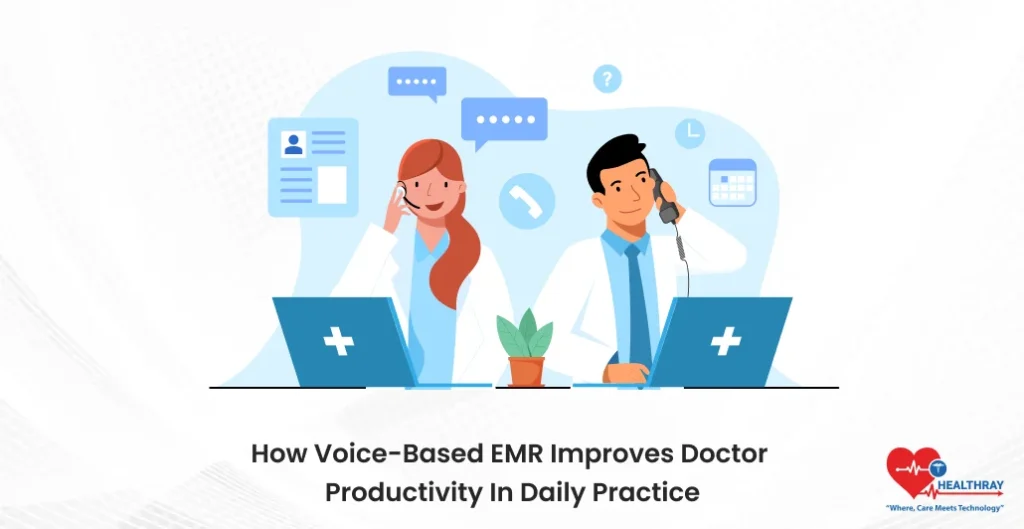
There are three changes that can be noticed once a doctor starts to use voice EMR:
1. Faster consultations, smoother flow
Physicians cease to alternate between typing and listening. It all takes place in a continuous movement. This enhances better communication and accelerates closure of cases.
2. Better patient experience
Patients feel heard. They do not see their doctor typing all the time. They are instead subjected to uninterrupted focus and explanations.
3. Better and full EMR documentation
Doctors speak naturally. AI seals the loopholes, matches parts and keeps clinical information intact. This minimizes risk and enhances quality.
That is, the benefits of voice EMR in enhancing the productivity of doctors are in the fact that it will fit into the day as it is. Physicians do not acquire a new skill, they just talk.
Healthray: Voice-Based EMR in Clinics INDIA and the USA
Healthray builds an AI-powered doctor voice EMR designed for real-life clinical pressure. Doctors don’t get another tool – they get breathing room. The system converts every part of the consultation into clear digital patient records without slowing the doctor.
Here’s how Healthray supports clinics:
- Real-time voice documentation
Doctors speak, and the system captures everything accurately.
- Automatic structuring of notes
AI organizes the case into history, observations, diagnoses, and plans.
- Support for busy OPDs
Whether a clinic handles 20 cases or 200 cases daily, Healthray keeps up.
- Deep integration with appointments
Get seamless scheduling, instant records, and faster consultations automatically.
- Compatibility with clinic EMR setups
Doctors access all records, voice notes, and history instantly.
- Faster follow-ups
Past voice notes appear instantly during next visits.
- Perfect for specialists
Orthopedics, gynecology, pediatrics, cardiology – all benefit because voice suits every specialty’s pace.
With this, Healthray doesn’t just modernize documentation – it makes clinical practice human again.
Conclusion
Physicians in INDIA and the USA are switching to voice EMR due to its naturalness, time-saving and the ability to regain the connection that was lost with typing. When physicians cut down on documenting hours, they will have time to do what is important, listening, guiding, diagnosing and developing trust.
However, all clinics come to a certain conclusion eventually: typing can once work, but voice can make doctors prosper nowadays. It decreases burnout, enhances accuracy, and allows physicians to concentrate on their patients without screen battles.
Voice EMR is the next step in case your clinic wishes to have a smoother, calmer, and faster OPD experience.
Healthray assists in implementing it with a familiar, understandable, and natural aid of AI.
Ready to experience voice-based documentation? Book a free demo and see how quickly your day becomes lighter.