



Summary
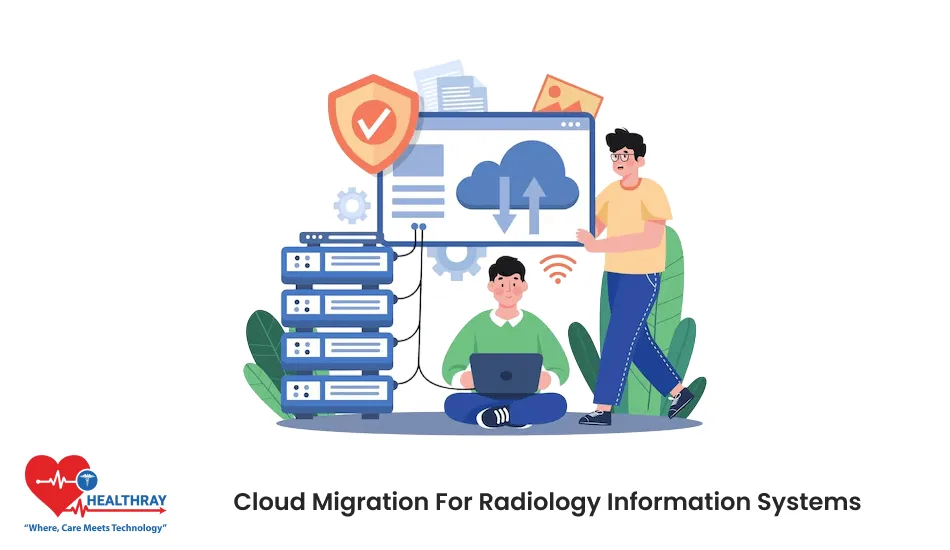
RIS cloud migration has become a clinical and business decision as opposed to an IT upgrade. Hospitals, clinics, and specialists now expect speed, security, and flexibility from their radiology platforms. This blog guides readers through the actual meaning of the cloud migration as applied to radiology teams, its effect on the daily routines, and why leaders think more of this as a long-term solution instead of short-term solutions.
Introduction
Radiology teams are under stress on all fronts at present. Volumes keep growing. The timeframes on reporting continue to become smaller. In the meantime, legacy systems are struggling to make ends meet. That reality pushes many organizations toward cloud migration for RIS, not because it sounds modern, but because daily work demands it.
Workflow forms the starting point of the conversation in the majority of hospitals and clinics. Physicians desire expediency in access to images. Administrators desire to have fewer system failures. IT departments desire reduced overheads in maintenance. All these goals meet inside a digital radiology workflow, where the information flows freely rather than gets trapped in silos.
Simultaneously, RIS cloud migration is no longer an experiment. Vendors, regulators, and clinical leaders understand the model. As a result, adoption now centers on trust, reliability, and outcomes rather than hype.
Why Hospitals Are Rethinking Cloud Migration for RIS
Hospitals do not upgrade basic systems easily. Nevertheless, RIS platforms are at the heart of imaging activities, and thus inefficiency soon permeates patient care. On-premise environments limit scale, slow updates, and demand constant attention.
In comparison, RIS cloud migration enables hospitals to change more quickly. Infrastructure scales in case of imaging bursts. Updates are released without interruption. There is better interdepartmental cooperation. For that reason, cloud migration for radiology information systems now aligns with broader clinical goals.
Also, the problem of staffing shortage makes organizations turn to automation. Radiology leaders desire systems that would minimize manual actions instead of complicating the system. Cloud systems enable that change by default. As a result, the operation value is evident to decision-makers rather than technical benefits that are abstract.
Cloud Migration for RIS: What It Means to Modern Radiology
The immediate thought of people when heard about cloud migration of RIS is the movement of the servers off-site. As a matter of fact, the change is even deeper. Clinical teams experience it through faster logins, smoother scheduling, and more reliable access to images.
From On-Premise Systems to Cloud-Based Care Delivery
On-premise RIS systems commit organisations to capacity. Expansion needs additional hardware, larger premises and maintenance. Migration to the cloud of RIS eliminates all those limitations and substitutes them with flexing resources that expand with the clinical demand.
In addition, RIS cloud migration enhances consistency. All users operate under the same version of the system. Reporting processes remain on course. Consequently, radiologists are spending less time on technology mischief and more time in studying interpretation.
 PRO TIP
Cloud Migration for Radiology Information Systems in Clinical Practice
The process of radiology information system migration to the cloud in day-to-day activities alters the modes of collaboration between teams. Radiologists access studies from any approved location. Clinicians receive reports faster. Administrators monitor real time performance.
That visibility matters. With the free flowing of data, departments can expose the bottlenecks within a short period. In the long run, such insights will help in making staffing choices and smarter planning.
Besides, RIS cloud migration enhances resilience. There is reduced downtime since systems are based on excess infrastructure. To clinicians, such reliability instills confidence and eliminates frustration when having a busy shift.
Radiology Information System Cloud Migration Challenges Hospitals Face
Any change has its challenges. Radiology information system cloud migration raises some issues of data integrity, schedule and adoption among the users. Hospitals must plan carefully to avoid disruption.
RIS Data Migration Challenges and How Teams Overcome Them
RIS data migration issues tend to have volume and complexity. Historical studies, reports, and patient metadata require careful handling. The solution teams have to do this is to migrate in stages and data validation during the course of the migration.
Communication also matters. The radiologists should have a vision of training and schedules. Adoption is enhanced when the leadership makes the process understandable. Thus, the process of cloud migration of RIS will become organized, and not a stressful experience.
 NOTE
NOTE
Enterprise RIS Cloud Migration for Large Hospitals and Health Networks
Huge organizations have special requirements. Enterprise RIS cloud migration should be able to achieve the scale, compliance and various specialties without delaying service. This is managed by cloud platforms which distribute workloads regionally.
Supporting Scale, Performance, and Clinical Confidence
For health networks managing multi-branch radiology centers, centralized access becomes essential. Migration of RIS to cloud enables the leadership to standardize workflows and at the same time, the local needs are honored.
Meanwhile, reporting consistency gets better with enterprise RIS cloud migration. Leadership can have a cohesive perspective of inter-site performance. The knowledge facilitates the efforts of quality improvement and strategic development.
RIS for Diagnostic Imaging Centers and Specialty Clinics
RIS for diagnostic imaging centers is equally helpful to smaller organizations. Cloud systems do not require costly hardware solutions. Clinics are provided with enterprise-levels of performance without enterprise-level overhead. Consequently, imaging facilities remain competitive without straining budgets and information technology departments.
Furthermore, the RIS cloud migration facilitates cooperation with the referring physicians. Pictures and reports are quicker and enhance the experience of the patient. In the long term, such efficiencies build a stronger relationship and lead to growth. Also, cloud-based access can assist specialists with studying reviews remotely without interrupting the workflow. Said flexibility is important when the staffing fluctuates or when the volumes are high. Finally, the RIS migration to the cloud enables imaging centers to devote their attention to throughput, accuracy, and service quality and not spend time on the system maintenance.
Cloud-Based Radiology Workflow Systems and Day-to-Day Efficiency
Modern cloud-based radiology workflow systems focus on reducing friction. Scheduling, reporting, and billing connect seamlessly instead of operating as separate tools. As a result, teams do not have to enter data more than once or manually change data to slow down the progress.
Faster Reporting, Smoother Collaboration, Better Patient Flow
Under cloud migration of RIS, there is reduction in reporting cycles. The dictation of radiologists is automatic, and clinicians get the results. This efficiency supports digital transformation in radiology, where speed and accuracy define success. Simultaneously, employees do not spend the same time fixing system malfunctions and assisting the patients. Better coordination removes waiting time, maintains appointment time, and enhances interdepartmental satisfaction. These profits are multiplied into quantifiable operational gains in the long run.
Medical Imaging Cloud Systems and Data-Driven Care
The value of medical imaging cloud systems is not limited to storage. The analytics tools reveal trends in the usage of modality, turnaround times, and distribution of work.
Furthermore, cloud migration for RIS strengthens radiology data security through encryption and access controls. Consequently, organizations secure patient information and enhance access.
Security, Compliance, and Trust in Cloud Migration for RIS
The main concern that hospitals have related to cloud migration in regards to RIS is security. That concern makes sense. Radiology systems deal with confidential patient information, clinical documents and work processes. Any interference impacts on quality of care and trust.
Luckily, the contemporary cloud services take these threats into consideration. A HIPAA-compliant cloud RIS is one that has stringent access controls, encryption and audit trails. These safeguards are in effect at all times, and are not limited to times of audits. Consequently, organizations will limit the exposure, and still be flexible.
Moreover, radiology data security in the cloud is enhanced by the fact that updates are performed automatically. Security patches are no longer maintained during maintenance windows. Rather, platforms are updated automatically. Therefore, RIS migration to the cloud assists in compliance, but does not make it more complex.
Cloud Migration for RIS and the Real Cost Conversation
Cost negotiation is a source of reluctance. Executives fear unknown expenditures or undisclosed charges. Cloud migration of RIS tends however to shed light on costs rather than swell them.
On-premise systems are costly to set up, hardware refresh, and need to be maintained. The cloud platforms transfer that load to foreseeable operational costs. In the long-term, the cloud RIS reduces costs in the organization by decreasing the costs of the infrastructure and minimization of downtime.
Moreover, there is the issue of cloud migration of RIS, which reduces indirect costs. IT departments are faced with less time to deal with servers. Radiologists participate in testing, which ensures usability aligns with clinical expectations. Consequently, cloud migration for RIS feels controlled rather than chaotic.
How to Migrate RIS to the Cloud Without Disrupting Clinical Operations
A common question to hospitals is how to transition without disruption of care. Planning and communication are the solution. The migration of RIS to the cloud does not include a cutover as it is a successful process conducted in stages.
The teams start with the evaluation of the workflows and dependencies. Then they ship non-critical parts initially. The basic clinical functions are followed when the validation shows stability. This will reduce the risk and develop confidence.
In the process, organizations overcome the RIS data migration problems through the validation of data sets in phases. Radiologists are involved in testing and this makes them relevant in usability to clinical expectations. It is therefore controlled and not chaotic when cloud migration to RIS takes place.
Cloud Backup and Business Continuity in Radiology Systems
Pause in service breaks service and destroys trust. Cloud backup for radiology systems reduces that risk through redundancy and geographic distribution. Systems recover quickly, even during regional outages.
Unlike traditional backups, cloud-based recovery works automatically. Data synchronizes continuously, not once per day. Thus, recovery points become up to date. In the case of radiology teams, this reliability helps them to have continuous operations.
In addition, the RIS migration to the cloud enhances disaster recovery planning. Organizations are able to test recovery scenarios without affecting live environments. The preparation will increase resilience and regulatory requirements.
Medical Imaging Cloud Systems and Performance Expectations
Security is just as important as performance. Medical imaging cloud systems provide high availability and rapid access even when under peak condition. Cloud infrastructure is dynamically scaled, making sure that there is a consistent performance.
This is beneficial to the clinicians in that they have less waiting time in researching. To administrators, it will entail foreseeable service levels. These results combined will ensure that there is confidence in cloud migration as a long-term move at RIS.
How Healthray Supports Cloud Migration for RIS
Healthray uses cloud migration of RIS as a clinical initiative and not as a technical project. The platform assists hospitals, clinics, and specialists by integrating technology with actual processes.
Healthray emphasizes compliance, usability, and reliability. The system is also compatible with the tools that are already in place and allows expansion. Consequently, companies implement cloud migration to RIS without loss of control or visibility.
Healthray facilitates the smooth transition of teams by focusing on the experience of clinicians. RIS cloud migration is no longer a distraction of care quality, but an enabler.
Conclusion
Radiology teams are under pressure to do more with systems that were never built for today’s volume or pace. That’s why cloud migration for RIS has shifted from a future idea to a present-day foundation. Hospitals and clinics that rely on imaging cannot afford systems that slow clinicians down or put data at risk.
When done right, cloud migration for RIS brings clarity instead of complexity. Workflows become smoother. Costs become predictable. Systems stay available when clinicians need them most. Above all, radiology teams gain confidence that their technology supports care rather than getting in the way.
Organizations that act now aren’t chasing trends. They’re building stability and room to grow. If you’re curious what that could look like in your environment, you can book a free demo and explore it at your own pace – no pressure, just a clearer picture.