


Summary
In 2026, the Indian radiology ecosystem is a silent revolution. RIS is not just a work tool but it has become the memory and intelligence of imaging centers. With RIS, all workflows-scheduling ,reporting, PACS–EMR integration and billing, move in a smooth digital rhythm. Best RIS platforms understand the Indian workflow realities, such as high volumes, multi-branch expansion and strict compliance. This system minimizes noise and enhances the clarity. Radiologists can make decisions more quickly with the use of RIS software, and patients receive timely, validated diagnoses. In this blog, I’ll go over the top RIS software available in India in 2026, their best features, and how to choose the best program to meet all of your radiologists’ needs. Keep reading!!
Introduction
The radiology industry has entered a new phase in 2026, in which turnaround time has become a competitive weapon, volumes are high, and patients are aware of digital technology. In this context, the radiology information system has evolved into more than just software; it now serves as the foundation for the entire diagnostic ecosystem. As hospital complexity is growing day by day, there is a strong need for a system. Nowadays imaging centers demand RIS that combine speed, scalability and compliance in a single frame.
Multi-branch operations, teleradiology networks, PACS–EMR integrations, and HL7 and FHIR standards are not merely “future features” but have become daily necessities. RIS creates a seamless workflow from AI-driven scheduling to automated billing, structured reporting and analytics dashboards where manual work is minimum and clinical workflow becomes maximum. Best radiology information systems in India are not a list of popular names; instead, they’re an evaluation of Indian workflows-high patient load, varied modalities, regulatory expectations and cost sensitivity. For additional information, read our blog on RIS training and user adoption.
Evaluation Framework: What Makes an RIS “Best” in India?
In simple words, the most effective RIS is the one that understands the fundamental realities of existence. In India, radiology is not a unified system. Furthermore, it’s a mosaic of extravagant hospitals in metros and rapidly expanding chains in tier-2 cities and tier-3 towns with pragmatic diagnostic centers. The true evaluation of RIS in 2026 will be how proficiently it responds to this variation.
Cloud-First Architecture with Deployment Flexibility
Best RIS follow a cloud-first design, but they are not rigid. Along with web-based access, on-premises and hybrid deployment support is also crucial. Further, many Indian hospitals have to keep the imaging info locally. Integral backup and catastrophe recovery capabilities mitigate interruption pitfalls.
Deep PACS and Modality Integration
Strong RIS is the one that integrates with PACS and modalities without creating any friction. Further, DICOM support and modality worklists minimize manual demographic entry. Integrated, tightly linked users can view the radiologist images and reports in a single context. Moreover, this saves time and minimizes errors.
Teleradiology and Multi-Branch Workflows
In 2026, radiology is not just limited to a single location. Additionally, centralized worklists give radiologists the flexibility to manage reports and distribute their workload from a distance. With Role-based access control, radiologists can share studies with external specialists and teleradiology partners securely.
Reporting, Templates, and Analytics
Structured reporting templates, macros, and speech recognition make the reporting fast and consistent. Further, Analytics dashboards such as AT, modality utilization, and referral patterns are not just limited to operational data but also provide clear business insight to managers.
Compliance, Security, and Interoperability
Strong audit logs, encryption, and access controls are global standards and ensure all the processes are safely managed. The Indian DPDP Act ensures the system aligns perfectly with hospital rules. Further, HL7/FHIR-style APIs connect RIS with HIS. Also, the medical radiology system brings together EMR/EHR, LIMS, and NDHM-enabled health records. To learn how RIS flawlessly offers a secure environment without sacrificing quality, also read our blog, RIS compliance & audit trail.
Usability and Local Support
Intuitive UI reduces radiologists, technologists, and front-office teams for radiologists, technologists, and front-office teams. Further, Local implementation teams and India-aware pricing models ensure that RIS should be equally effective in metros and tier-2 and tier-3 markets.
 PRO TIP
Top Radiology Information Systems in India
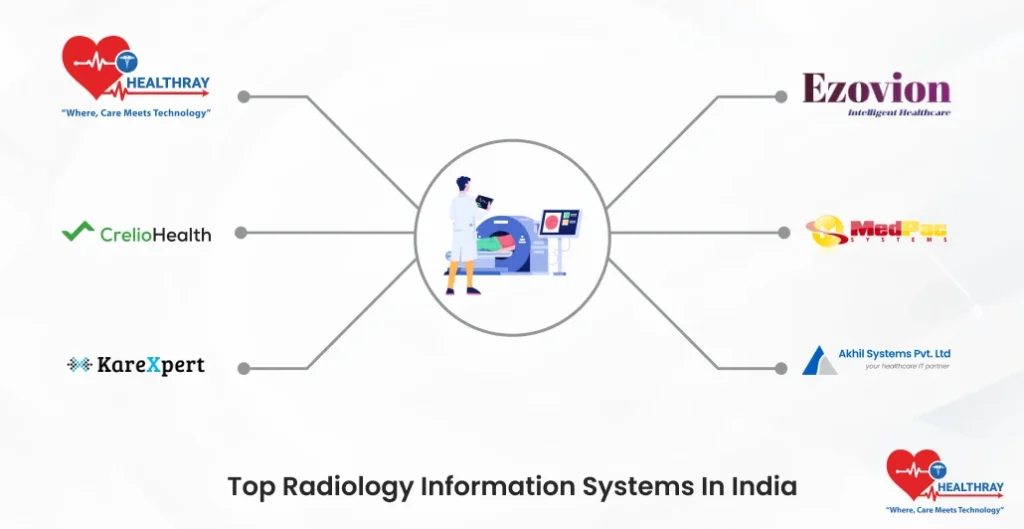
Let’s check out:
Healthray
AI-Assisted Triage for Urgent Care
HealthRay’s AI-assisted triage automatically acknowledges emergency circumstances. Additionally, it keeps important studies from getting lost in lines. Right case, right time, right radiologist is the promise of the Healthray system.
Smart Load Balancing Across Locations
Multi-location networks commonly face challenges with workload imbalance. Further, Healthray digital radiology workflow software through dynamic load balancing evenly distributes reporting pressure without the need for any manual supervision.
Dynamic Worklists with Subspecialty Routing
Beyond general worklists, Healthray RIS software enables subspecialty-based routing. For example, all cases related to pulmonology are automatically diverted to pulmonology practitioners and urology concerns to urology specialists.
Automated Patient Flow Optimization
Healthray Cloud migration for RIS endows features such as Automated SMS or WhatsApp reminders. Furthermore, these subtle features minimize no-shows to a considerable extent. It keeps the appointment function flawless; scanners no longer remain vacant. Overall, it improves patient experience.
Actionable Analytics Dashboards
TAT, modality utilization, and referrer patterns are presented in visual dashboards. Further, this helps management to critically evaluate the insights and take valid initiatives in areas that currently need high scrutiny.
ABDM-Ready and Compliance-First Design
Healthray software boasts ABDM-compatible interoperability. Plus, HIPAA-aligned protection safeguards and comprehensive audit trails cover both India and global compliance.
Built for Clinics to Enterprise Hospitals
Healthray specialty templates and scalable architecture allow small and enterprise-level clinics and medical centers to flourish naturally.
CrelioHealth
Built for Integrated Diagnostics
CrelioHealth provides a web-based RIS that integrates tightly with PACS, LIMS aur billing modules. Furthermore, it is a single operational spine for labs and imaging chains, allowing radiology and pathology to move in parallel.
Browser-Based Reporting at Scale
Browser-based reporting does not allow radiologists to depend on heavy local installation. Further, in a high-volume environment, that flexibility enhances reporting speed and reduces TAT noticeably.
Lossless Image Upload and Secure Sharing
CrelioHealth ensures uninterrupted image uploads without hampering diagnostic quality. Plus, secure study sharing makes the collaboration effortless and dependable among clinicians or source referrals.
Where It Falls Short
While comparing it with Healthray, creliohealth have limited scope in deep AI-assisted triage, advanced load balancing, and HMS-wide analytics. Furthermore, Heathray is more powerful in handling pure enterprise hospital orchestration.
KareXpert
RIS Within a Full HMS Ecosystem
KareXpert offers RIS inside its enterprise-grade HMS. Further, scheduling, reporting, and core integration workflows from OPD to IPD naturally align.
AI-Driven Hospital Workflows
Platforms highly centered on AI-enabled automation. Furthermore, this makes the routine radiology process more rapid and more predictable, especially for large hospitals.
Designed for End-to-End Hospital Use
KareXper is suitable for organizations that want to manage OPD, IPD, billing, and clinical modules of radiologists in a single system.
Where Healthray Pulls Ahead
In comparison with Healthray ,karexpert is limited in specialty-specific reporting templates and deep radiology customization. Furthermore, karexpert multi-branch radiology adoption is unproven when compared to Healthray, which has over 1,000+ live sites.
Ezovion
Cloud Scalability for Growing Hospitals
Cloud-based architecture makes Ezivon an appealing option for fast-growing hospitals. Furthermore, as patient volume increases, the system maintains performance and access consistency.
Core Worklist and Reporting Features
Ezovion supports basic radiology worklist management and reporting. Moreover, it is sufficient for routine hospital imaging needs.
Where AI Depth Is Limited
While comparing it with Healthray, Ezovion’s AI-driven routing and intelligent exam prioritization are not highly advanced. For deep automation of critical cases, Healthray outperforms Ezivion.
Usability: Close, But Not Leading
Ezovion UI is functional but gives a generic look when compared with Healthray’s radiology-first design, especially in large-volume diagnostic circumstances.
Best-Fit Use Case
Ezivion is a solid alternative for multi-specialty hospitals that require integrated hospital IT; on the flip side, for advanced radiology intelligence or specialty-focused workflows, Healthray is the dominant solution.
MedPac Suite
PACS at the Core
MedPac Suite puts a strong focus on imaging storage or PACS. Further, RIS is bundled to support imaging workflows. It is not a convenient option for full hospital orchestration.
Designed for Narrow-Band Environments
Medpac’s primary strength is low-bandwidth efficiency. Furthermore, this setup ensures reliable image transfer and access for remote centers and satellite clinics.
Teleradiology-Friendly Design
Medpac is a highly versatile application for remote reporting. Further, radiologists can interpret studies even sitting at a faraway location.
Where HealthRay Leads Clearly
While comparing with Healthray, medpac downperforms in end-to-end HMS integration, AI-driven prioritization and advanced analytics.
Best-Fit Use Case
Medpac is appropriate for setups that revolve around imaging storage and remote access especially in rural, small towns and bandwidth-limited regions.
Akhil Systems
Designed for Diagnostic Chains
Akhil RIS supports centralized scheduling and reporting. Furthermore, it makes the daily operations of regional diagnostic chains unified and more organized.
Centralized Multi-Branch Operations
Akhil’s system’s core strength is managing appointments and reports centrally among multiple centers, especially when expansion reaches the regional level.
Hybrid Deployment Flexibility
Akhil Cloud and on-premises hybrid deployment options are suitable for platforms that emphasize data locality and regulation.
PACS Connectivity
Akhil provides an integration option with PACS; this keeps the image storage and retrieval workflows stable, without any major changes needed.
Where Technology Depth Is Limited
When compared with Healthray, Akhil RIS software has limited scope in native AI-driven triage, intelligent prioritization, and advanced automation.
Conclusion
CrelioHealth, KareXpert, Akhil system and Ezovion are strong systems, but they are incapable of matching the consistency level with healthray deep AI orchestration, proven multi-branch adoption, and radiology-first intelligence. Healthray architectures are well-designed with AI-ready, analytics-driven, and future-compliant features that are benchmarked in 2026.