



Summary
Custom LIS software provides powerful solutions to labs to design their unique workflows, instruments, and testing processes according to their requirements. Ready-made LIMS are powerful but they are incapable of providing features that fully support the specific needs of clinics. Custom LIMS are perfectly aligned with existing workflows and are adept at handling sample management, data tracking, and reporting. Beyond that, custom LIMS supports future growth. As the software expands, clinicians can easily add new functionality. This flexibility supports labs to become efficient in the long term and gain a competitive edge. In this blog, I will discuss how customization in lab software helps you achieve measurable gains, accuracy and adaptability. Keep Reading!!
Introduction
Modern laboratories don’t just operate with basic data recording. Every lab workflow, testing process, instrument, and reporting style is different. That’s the reason why one-size-fits-all software is not an ideal solution for all lab practices. This is where the concept of custom Laboratory Information Management System development becomes significant. In simple words, custom LIMS is lab management software that is specifically designed for a particular lab’s needs, procedure, and workflow.
Every laboratory, whether it is a diagnostic lab, research lab, pharmaceutical lab, or food testing lab, works on its unique style. If your software is constructed according to your business needs, then naturally workflow becomes smooth. Traditional or ready-made LIMS systems are useful, but every time clinics need to compromise on the features. Few labs demand specific instrument integration, few labs ask for customized reporting formats and few are looking to simplify their complex sample tracking workflows. Ready-made software is available, but it has limited options for these features. In this situation, custom lab software provides full flexibility to clinics. Clinics can build custom software as per their existing workflow. When software exactly follows the lab process, then naturally manual errors become less noticeable, data accuracy gets enhanced, and overall clinic efficiency gets a thrust.
Why Do Labs Need Custom LIMS?
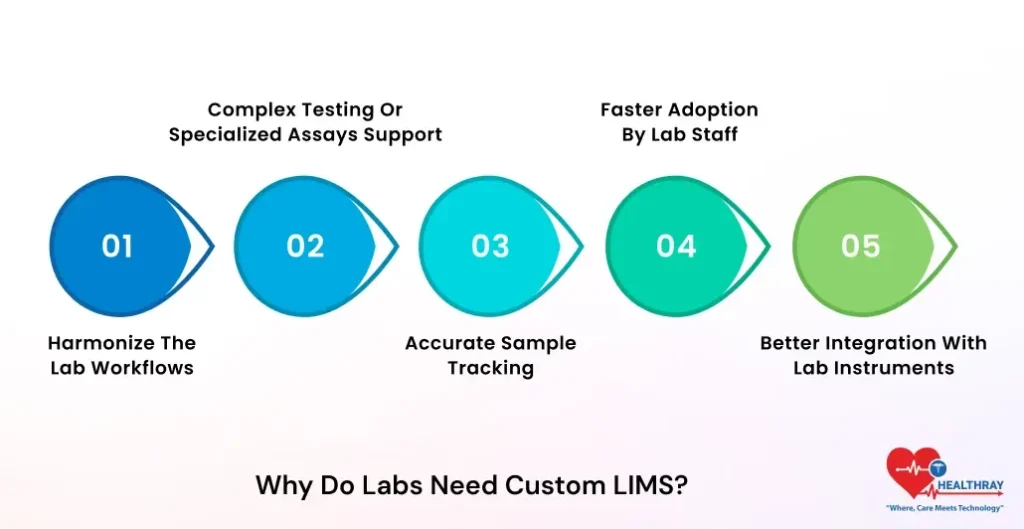
Harmonize the lab workflows
Every laboratory workflow is different. Further, few labs deal with simple testing; few have complex and multi-step analysis processes. Standard LIMS have fixed workflows and do not coincide with every lab process. Custom LIMS provides powerful solutions to clinics to add functionality as per their practices. Unlike in standard platforms, they no longer need to buy functionalities that hold no purpose in their lab practices. Moreover, this helps technicians to accomplish their work in their own work style. It eliminates unnecessary steps that lab practices do not require.
Complex Testing or Specialized Assays Support
Many labs don’t just stick to simple testing. Further, they perform complex and specialized assays such as forensic analysis, pharma R&D, and environmental testing. In these procedures, clinics must conduct a thorough assessment of each sample and create a personalized report for each sample. Custom LIMS provides solutions by considering all the aspects of complex clinics’ practices and builds solutions according to every lab’s needs. Additionally, this helps labs to manage their unique test procedures without the need for any other workaround.
Accurate Sample Tracking
As we know, sample tracking is a core part of laboratory operations. Further, if technicians fail to track samples accurately, this can enhance the chances of confusion and error in the system. Custom LIMS helps lab technicians to easily resolve these problems. It encompasses features such as barcode scanning, automated tracking, and a clear sample lifecycle management that simplifies the complex lab practices. With a custom LIMS, clinics can conveniently track all the stages from sample collection to final report delivery. Overall, the lab will get clear visibility and help them follow a structured approach to their practices. Read our blog Importance of sample tracking software to understand how LIMS simplifies hectic operations of sample collections.
Faster Adoption by Lab Staff
When software is designed according to the real workflow of labs, then staff takes less time to understand the complete features of lab management software. Further, Custom LIMS can convert the familiar lab process to digital format so that technicians and lab managers can easily adapt to the features. They no longer need to learn the entire new system’s functions. Additionally, it minises training time to learn the new system. Reduces human errors that raise complexity in the workflows. Employees can easily become conversant with the new system and leverage it in their daily practices.
Better Integration with Lab Instruments
Modern laboratories use multiple instruments or analyzers such as hematology analyzers, PCR machines, and chromatography systems. If clinics enter data manually in the system, it takes significant time to complete the procedure. Moreover, it enhances the risks of errors in the data. Smart LIMS system can easily integrate with such instruments. It automatically transfers the test results directly into the system. Additionally, it minimizes data entry workloads and renders the data more accurate and easy to read. It ensures a smooth work environment. Employees now only need to approve the reports; the system takes care of everything else.
 PRO TIP
Industry-Specific LIMS Customizations
Batch Tracking for Pharma Labs
In pharmaceutical labs, batch tracking is a significant operation. Further, clinics need to track every phase of operation from production and testing to final approval. Custom LIMS can accurately track batch numbers, stability studies, and quality checks. This helps the pharmacy lab to accurately regulate the operation along with maintaining regulatory compliance at every phase.
Evidence Management for Forensic Labs
Forensic labs deal with legal evidence. Further, it is highly crucial for clinics to maintain chain-of-custody. Custom LIMS records all the steps of evidence collection, storage, and investigation. This keeps the data secure and maintains transparency in the investigation steps.
Food Safety Testing Workflows
Food testing labs mostly deal with allergen detection, contamination checks, and quality testing. Lab need to check multiple parameters of every sample. Further, Custom LIMS automates the entire operation of food safety labs and generates reports as per regulatory standards.
Environmental Testing Requirements
Environmental labs check water, soil, and air samples. Furthermore, sample composition or variable metrics are different for every lab. Custom LIMS are adept at managing these different sample types and provide flexibility to labs to customize their testing parameters as per their lab needs. Read our blog, LIMS vs LIS to know which software will best suit your business needs.
Risk Management in Custom Projects
Define clear project scope
It is crucial for lab specialists to define a clear scope before initiating the custom LIMS projects. Further, if the lab is incapable of defining the requirement, this will create error,delays and unnecessary modifications in the development journey. Therefore, lab teams should clearly define the scope at the beginning. They should mark down which features are “must-have” and which features can be added in a later stage of the development cycle. When scope is clear, the lab and development team work in the same direction. Thus, helping clinics to accomplish all the development steps quickly without wasting capital on unnecessary features.
Controlling Scope Creep
If you add new functionalities in the middle of the development phase, this will lead to scope creep. Further, these negatively impact the timeline and budget. To combat such unavoidable circumstances, clinics should emphasize MoSCoW prioritization (Must have, Should have, Could have, Won’t have). This helps clinics set clear boundaries and goals while undergoing the development phase.
Early User Involvement
It is one of the critical aspects in the custom LIMS development process. Sometimes labs feel hesitant to start the new software. They think the new system will further complicate their daily routine. Therefore, clinics should involve the lab technicians, quality managers, and supervisors at the beginning of their project development. When a user becomes a part of planning and development, they feel anxious at the later stage. They feel more comfortable sharing practical suggestions. In this way, clinics can customize their lab needs and even staff can easily adapt to it.
Create Lab Champions
In every laboratory, they are proficient and knowledgeable teams who have deep knowledge about the lab practices. Creating “lab champions” during the development phase of a custom LIMS can be very useful. These knowledgeable members can work closely with the development team and provide them practical feedback on real workflow. Plus, they can even train and guide the new staff after the implementation of the new system. Overall, this minimses confusion and system adaptation becomes effortless.
Choosing a Development partner
When selecting a development partner, you should first determine whether the company has a solid background in LIMS and healthcare IT development. Vendor should have a deep understanding of lab workflows, regulatory requirements, and industry challenges. Check out the following criteria before choosing a vendor:
- Check the relevant experience
- Evaluate the LIMS portfolio
- Deeply evaluate the vendor compliance knowledge
- Check whether they are proficient in the agile development approach.
- Demand Proof of Concept (PoC) Testing
- Check if the vendor provides post-development assistance.
 NOTE
NOTE
Conclusion
Custom LIMS development is a strategic upgrade that takes the simple lab capability to the next level. Unique lab workflows, testing procedures, and operational requirements are the foundation for the creation of custom LIMS. Custom LIMS through requirements mapping and modular architecture converts the lab manual process into digital form. Platforms like healthray supports NABH compliance, Digital India initiatives, and system interoperability and make the lab process efficient and competitive.