


Summary
Is managing clinics on schedule difficult? Even after proper planning, clinics still face delays in their daily flow. Automated appointment reminders for doctors work as a silent assistant for clinics. This digital tool provides time-to-time updates to doctors, reduces no-shows and last-minute cancellations, and makes the entire schedule smooth. It keeps all the activities of clinics on track and minimizes workloads on staff. Clinics run at perfect timing without creating unnecessary chaos at the front desk. In this blog, I will discuss how automated appointment reminders for doctors save time, streamline hectic operation and elevate patient experience—all while strengthening profitability and staff productivity. Continue reading!
Introduction
We often ignore the power of automated reminders, even though they are the hidden champion to run the clinics smoothly. Automated reminders silently work in the background and help clinics function smoothly. Automated appointment reminders serve as an assistant that never forgets, never grows weary, and promptly communicates with patients. Doctor appointment system reduces no-shows and keeps the patient informed and doctors’ schedules on precise track.
Whether it’s an SMS, WhatsApp, Email, or App notification, automated appointment reminders instantly send notifications to patients and minimize confusion that results from last-minute cancellations. Further, doctors get better control over their workflows and patients get stress-free, well-timed visits. Consider it as a smart system that brings opd clock into perfect rhythm.
Besides, it keeps reminding patients about their consultation with doctors, share instructions and notifies them to bring essential documents in order to prevent the delay from becoming a headache. With automated reminders, clinics can actively focus on patient care. Next, I will talk about how these “silent assistants” raise doctors’ productivity, reduce idle time and minimize work pressure on staff. Without killing the vibe, let’s begin!!!!
The Problem: The Hidden Cost of Missed or Delayed Appointments
On the outside, the clinic’s schedule appears seamless, but in practice, it is completely different. Furthermore, a missed or late appointment not only impacts a single slot, but it also breaks down the entire treatment flow, drops the doctor’s productivity, and causes revenue loss in the system. When patients repeatedly miss the appointment, unknowingly, the patients shift to other clinics that provide better services.
Healthcare reports clearly reveal:
- No-shows cause an annual revenue loss of $150 billion in US healthcare sectors.
- All missed appointments as per doctor, specialty and practice size, generate a loss of $150–$400.
- 18%–30% of appointments are either no-shows or last-minute cancellations.
- Specialty clinics like orthopedics, ophthalmology, and cardiology these disruptions can lead to hours of lost productivity, and the majority of staff become idle.
The common reasons for missed appointments:
- Patients usually forget their appointment date.
- Miscommunication and unclear instructions.
- Fear and anxiety about the procedure.
- Transportation issues
- Follow-up reminders and confirmations.
Traditionally, front desk staff spend considerable time on manual calls, such as sending reminders, confirming visits, or managing cancellations. Moreover, the entire process becomes slow and error-prone and creates an uneven workload. This leads to more missed reminders, more confusion, and poor OPD flow.
How Automated Reminders Keep Clinics Running on Time
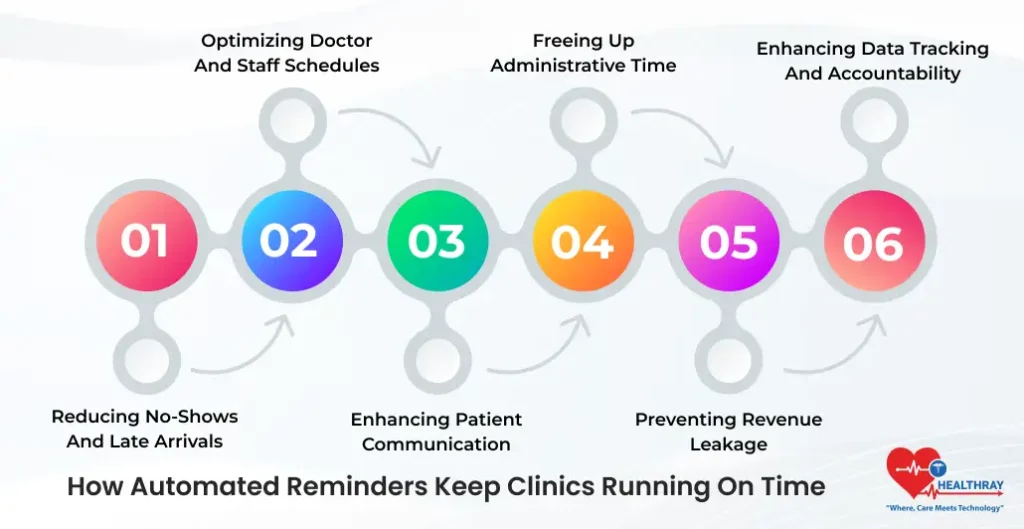
The clinic’s workflow seems smooth from the surface but the real challenge lies in timing. Here, doctor queue management software plays a smart role quietly, efficiently, and on time. Further, this software makes the entire opd workflow smooth and meticulous. Let’s check out the role of automated reminders in clinics:
Reducing No-Shows and Late Arrivals
Patients receive regular SMS, WhatsApp, or voice reminders before their consultation within 24-48 hours. Its seem simple but the impact is quite massive. Further, two-way messaging systems are highly powerful; in a single tap, it confirms the patients and reschedules the patients. Additionally, staff gets early-predictable empty slots. The same old “forgotten appointment” issue ultimately dissolves.
Optimizing Doctor and Staff Schedules
The clinic’s schedule seems perfect but from inside, the picture is entirely different. Furthermore, a small delay and missed confirmation disrupt the entire opd rhythm. Doctors are sitting idle; rooms are vacant, and staff juggles at the last minute, resulting in a slow flow and frustrated patients. Doctor availability management software can easily regulate the entire chaos. Further, real-time confirmation helps doctors smoothly plan their consultation. Also, the front-end team can proficiently manage rooms, slots and patient flow. Reminder data help clinics gauge patterns.
Enhancing Patient Communication
Automation platforms are not just limited to reminders; they take patient communication to the ultimate level. Further, automated appointment reminder software automatically shares: Pre-visit instructions (like fasting or special prep), clinic directions and parking details and post-visit follow-ups and educational information. Moreover, patients get clear clarity, which reduces confusion and naturally improves treatment adherence.
Freeing Up Administrative Time
Front desks typically handle over 1000 calls per day; entire days are spent simply asking patients for next-day appointment confirmation. Furthermore, automated reminders vanish the entire manual workload. Clinics can save 4-6 hours daily on unproductive activities such as handling calls, confirming appointments, sending reminders, etc. Even more, staff can spend their valuable time on fundamental activities such as in-office patient handling, smoother check-ins, and coordinating complex cases.
Preventing Revenue Leakage
Every empty slot in a clinic directly reduces revenue. Further, early reminders and quick rescheduling links instantly fill the cancellation. The Medical Appointment System automatically notifies waitlisted patients to help clinics to run the entire day at maximum occupancy.
Enhancing Data Tracking and Accountability
Modern reminder tools can connect with analytics dashboards. Further, administrators can easily track: No-show rate before and after automation, SMS, WhatsApp and voice call response rates, and average rescheduling time. Furthermore, these data help clinics to boost their operational efficiency. Also, it makes the staffing, load distribution, and revenue forecasting more precise.
 NOTE
NOTE
The Technology Behind the “Silent Assistant”
The clinic environment appears to be quiet, but powerful software is running in the background. A silent assistant that makes the reminders, confirmations and scheduling smooth without creating any noise. The automation strength depends on three integrated technologies; let’s find out:
EHR and Practice Management System (PMS)
From here the entire data flow begins. Further, the system pulls the appointments, patient details, and timings from a single real-time database. Through this integration, the reminders are completely accurate and based on updated information. There will be no double data entry or mixing up.
Communication API (SMS/Email/Voice)
Automated appointment reminders ensure the message reaches the patients on time. Whether it’s SMS, WhatsApp, email, or voice call, the system makes the entire channel reliable. In other words, it is the backbone of fast services.
 PRO TIP
AI-driven Scheduling Logic
In simple words, it is the main component of the automation. Further, the algorithm decides the reminders’ best timing and personalizes the messages per patient physical symptoms. If patients fail to respond to the messages, the system triggers automated follow-up. There is no place for human error.
Additionally, advanced systems are becoming more intelligent; they utilize predictive analytics to identify the patient’s probability of missed appointments. Doctors Appointment System for Modern Healthcare sends extra reminders, nudges and follow-ups to patients and prevents no-shows before they show up.
The Patient Perspective: Why It Works
Automation seems mechanical but you look at it from a patient’s perspective, this system actually creates comfort. Furthermore, timely reminders serve as reassurance, a simple nudge that reduces stress and improves the overall healthcare experience.
Patients’ emotional benefits are completely clear:
- Reduces the anxiety of forgetting appointments or preparation steps.
- Provide confirmation and rescheduling on a single tap and upgrade the convenience level instantly.
- When communication seems consistent or professional, it naturally boosts trust.
In specialty practices such as dialysis centers, fertility clinics, and chronic care programs, it creates a stronger impact. Furthermore, automated reminders help patients to remain committed to treatment schedules. Ultimately, it improves patients’ adherence to schedule and makes the clinical outcomes more favorable.
The Future: From Reminder Automation to Predictive Scheduling
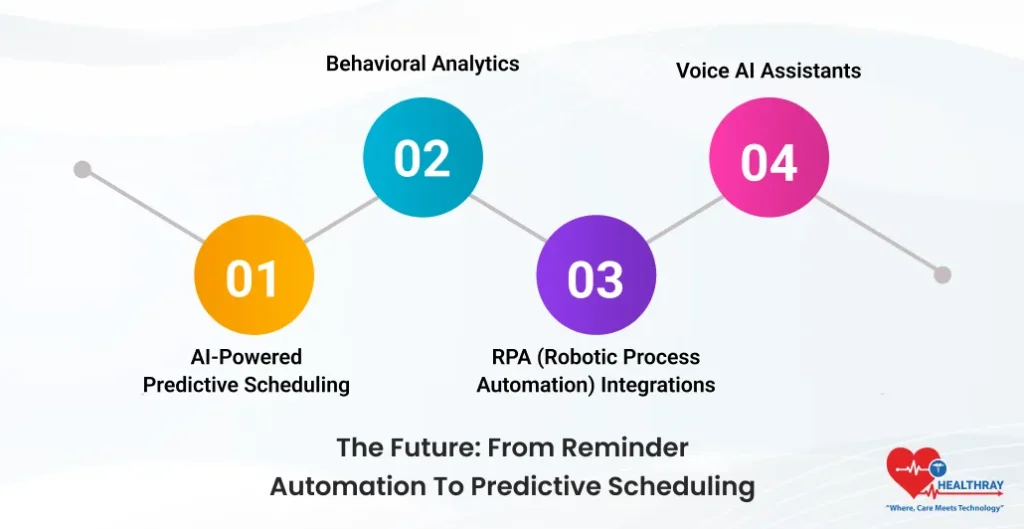
Nowadays, automated reminders help clinics to run on time. However, this is just a beginning. In the coming years, scheduling will be smarter, more intuitive and predictive. Here the system will not only perform follow-up. Beyond that, it will understand the workflow and plan the situation accordingly.
AI-powered Predictive Scheduling
Advanced AI models will predict demand peaks. The system will then analyze the time of the patient’s arrival and the number of patients who will arrive at that particular time and will automatically suggest the doctor-to-patient ratio. Further, the system will smartly auto-assign the time blocks. No more guesswork!!!!
Behavioral Analytics
The system will analyze the patient’s behavior, including late arrivals, frequent cancellations, and high-risk no-shows. Further, the system will send personalized and extra reminders to these patients. This will help clinics minimize the chances of missed appointments.
RPA (Robotic Process Automation) Integrations
Through RPA integrations, the entire workflow from booking to payment reminders, confirmations, cancellations and post-visit surveys will become fully automated. Instead of focusing on manual tasks, staff will prioritize more on patient care.
Voice AI Assistants
Natural-language chat or IVR systems allow patients to confirm or reschedule the appointment through simple voice commands. Overall, in the future, the clinic will not only run on time, but it will also dynamically adapt, recognize patient behaviour and make concrete decisions.
Why Clinics Should Treat Automation as a Strategic Investment
If you think of automation as a minor upgrade, you’re missing half the picture. But the reality is automating appointment reminders is a strategic move. Automation makes the care delivery smooth and brings stability to clinics’ financial health for the long term.
Early adopters get a clear advantage:
- Higher consistency in workflows
- Work schedules never operate in “guesswork mode.”
- Boost staff productivity.
- System easily handles routine calling and repetitive work.
- Patients feel more valued with timely communication.
- Build long-term trust and loyalty.
- Forecasting in doctors’ schedules and capacity planning improves.
Conclusion
Automated appointment reminders have completely transformed the practices of modern clinics. Doctor works on time, patients feel connected and the workflow operates smoothly without any unnecessary friction. By bridging the communication gap between patients and staff, these tools quietly eradicate ineffectiveness that previously cost practices hours and revenue.