


Summary
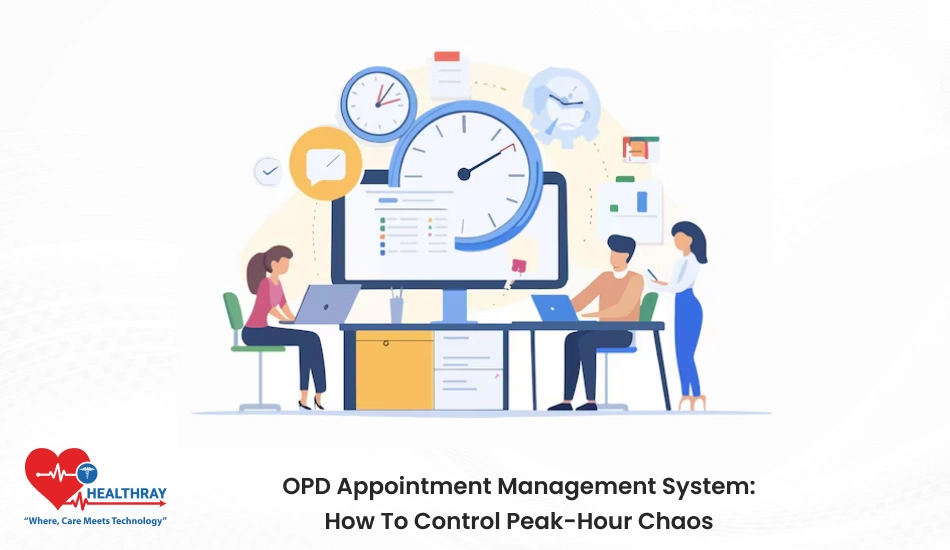
Peak hour chaos challenges aren’t just for long lines. It is also the reason for delayed treatment, stressed doctors, frustrated patients and revenue loss. Majority of clinics still manging opd traffic through phone calls, manual registers and walk-ins. But clinics that are truly efficient use a smart digital backbone behind the scenes. Opd management system silently works in the background and gives a proper structure to the daily rush. In this blog, I will discuss how Opd appointment management system converts confusion into control, saves doctor time, improves patient experince and transforms the overcrowded OPDs into smooth, predictable and high-performing care centers.
Introduction
Every clinic’s peak hours start with the same rhythm. At 9 a.m., there is a rush of patients holding files, an argument at reception, and a call to the doctor. There is a never-ending line outside the doctor’s ward and patients are racing from one screen to another. Everything seems to be going smoothly but nothing is in control. India is not the only country dealing with this chaos; the United States is also facing similar challenges. The only difference is scalability; the struggle peak-hour pressure, overbooking, walk-ins, and delayed consultations is the same for every healthcare organization.
As the OPD appointment management system comes into the picture, the entire scene transforms. Patients reserve the time slot in advance, and the physician is aware of the patient’s arrival time. Even walk-ins get proper digital queues. Sudden patient surges do not interrupt the workflows and discipline is maintained at the front desk. Each activity is properly tracked in the system. Doctor appointment system neither replaces doctors nor staff. Instead, it silently becomes a support system that works efficiently in the background, ensuring smooth workflows of OPD. Peak times that used to be a source of stress are now predictable and feasible. Clinics not only serve as patient care centers but are also eminent as well-organized, high-performance care centers.
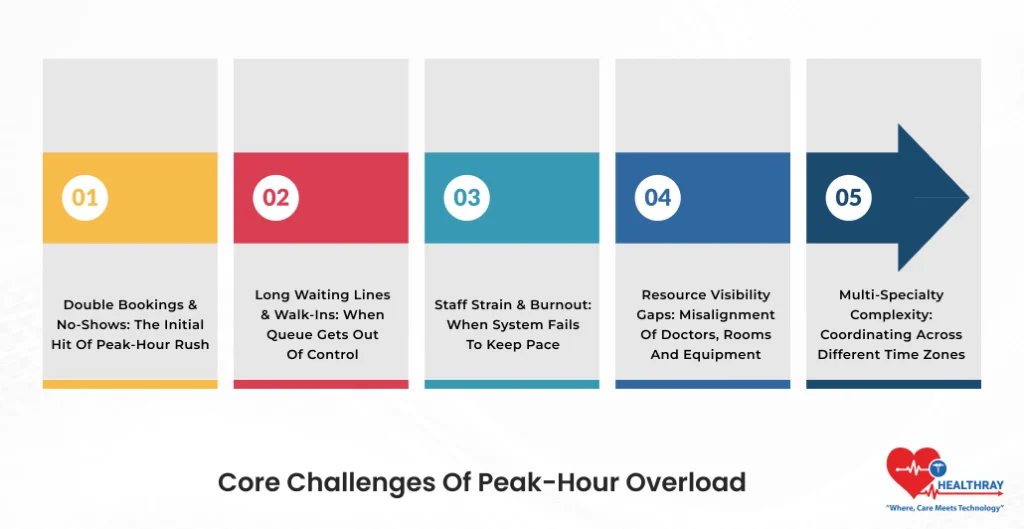
Core Challenges of Peak-Hour Overload
Let’s check out:
Double Bookings & No-Shows: The Initial Hit of Peak-Hour Rush
The real problem of peak hours is not just crowds. Further, the real barrier is hidden cracks that gradually build pressure in the system. Double bookings or no-shows are the main source of stress for clinics. When entries are manual, a single patient gets multiple slots at a time. Furthermore, when patients arrive at clinics without any prior consultation or appointment, then 20-40% of the slots get wasted. To cover up these losses, clinics indulge in overbooking and peak hours get completely out of control.
Long Waiting Lines & Walk-Ins: When Queue Gets Out of Control
Next comes the problem of long waiting lines or walk-ins. Further, patients arrive without any prior booking, and the queue becomes lengthy. Further, in a few systems, 17% of patients have to wait for appointments for 2-3 months. Peak hours not only become slow, but also they become arduous.
Staff Strain & Burnout: When System Fails to Keep Pace
Following this, it has a significant impact on employees. Fewer patents, a sudden increase in patient volume…this unpredictability drains the medical staff physically or mentally. Further, manually scheduling bypasses flu season or seasonal rush, resulting in staff burnout, frustration, or human errors.
Resource Visibility Gaps: Misalignment of Doctors, Rooms and Equipment
When clinics lack clear visibility of doctor availability, rooms and equipment, this retards workflows from registration to consultation. pharmacy and billing. Moreover, a small delay impedes the entire routine of OPD.
Multi-Specialty Complexity: Coordinating Across Different Time Zones
Multi-specialty clinics further amplify this chaos. Cardiology requires 30-40 minute appointments, while orthopedics and general OPD require different times. When different specialists follow different rules in the system, peak hours not only appear crowded but also become uncontrollable.
Digital OPD Systems: The Chaos Tamers
Let’s check out:
Real-Time Centralized Booking
Clinic appointment system helps medical staff shift from reactive management to predictive control. Additionally, it synchronizes with all of the clinic’s devices and enables centralized booking in real-time dashboards. Opd appointment management system allows 24/7 online booking in both web and mobile apps. Therefore, it creates comfortable space for patients and helps them book appointments as per their convenience. It auto-updates calendars and minimizes redundant situations and workload on the front desk.
AI-Driven Peak Prediction
The most powerful feature of opd appointment management system is AI-based optimization. Further, the algorithm analyzes historical data and anticipates peak hours, provides smart slot suggestions and creates buffer time for consultation overruns. When a slot is cancelled, it is immediately filled from the wait list.
Smart Queue Management
Queue management truly shines over here. Further, online slot booking for doctors‘ apps shows dynamic, color-coded statuses of check-ins, waiting and consultations in real time. Also, doctors get real-time updates as the next patient becomes available, thereby eliminating the need to ask at reception every time.
EHR & Pharmacy Integration
Clinics can conveniently retrieve patient records with ehr integration. Further, it eliminates unnecessary workloads of paperwork and creates space for staff to focus on patient care, which is the more vital part of the journey. Pharmacy systems can directly link and immediately dispatch billing and medicine post consultation. Thus, opd appointment management system makes the medical practices fast, facile and trouble-free.
Telemedicine Slots
Telemedicine slots minimize the physical pressure of OPD. Further, in hybrid models, 40% of rural consultation loads shift to virtual mode. Thus, it naturally minimizes the crowd during peak hours. Also, rural patients get access to medical facilities through video consultation. In the traditional system, the rural system faced difficulties with consultation. They had to travel miles for a one-on-one consultation with doctors. The patient appointment booking app provides instant access, and patients can discuss their health symptoms without the need to go into urban areas to diagnose their symptoms.
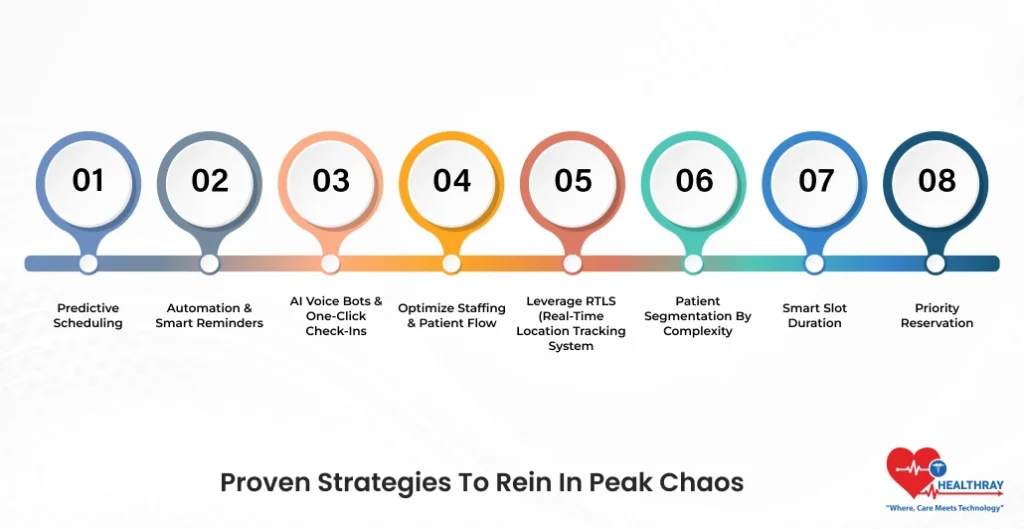
Proven Strategies to Rein in Peak Chaos
Let’s check out:
Predictive Scheduling
The most powerful way to control peak hours is predictive scheduling. AI-powered doctor appointment platforms review past appointment trends and forecast patient demand. Based on that, 10-15% of slots get buffered for walk-ins. Also, bookings get staggered to avoid unpredictable pile-ups during 9am-12pm. Further, opd management software is set on specialty-based rules.
If the orthopedics department needs more time for a consultation, the system will automatically adjust the time to be longer, without disrupting the opd operations. This directly impacts no-shows. Through predictive reminders or smart follow-ups, clinics can reduce no-shows up to 35%. Thus, the clinical appointment system not only regulates patient crowds but also helps clinics to recover empty slots.
Automation & Smart Reminders
The biggest reason for peak-hour chaos is last-moment no-shows. To control such stressful situations, automation or smart reminders become an indispensable tool for clinics. Now, clinics use progressive alerts such as sending sms or email reminders before 48 hours and WhatsApp confirmation before 2 hours of confirmation. This minimizes no-shows by up to 30 to 50%.
 NOTE
NOTE
AI Voice Bots & One-Click Check-Ins
AI voice bots handle 24/7 patient calls and messages. These bots can automatically perform booking and rescheduling and do urgency equivalents and reduce 80% of the booking load at the front desk. Thus, helping staff focus on patient care rather than responding to patient calls. Automation platforms endow one-click check-in hubs and ease the workloads of the front desk in just a few seconds. As the patient checks in, the status gets automatically synchronized on the doctor’s and patient’s screens. Automation not only accelerates the speed, but also it makes the clinic’s OPD operations predictable, disciplined and peak-ready.
Optimize Staffing & Patient Flow
Peak hour chaos affects more than just scheduling appointments; also, it impacts staffing and patient movement. That’s the reason smart clinics rely on flexible rosters that automatically scale the staff capabilities during peak hours. Cross-training helps staff handle multiple roles, minimizing the risk of system collapse during an unexpected emergency. Here triage-based prioritization plays a critical role. First, urgent cases are resolved, and routine flows are systematically adjusted.
 PRO TIP
Leverage RTLS (Real-Time Location Tracking Systems)
RTLS (Real-Time Location Tracking Systems) tracks patient movement and instantly identifies bottlenecks. When technology guides the flow, then delays break down even in chaotic situations. Some execution-level tactics are equally powerful for controlling peak hours. Firstly, clinics should keep a buffer of 5–10 minutes after 2–3 appointments so that overruns do not perturb the system. Secondly, as a patient cancels the appointment, the system should immediately assign the slot to the next waiting patient. Lastly, conduct a short survey after every visit to evaluate peak-hour pain points. Using an online form builder makes it easy to create, distribute, and analyze these surveys quickly, helping you gather actionable feedback without adding extra work for your team. This will help clinics refine the next cycles.
Patient Segmentation by Complexity
The reason behind peak-hour chaos is that every patient gets medical care by the same rule. But the reality is that every patient case’s complexity is different. That’s the reason smart clinics separate appointment tracks such as follow-ups, new consultations, chronic disease reviews, procedures and diagnostic visits. This reduces the burden on systems by maintaining patient mobility in accordance with the complexity of their health.
Smart Slot Duration
Here, the slot duration role is equally critical. Clinics should fix short slots for simple follow-ups and longer slots for high-complexity or multi-complaint cases. This makes the peak-hour capacity perfectly match with real consultation time. This minimizes the rush at the front desk and patient wait time.
Priority Reservation
During rush hours, smart clinics follow a powerful rule: “reservation of fixed percentage slot.” This helps clinics reserve 20–30% of slots for high-priority or acute patients. It assists clinics in moving regular reviews to off-peak hours or managing them via online consultations. When both priority and complexity get a clear perspective, then peak hour crowds become manageable. Thus, doctor appointment apps make the entire workflow smooth.
Conclusion
Modern opd appointment management proves that peak-hour chaos is not an unavoidable reality but a manageable and data-driven problem. By combining predictive scheduling, automation, AI, and disciplined walk-in, triage, and queue practices, hospitals can dramatically cut waiting times, stabilize staff workload, and deliver smoother, more reliable care experiences for every patient.